Verse 2after 1847aahotaa hai
G5
In this meter the first long syllable may be replaced by a short; and the next-to-last long syllable may be replaced by two shorts.
1
I am full of complaint, {in this way / for no reason}, the way a musical-instrument [is full] of melody
2
{just a bit / please} once touch/tease/play me-- then see what happens!
'Thus, in this wise, in this manner; —just so, for no particular reason; without just ground, vainly, idly, causelessly, gratuitously; to please oneself'.
'Colour, hue, tint, dye; mental affection, emotion, feeling, passion, love, affection, desire; joy; sorrow; anger, &c.; —a musical mode ... —music, harmony, melody, vocal music, song, tune, air'.
'A little; --a little while, short time; a slight or trivial matter; --adv. Just, would you just, please, kindly'.
'To touch, lay the hand on, pass the hand over; to meddle with, molest, interrupt, disturb, trouble annoy, tease, torment, worry, irritate, vex, excite, provoke; to touch up, stir up, incite, stimulate.... -- to tune (an instrument preparatory to playing on it), to strike the chords, to begin playing'.
| References | |
|---|---|
| Arshi, Imtiyaz Ali | Ghazal# 218 |
| Raza, Kalidas Gupta | 403-04 |
| Hamid Ali Khan | Open Image |
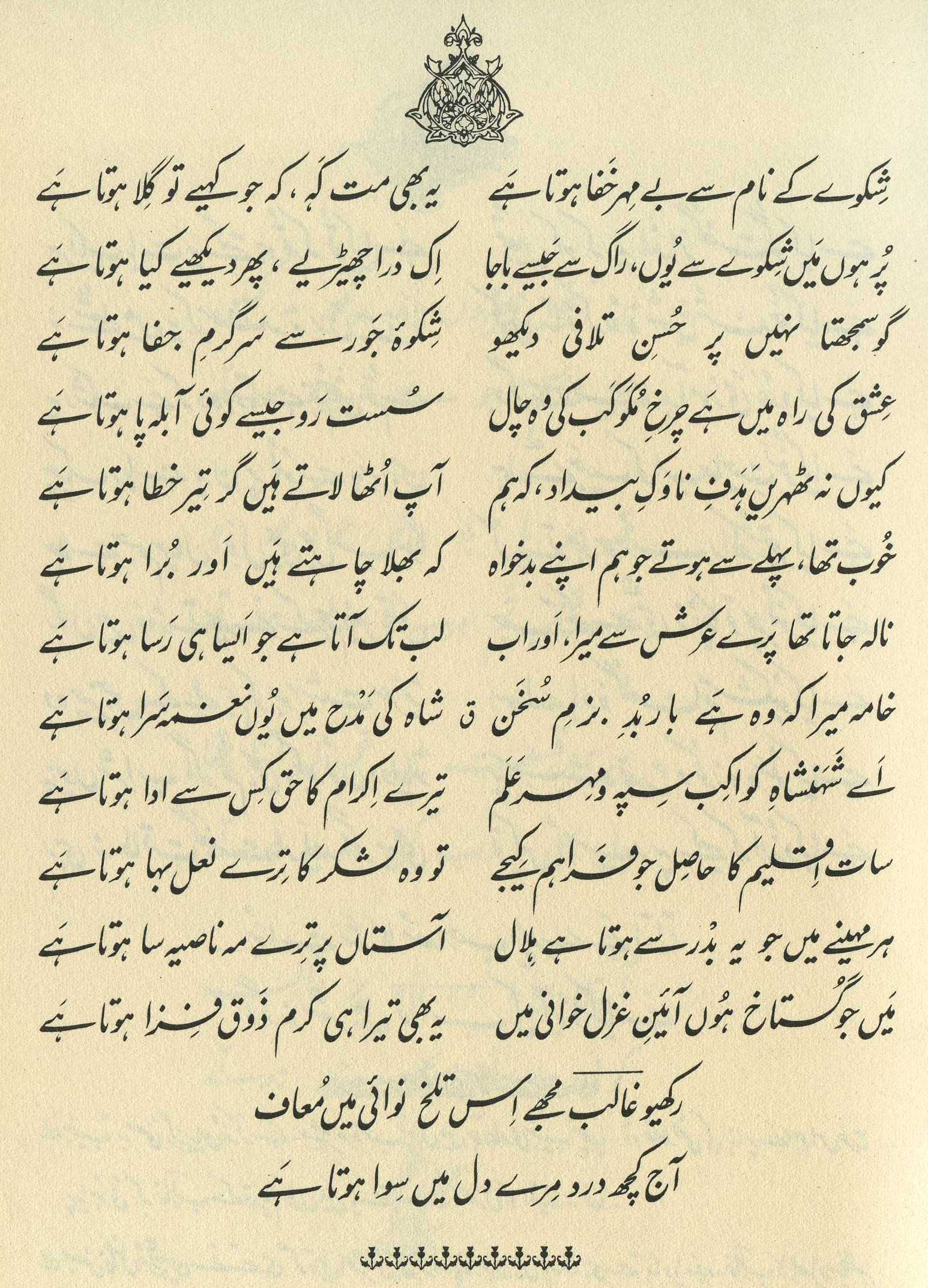
[1860, to Shafaq:] Listen to it from the beginning: I sent your ode , after providing correction for it. An acknowledgement [] for it came, many deleted and rearranged verses came, their defects were inquired about; the defects were explained [by me]. In place of the defective words, non-defective words were written [by me]: 'there, Sahib, write these verses too in the ode'. Even now, no answer to this letter has come [from you]. I gave to Shah Asrar ul-Haq the paper directed to him. What he said orally, has been written to you [by me]. On Hazrat's [=your] part, not even this letter received an answer. A verse: {177,2}.
I reflect that both letters were sent without postage stamps-- it's impossible to believe that both were lost [because no one would steal them for the stamps]. Well, now after many days, how would a complaint be written []; why would stale curry [] come to a boil again? 'Servitude is helplessness' [].
==Urdu text: Khaliq Anjum vol. 3, pp. 988-89
==another trans.: Daud Rahbar , pp. 178-79
The meaning of is 'to torment' and 'to begin to play a musical instrument'; and 'to broach the subject' [] is also an idiom. Here, all these meanings are intended. (199)
== Nazm page 199

He says, 'I am filled with complaint in the way that a musical instrument is full of melody, and just once touch/tease/play me a bit, then you'll see what happens'. That is, to what an extent I complain, and what kind of grievances come to my tongue. In idiomatic speech, they call the beginning of conversation , and the beginning of playing a musical instrument too. And also the kind of joke/jest which the other man would take badly. (256-57)
I am full of complaint in the way that an instrument is full of melody. Just touch/tease/play me a bit and see, and I'll make such complaints as wouldn't be able to be listened to. (348)
The verse relies chiefly on the wonderful multivalence of , as the commentators note. Its three main meanings-- 'touch', 'tease', 'play [an instrument]'-- are all here perfectly appropriate and full of resonance. (The third sense imagines no doubt not a wind instrument but a stringed instrument, such that one 'plucks' the strings.)
The lover says that a huge turmoil of complaint is barely contained within him, and the slightest touch will bring it out-- just try it and see!. As with similar expressions in English, this can be both a straightforward request ('I want to make my complaint-- please give me the occasion!') or a threat ('You don't want to hear my complaint-- don't get me started!').
The literal meaning of is 'a little', from which comes its idiomatic usage as a form of politeness, to soften a request by minimizing it. We use similar structures in English: 'will you just open the window a bit?' is politer than 'will you open the window?', because of both the 'just' and the 'a bit'. Conveniently, has both senses, and they're both excellently relevant to the line. Another example of such clever use: 193,5 .
In this verse the analogy between the lover full of complaint, and the instrument full of music, is made directly and emphatically, and has further pleasures of its own. An instrument is designed to produce music-- that's its whole goal in life, and it's judged and valued only according to the quality of the music it produces. It seems then that the lover must be similarly designed for complaint, and must have his chief excellence and self-expression in producing it. A musical instrument that remains unplayed is only latently itself, and never reaches its real potential; similarly, the lover must long for the touch/tease/plucking that will evoke his torrent of complaint. A stringed instrument vibrates in proportion to the nature, placing, and force of the plectrum with which it is played; the lover too must long to quiver when touched/teased/plucked by the beloved.
But of course there's also the pleasure of (see the definition above, which can either reinforce the causal-seeming comparison between lover and instrument ('like this, in this way'), or else reject any causality at all ('for no particular reason, gratuitously').
Arshi suggests a comparison with 142,1 , in which the warning is against 'repeatedly digging' matters of complaint, because 'fire' is suppressed in the heart; the risk seems to be the eruption of a volcano. By contrast, in 233,17 the warning is that the lover, if subjected to , is ready to produce a 'typhoon'. But by far the closest cousin to this verse is 172,3 , which also warns against the of a musical instrument.
graphics/sitarstrings.jpg