Verse 4after 1847aahotaa hai
G5
In this meter the first long syllable may be replaced by a short; and the next-to-last long syllable may be replaced by two shorts.
1
on/in the road of passion, the star-studded sphere has that gait--
2
{slack/weak/sluggish}-moving, just as [habitually] is some blister-footed one
'Indisposed, heavy, languid; feeble, weak; dejected, downcast; unbraced, relaxed, lax, slack, loose; sluggish, inactive, slow, dull, depressed (as a market, &c.); indolent, slothful, idle, lazy, dilatory, tardy, negligent, remiss'.
| References | |
|---|---|
| Arshi, Imtiyaz Ali | Ghazal# 218 |
| Raza, Kalidas Gupta | 403-04 |
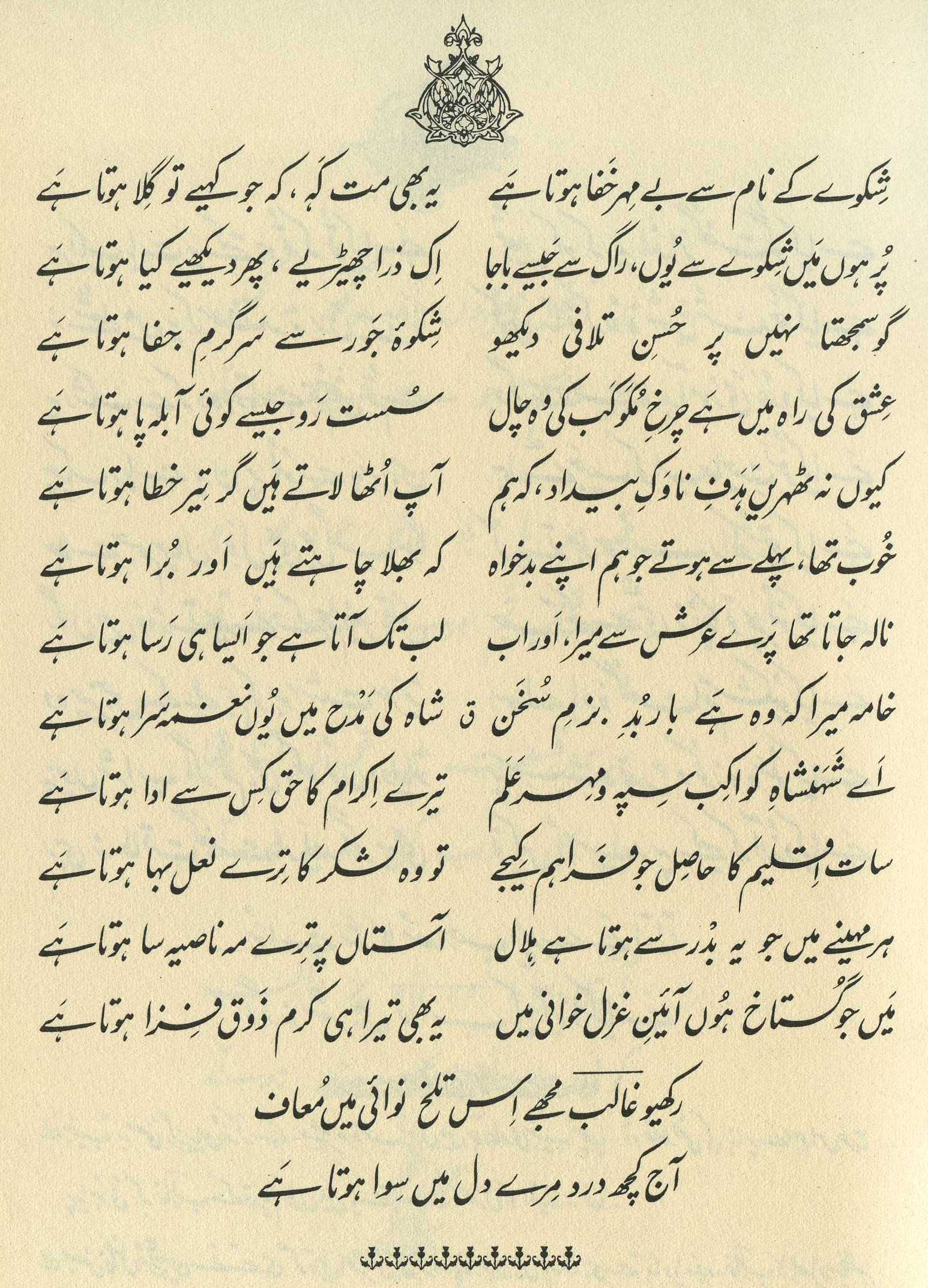
| Hamid Ali Khan | Open Image |
By saying -- that is, 'star-possessing'-- he has made manifest the sphere's being blister-footed, and he's given for the stars the simile of blisters. (199)
== Nazm page 199

He says, on the road of passion the starry sky moves the way someone with blistered feet moves, very slowly and with difficulty. By calling the sky the 'starry sphere' he has established its being blister-footed. (257)
On the road of passion the starry sky moves slowly, like a person on whose feet there would be blisters. between the stars and blisters there is a simile. (348)
To the lover, who walks painfully 'on the road of passion', the nights of separation-- and they're the only kind of nights he really knows-- seem to go on forever (as witness their immeasurableness in 97,2 ). The night sky in its slow turning seems to creep along sluggishly, feebly, painfully, the way a person with blistered feet walks. And why is its movement like that? The 'objective correlative', the hinge on which the two lines pivot, is the equation of the stars with blisters. After all, they look white, as blisters often do; they are round and small and numerous, as blisters often are. The heavenly sphere is above us; if it moved, its 'feet' would be visible from below-- the soles of its feet, in fact, which are the most plausible places for blisters. It may sound a little strange for the stars to have feet, but after all, they have eyes (see 14,8 for proof), so why not feet as well?
Although the verse doesn't develop the kind of excessive physical vividness about the blisters that 39,3 itself does, I'd still put it in the 'grotesquerie' category (for more on this, see 39,3 ). To look up at the stars and see them as blisters on the feet of the night sky-- who needs it? The worst of it is that, as in 69,1 , to imagine blisters on feet is to imagine their bursting-- and do we really want to envision a rain of the fluid from burst blisters coming down on us from the celestial sphere?
graphics/starrynight.jpg