Verse 5after 1847aahotaa hai
G5
In this meter the first long syllable may be replaced by a short; and the next-to-last long syllable may be replaced by two shorts.
1
why wouldn't we {stand / remain / be chosen} as the target of the arrow of cruelty/injustice? -- for we
2
ourselves pick it up and bring it, if the arrow is [habitually] misguided
'To stand; to stand still; to stand firm; to be stationary; to be fixed; to be stopped; to be congealed, be frozen; to stop, rest, pause, cease, desist; to stay, remain, abide, wait, tarry; to last, endure; to be ascertained, be proved, be established; to be settled, be agreed upon, be concluded; to be fixed on, be determined, be resolved; to prove to be, to turn out'.
| References | |
|---|---|
| Arshi, Imtiyaz Ali | Ghazal# 218 |
| Raza, Kalidas Gupta | 403-04 |
| Hamid Ali Khan | Open Image |
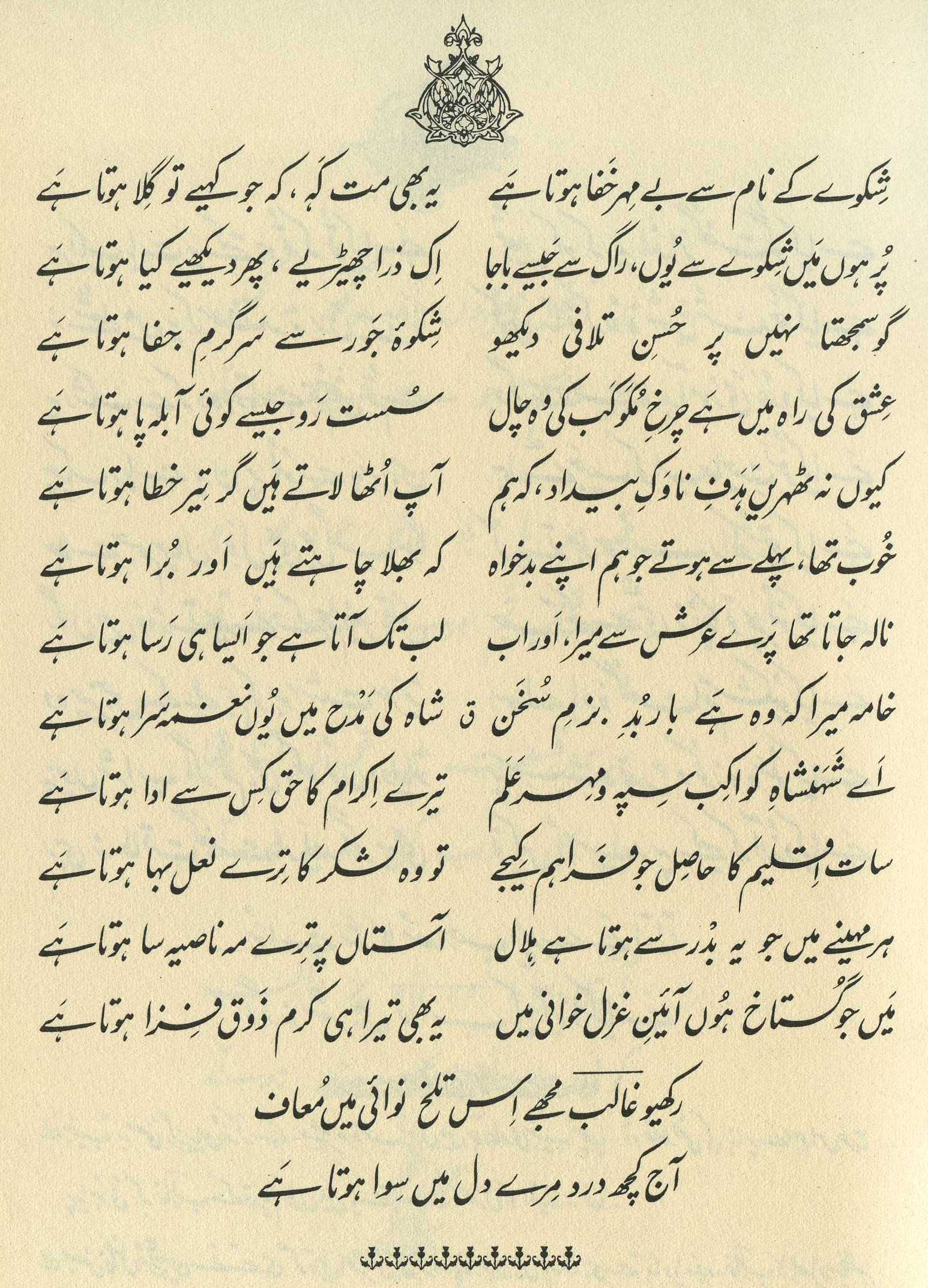
That is, we have such ardor for the arrow of cruelty/injustice that if it misses, then we ourselves pick it up and give it to the archer, [saying] that, 'Please shoot this arrow again, and don't leave us in a state of not being the target'. (199)
== Nazm page 199

He says, we are such an ardent seeker of the arrow of tyranny that if some arrow misses, then we run and pick up that arrow and present it as an offering to the archer, [saying] that 'Please take it, please shoot it again, and please don't leave us without having made us the target of the arrow of tyranny'. (257)
Why would we not be made the target of the arrows of tyranny? We've come to have such a taste for enduring tyranny that when her arrow misses, then we ourselves pick it up and always give it to the murderer. That is, by always pestering her, we teach her to practice tyranny. (349)
The commentators are sure that the lover picks up the arrow and returns it to the beloved, begging her to shoot it again; they even supply him with lines of dialogue for the occasion. That scenario works perfectly well, but it's also possible to imagine a more abstract one: fate, destiny, the heavens are against the lover; the arrows of misfortune are raining down on him. And he is such a natural, foreordained target that he not only attracts them but actually invites them-- so much so that if they somehow miss him he goes and helpfully fetches them into his vicinity, where they should by rights have landed.
The real pivot of the verse is the wonderfully versatile verb . By no accident, all of its three main senses (see the definition above) work perfectly with the second line. The sense of 'to stand still' defines the ideal behavior of a target; the sense of 'to remain' is justified by the act of fetching back, and thus claiming, the arrows that have missed; the sense of 'to be chosen or determined' is just what the lover's rhetoric is arguing for.
graphics/archery.jpg