Verse 9after 1847aahotaa hai
G5
In this meter the first long syllable may be replaced by a short; and the next-to-last long syllable may be replaced by two shorts.
1
oh King of Kings with constellations for armies, and the sun for a banner
2
by whom is justice [able to be] [habitually] rendered to your benevolence?
| References | |
|---|---|
| Arshi, Imtiyaz Ali | Ghazal# 218 |
| Raza, Kalidas Gupta | 403-04 |
| Hamid Ali Khan | Open Image |
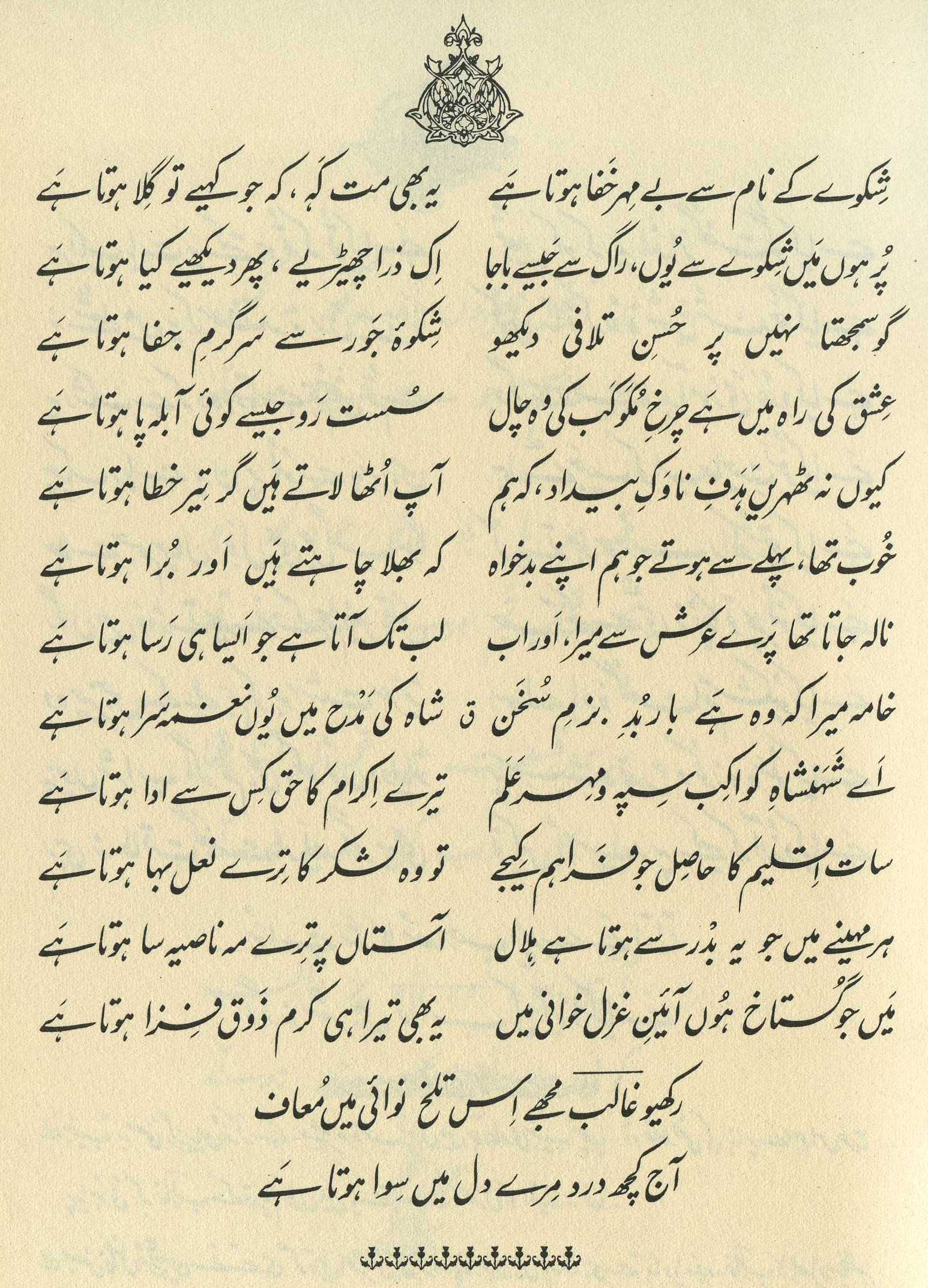
The meaning of the verse-set is clear. (200)
== Nazm page 199

Oh King of Kings, it's as if the stars are your soldiers, and the sun is your banner. You are such a great king-- by which person can justice be rendered to your kindnesses? (258)
Oh King of Kings whose army is countless like the stars, whose banner, like the flag of the sun, waves over the whole world-- who can render justice for your kindnesses as they deserve? (350)
This is the official first verse-- official according to Arshi, that is, and therefore to me as well-- of a four-verse verse-set that extends from {177,9} to 177,12 . However, many editors place the beginning of the verse-set one verse earlier; for discussion, see 177,8 .
This ghazal dates from sometime after 1847, when Bahadur Shah ' Zafar ' was in the last years of his life as an British-pensioned 'emperor'. His extremely limited powers, cramped quarters, quarrelsome family, and increasingly dire financial straits were clear to everybody. But for him to be praised in these extravagant, cosmic terms was very much in the tradition of court eulogies and ode s. How would it have seemed to him to hear it, and to Ghalib to compose it? Might there have been an undercurrent of bitterness on one side or the other, or would it have been impossible to avoid the effect of irony, or would such phrases have been so stylized that they hardly even registered? (Not so long ago, after all, people used to routinely end their business letters with 'Your most humble and obedient servant'.)
We do know that Ghalib and Bahadur Shah really didn't like each other that much. Bahadur Shah preferred Zauq as his Ustad , and only grudgingly accepted Ghalib after Zauq's death in 1854. Ghalib considered the Emperor to be much less generous than was proper, as we know from his letters; he found some of the Emperor's special literary assignments to be a real burden. He eulogized Bahadur Shah for money, not love.
So here is Ghalib doing some literary 'work'-- some judicious flattery of the traditional kind. He needed the money. Always, throughout his life, he needed the money. Praising patrons was a traditional, acceptable way to obtain it-- in fact, almost the only way, since in Ghalib's view entering into any (other) kind of 'service' was to be in danger of humiliation. (For the classic case in point, see 22,2 .)
graphics/sun.jpg