Verse 8after 1847aahotaa hai
G5
In this meter the first long syllable may be replaced by a short; and the next-to-last long syllable may be replaced by two shorts.
1
my pen, since it is the Barbud of the gathering of poetry/speech
2
in the Shah 's praise is {like this / casually} [habitually] melody-making
'Name of a famous Persian musician, native of Jahram, a town near Shiraz'. (Steingass p.141)
'Thus, in this wise, in this manner; —just so, for no particular reason; without just ground, vainly, idly, causelessly, gratuitously; to please oneself'.
| References | |
|---|---|
| Arshi, Imtiyaz Ali | Ghazal# 218 |
| Raza, Kalidas Gupta | 403-04 |
| Hamid Ali Khan | Open Image |
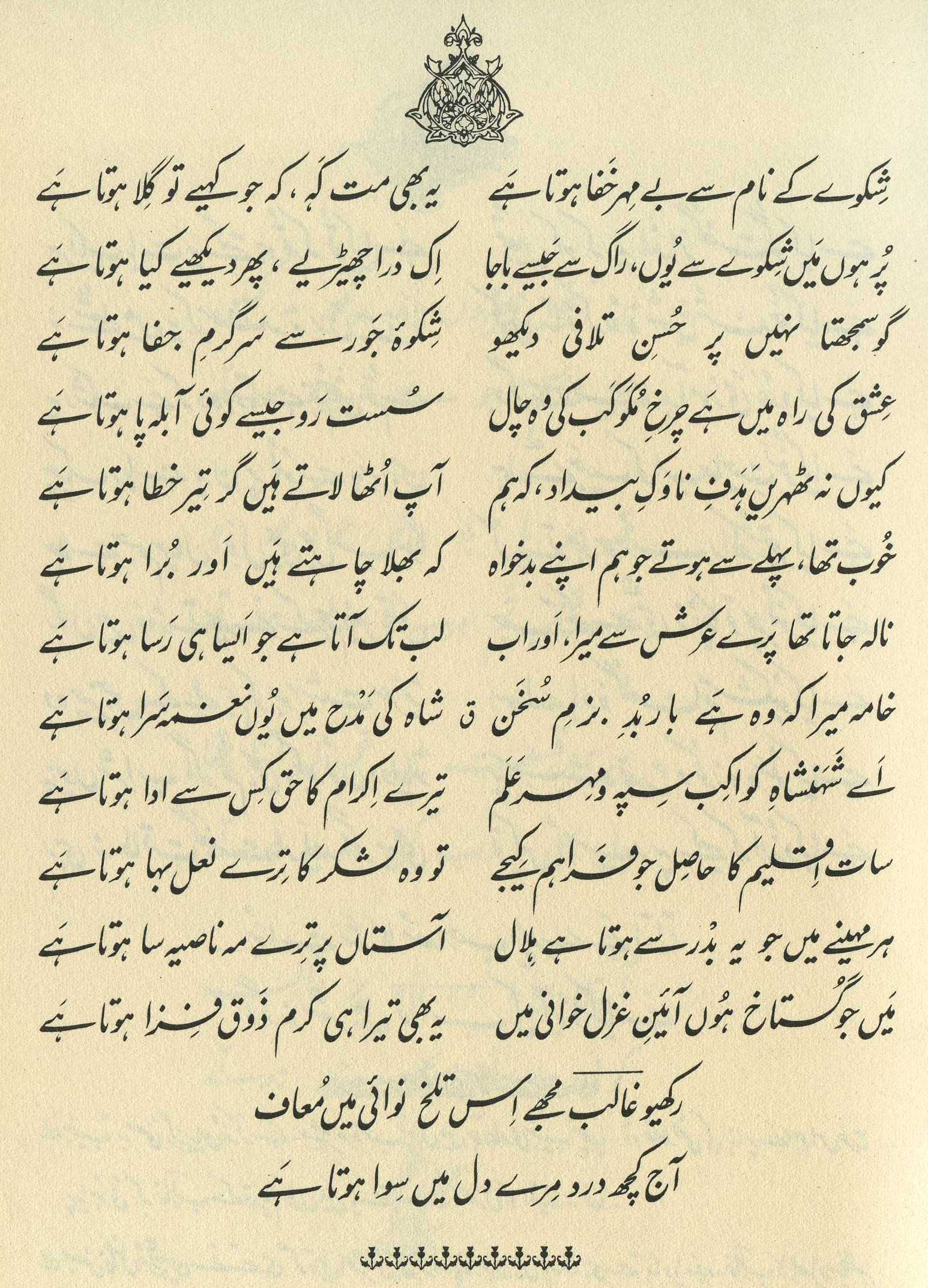
The meaning of the verse-set is clear. In the first verse the word is attractive in the way that a plectrum is on the string of a lute []. Here, the obvious words were 'musician', 'singer', etc. The author rejected them and used --just look, in the imagined [] there's more beauty than in the reality []! And the aspect of making the word fresh that the author has here devised-- it is worth remembering. That is, for someone to say 'you are a tyrant'-- better than that is 'you are Chingiz [=Genghis Khan]'. Someone has truly said that 'a fresh word is equal to a theme '. (200)
== Nazm page 199

Barbud is the name of a famous singer. He says, my pen is such that in the gathering of poetry it is a Barbud in praise of the King it makes melody in this way, that is... (258)
Barbud was, in the court of Khusrau Parvez, a peerless and inventive musician.... My pen, that in the gathering of poetry holds the rank that Barbud held in the pleasure gathering of Khusrau, in praise of the King makes melody like this... (350)
There is certainly a verse-set coming, and overwhelmingly the commentators think that it starts with the present verse. But Arshi marks it as beginning with the following verse, 177,9 . (Everybody agrees that it ends with {177,12}.) In this case it's easy to see how the disagreement could have arisen. For the present verse is an unusually specialized creature, neither fish nor fowl. It certainly seems to be acting as a prologue, since that is so suitable for introducing additional material-- and, of course, since we're biased by knowing that exactly such additional material is coming right along. But at the same time, if the verse is indeed an introduction then it might well be considered to be somewhat liminal, and not really a part of the set of verses that it's introducing. As always, I follow Arshi.
On behalf of Arshi's view it could be pointed out that this verse isn't limited to being read as a dedicated preface; if it weren't followed by a verse-set, we would feel quite comfortable reading the as meaning 'like this' in a general way-- that Ghalib's pen goes on producing superior verses the way Barbud produced superior music, as a matter of normal practice. After all, this is the eighth verse in the ghazal, so we could certainly be looking backward instead of forward. Or else, of course, that it goes on 'casually' or 'for no particular reason', just automatically praising the king.
Nazm's commentary is brilliant here. The 'someone' who made that famous remark about the 'f resh word ' was Shah Jahan's poet laureate Talib Amuli (see 17,2 ).
graphics/seeingmusic.jpg