Verse 11816abiihai
G16
1
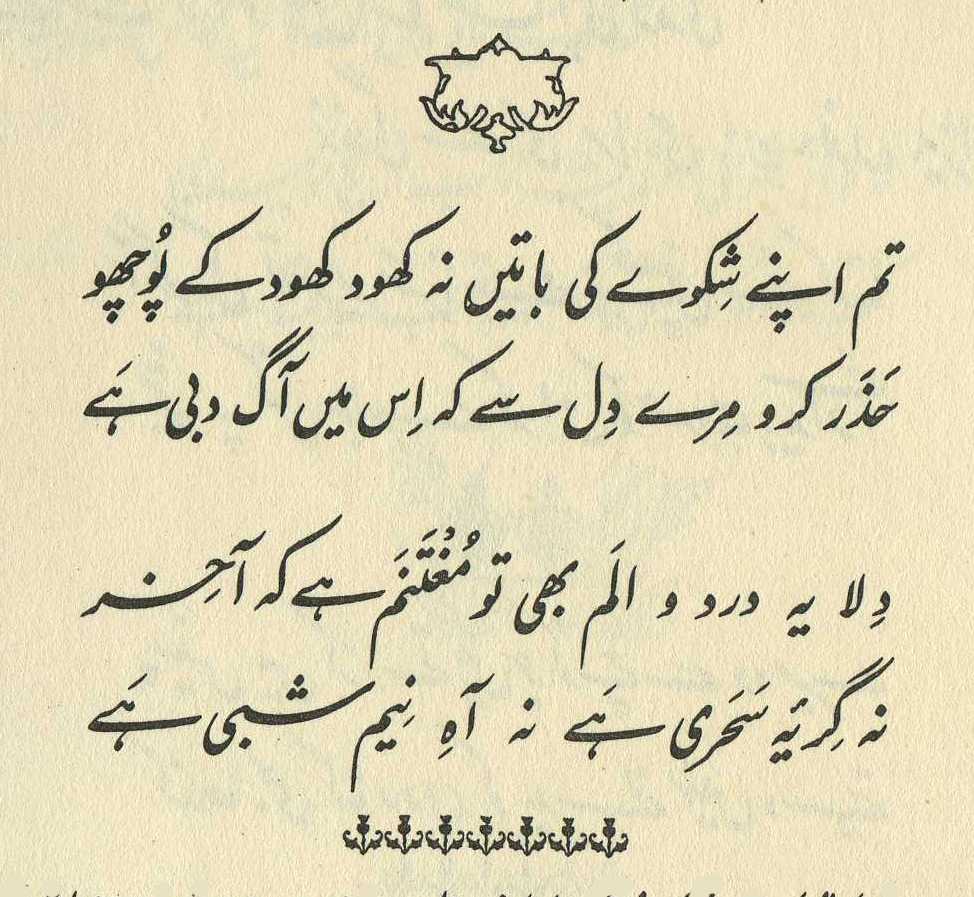
don't keep digging up and asking about matters of your complaint
2
be wary/fearful of my heart-- for in it fire is suppressed
'To dig, delve, excavate; to undermine; to scoop, hollow; to engrave; to carve; -- to search for; to inquire closely into, to investigate'.
'Caution, wariness, vigilance, care; prudence; --fear'.
| References | |
|---|---|
| Arshi, Imtiyaz Ali | Ghazal# 139 |
| Raza, Kalidas Gupta | 245-246 |
| Nuskhah-e-Hamidiyah | 189-190 |
| Asi, Abdul Bari | 219-220 |
| Gyan Chand | 335-336 |
| Hamid Ali Khan | Open Image |
He has given suppressed fire as a simile for complaint hidden in the heart, because from the expression of complaint, the fire of perversity often flames out. (152)
== Nazm page 152

He says, complaints against you are hidden in my heart the way that fire is hidden in a stove. If you keep poking and prodding and asking about them, then the complaining expression of these matters will cause a fire of enmity to flare up. The meaning is that among friends, complaints often lead to sorrow. (210)
The complaint that I have against you-- don't keep digging it out. Be fearful of my heart-- in it fire is suppressed. From it is clear that so far the lover has kept hold of his self-control, and doesn't make any complaint.... Pestering him, she asks again and again, 'After all, what did I do? Why are you angry?' Now the lover is unable to bear it any more. But even now he doesn't want to say anything.
Thus he says, 'Don't keep irritating me and asking. You ought to be afraid of my heart, since in it fire is suppressed.' That is, the Lord knows what complaints I have against you.... -- it's a phrase for which eloquence [] sacrifices itself. That is, he's said every single thing-- and he's said nothing. (278)
The beloved is, literally, playing with fire: through her nagging and kvetching she's rashly poking a stick again and again into an ominously smoking volcanic crater. The lover's suppressed grievances and sufferings and fiery passions are under high pressure, and are dangerously near the surface. She should be warned, and stop tempting fate. This is an ominous fire-warning verse; in addition to the ones that Arshi suggests, it could also be compared to ominous flood-warning verses like 233,17 .
The structure of the second line gives a powerful double emphasis to both 'fire' (watch out-- it's not just some extinct crater in the lover's heart, it's fire!) and 'suppressed' (watch out-- the fire in his heart is not just a little candle, it's huge flames under deadly high pressure!). In this vivid picture of his heart, the lover has, as Bekhud Mohani puts it, said everything; and yet since he's trying desperately to avert a calamitous explosion, he's also said nothing at all.
Note for grammar fans: It's especially attractive to read as short for 'is in a state of having been suppressed' [] , the adjectival past participle. The alternative reading of a present perfect verb would give us 'has become suppressed'. This latter form provides less information, and thus in this case less drama.
Another note for grammar fans: Can we possibly also treat as able to mean , so that the beloved would be prodding the lover to describe his complaints about her? It's rather a stretch, in view of the location right after . But it would also be such a Ghalibian kind of ambiguity! I think of it as a kind of ghostly, hovering presence. For more on the complexities of , see 15,12 . For more on the complexities of the possessive ( 'your complaint' as either 'the complaint made by you' or 'the complaint about you', see 41,6 .
graphics/heartfire.jpg