Verse 11816aanii-esham((a
G9
In this meter the next-to-last long syllable may be replaced by two shorts.
1
from the face of the beautiful one is the eternal 'burning' of the candle
2
the fire of the rose has become the water/luster/honor of the life of the candle
'A picture, painting, portrait, effigy; an idol; --a beautiful woman, beauty; mistress, sweetheart'.
'Burning; heat, inflammation; ardour, passion; affection'.
'Water; water or lustre (in gems); temper (of steel, &c.); edge or sharpness (of a sword, &c.); sparkle, lustre; splendour; elegance; dignity, honour, character, reputation'.
'Life, living; sustenance, livelihood'.
| References | |
|---|---|
| Arshi, Imtiyaz Ali | Ghazal# 75 |
| Raza, Kalidas Gupta | 191 |
| Nuskhah-e-Hamidiyah | 122-123 |
| Hamid Ali Khan | Open Image |
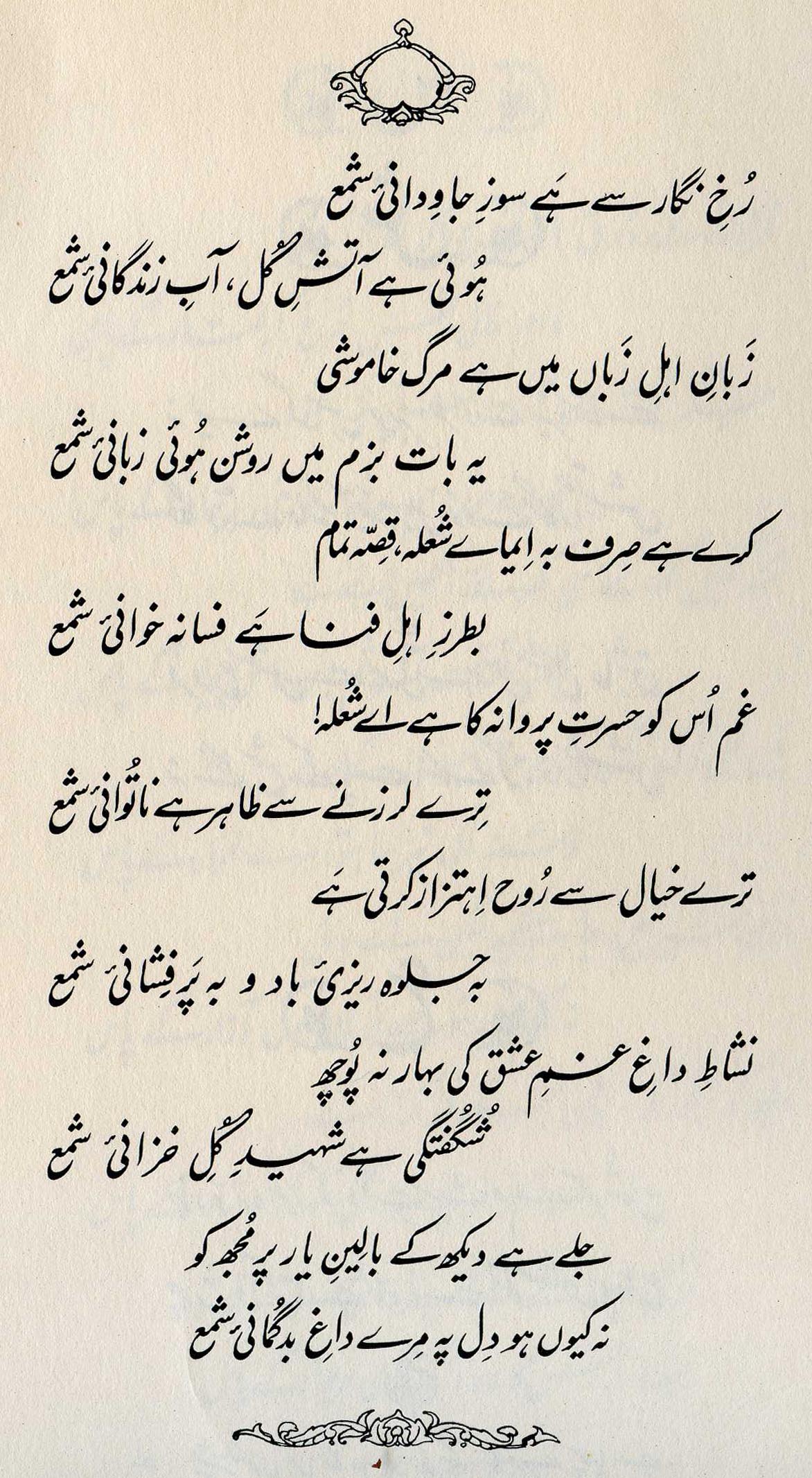
They call this a 'poetic claim' []. First he established that the candle burns after having seen the face of the beloved. Then on that foundation he has created the theme that the fire of the rose, which is in the face of the beloved, is 'water of life' [] for the candle. And for this reason, in the idiom they call an extinguished candle a 'dead candle' [], and poets imagine a burning candle to be 'alive'. (76)
== Nazm page 76

He says, the candle has felt envy of the beloved's radiant face, it is burning with the fire of envy. In the second line he says that the fire of the rose, which is in the beloved's face (that is, the rosy color of her cheeks) has the power of 'water of life' [] for the candle. In Persian they call an extinguished candle a 'dead candle' []; thus Mirza Sahib has imagined a lighted candle to be 'living'. Other poets also write [this usage]. (122)
He has made the rose a metaphor for the cheek of the beloved. And bees suck the juice of the rose, and from this wax and honey are created. And from wax, candles [are made]; so the life of the candle-- or rather, the very existence of the candle!-- is dependent on the rose. (238)
He says, seeing the beauty of the beloved's face, the candle is envious, and burns forever, as if the fire of the beauty of that flower had become 'water of life' [] for the candle. In this verse, how successful is the attempt to prove that fire is water! And then, what kind of water? Why, the 'Water of Life'! (160)
The commentators generally revert to the familiar, even petrified phrase 'water of life' []-- which the verse itself, however, avoids: it instead uses . Of course one could always say that this is for technical reasons of rhyme , but that kind of technical constraint is rarely a final determinant with a great poet. Surely we're meant both to think of , and to recognize its absence.
Thus the 'water of life' is both there and not there; similarly, the 'fire of the rose' is both deadly and soothing. Christina Oesterheld points out that Annemarie Schimmel has discussed at some length. Schimmel observes, 'The rose-fire that increasingly burned in poets' diwans became joined with Nimrod's fire, which turned into a cool rose garden for Ibrahim (Sura 21:69).' (' A Two-Colored Brocade ', p. 174).
Even more intriguing is the 'eternalness' insisted upon in the verse: what the candle gets from the beloved's face is its own , its 'eternal burning'. And yet we all know that candles are the very opposite of eternal; Ghalib's ghazals, like everybody else's, are full of images of burnt-out candles. These are even referred to by Ghalib specifically as 'dead candles' []; see for example 41,2 and 53,1 . So whence the 'eternalness'?
According to the verse, the eternal burning comes from the beautiful one's face, and the 'water of life' comes from the 'fire of the rose'. The (human) beloved's face is all too mortal, as is the rose (in the garden) itself. So we're led to consider some 'essence of candle' and 'essence of beauty' that never die. Or else we can feel that the candle, the rose, and the beloved live so totally and powerfully in their moment that the moment seems to become forever.
As Josh observes, Ghalib cleverly proves in this verse that fire is water. But of course, since is so protean, he also shows that the fire of the rose is the 'luster' and the 'honor' of the candle. (On the subtle possibilities of , see 193,2 .) And as Schimmel observes, the poet can evoke a fire that becomes a rose-garden. So why can't he also show that the candle's life is both eternal and brief? In the next two verses, 75,2 and {75,3 , he further explores this same paradox.
I once had a go at translating (1984) this ghazal.
graphics/belovedcandle.jpg