Verse 31816aanii-esham((a
G9
In this meter the next-to-last long syllable may be replaced by two shorts.
1
it makes, only with the sign/suggestion of the flame, the tale finished (off)
2
with the style of the 'people of oblivion', is the story-telling of the candle
is an archaic form of ( GRAMMAR )
'Pure, unmixed, unadulterated; neat; sheer; mere; --purely, merely, only, solely, alone, exclusively, &c.'.
'Turning; changing, converting; change, conversion; shifting or vicissitude (of fortune); passing, using, employing; use, employment; expending; expenditure; cost.... : To expend, spend (anything, in or on... ; to disburse; to pass; to use or employ (in or on)'.
'Sign, nod, beck, hint, suggestion, indirect reference or allusion; emblem, symptom'.
| References | |
|---|---|
| Arshi, Imtiyaz Ali | Ghazal# 75 |
| Raza, Kalidas Gupta | 191 |
| Nuskhah-e-Hamidiyah | 122-123 |
| Hamid Ali Khan | Open Image |
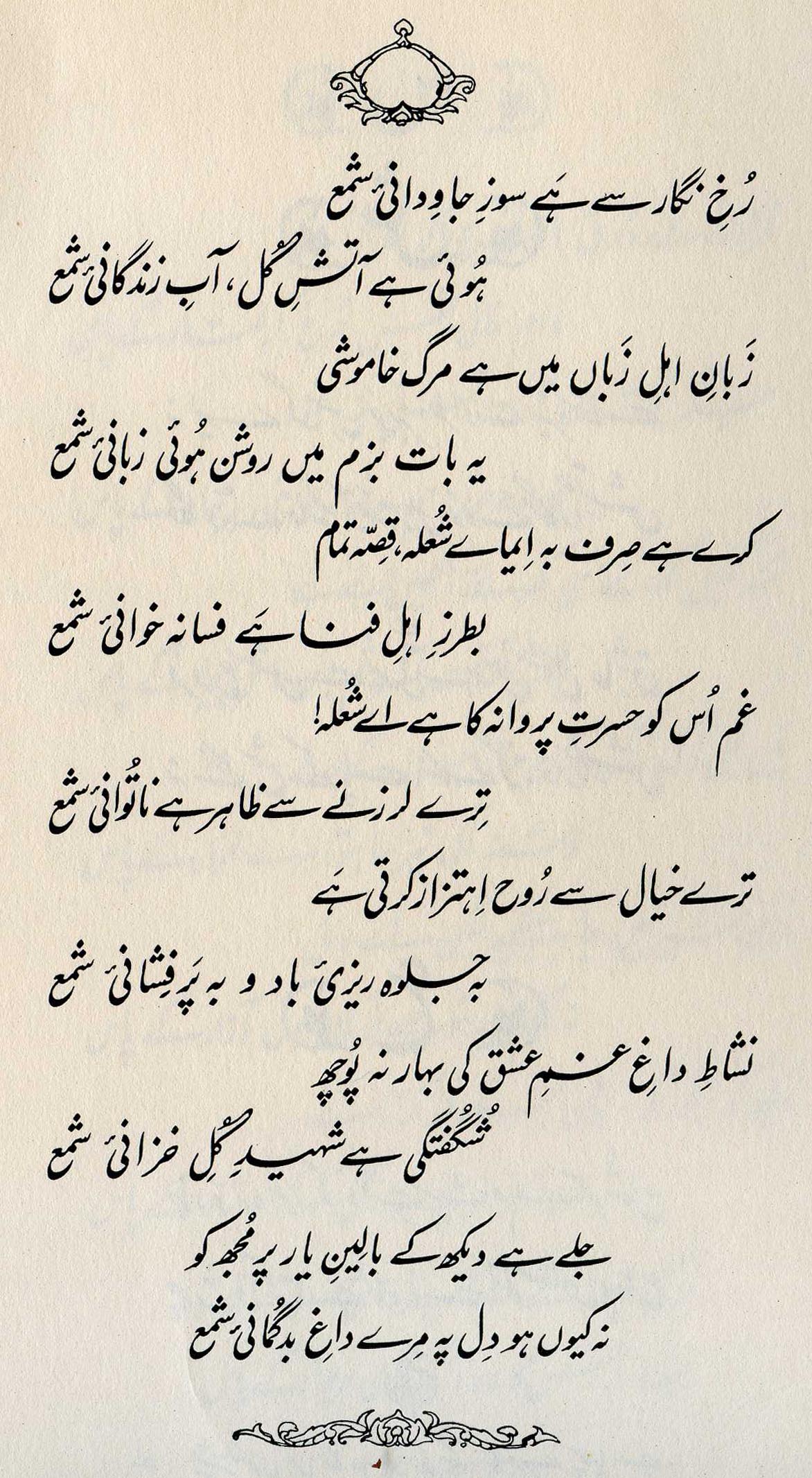
[1858, to Taftah:] Rajab 'Ali Beg 'Surur', who has written -- the first verse at the beginning of the narrative [] gives me much pleasure now:
[we people are a memorial of the age
remember-- we people are a story]
How 'hot' [] the second line is, and with regard to a story, what an affinity 'remember' has! (Arshi, introduction, p. 35)
==Urdu text: Khaliq Anjum vol. 1, p. 278
The candle completes the whole story only through the gesture of the flame. That is, when the flame is lit, then it [=the candle] becomes obliterated from head to foot, the way among the Sufis, the 'people of oblivion', having been set alight, become 'oblivious to themselves' in the fire of passion, and pass away from their lives. (77)
== Nazm page 77

[Discussion of how the commentators have had trouble interpreting 'story-telling'; they have interpreted as 'hint' or 'suggestion'.] If would be taken to mean 'gesture' or 'sign', then an extremely subtle/enjoyable meaning appears. The meaning of is 'to finish a thing off'. Thus the meaning of the first line becomes that the candle finishes off its idea/utterance by means of the 'sign' of the flame. That is, the candle expresses its illumined meaning by means of the symbol [] of the flame.
On the head of the candle, the flame has the form of a tongue (the tongue is used as a simile for the candle flame). That is, the candle makes its thought apparent wordlessly, through the tongue of the candle. The flame of the candle is a symbol of turmoil [] and oblivion []. In this way, through the 'tongue' of the flame's condition, the candle says, 'I am burning, I am becoming obliterated'.
In this theme there's a twofold pleasure. One [aspect] is that the candle uses the tongue of the flame-- the flame that has the form of a tongue and is a symbol of burning. The second aspect is that the tonguelessness of the candle is itself its tongue. 'Tongue' is in both meanings-- that is, in the meaning of 'conversation' as well as in the meaning of a part of the body. That is, it's a metaphor for a metaphor, and the dictionary meaning too is appropriate. This type of paradox is the special style of Ghalib and Mir .
Now it's clear that 'story-telling' [] has no special semantic importance.... Having written 'finished the tale' [] in the first line, to make the .zil((a of 'story-telling' in the second line would be, for Ghalib, irresistible. This skill too Ghalib learned from Mir [M 1514,1 and M 1514,3 ]:
[The story-teller's boy-- what can one say?-- he's worth seeing!
our and his tale, friends, is worth hearing].
[if the Moth has burned to death and been erased, and said nothing, then
oh candle, is this tongue, oh cruel one, to be cut off?]
[A discussion of the Sufistic dimensions of 'in the style of the people of oblivion'.]
Just think for a moment-- a kid nineteen years old, and such control over words and meaning, such an arrangement of wordplay and affinity ! This is a kind of ripeness/maturity and depth that is not vouchsafed to even the best of the best, during their whole lives.
== (1989: 90-91) 2006: 111-13
This verse completes (and 'finishes off'?) what I think of as a quasi-verse-set consisting of the first three verses of this ghazal. The first verse presents the candle's eternal life vs. its imminent death; the second juxtaposes the candle's (and the poet's) speech/life to its silence/death; in this one, the candle ends its tale in the style of the 'people of oblivion'. Are the people of oblivion dead, or alive? We can hardly say. They have traded in this mortal, transient world for a mystical realm that is utterly beyond our comprehension.
Like the other verses in this little set of three, this one is so rich you almost can't cut through the glowing, radiant, tightly-meshed surface to be sure of more than a rather basic meaning. And as in the others, much of the pleasure is to be found not in contemplation of a spelled-out, literal meaning, but in the whole ornate but flawlessly integrated, elaborate but perfectly relaxed, 'informal'-feeling quality of the verse.
The praise that Ghalib offers, in the letter cited above, to Surur's verse about story-telling has two elements: the second line's being 'hot' or passionate, and the affinity between the imagery of story-telling and the injunction to 'remember'. He thus praises in another poet's work the same effects he himself creates, through the (suggested) idea of the 'tongue' of the candle-flame, and the wordplay about story-telling, in the present verse.
The word ('only, merely, exclusively') can be distinguished from the word (see the definitions above) only by its short vowel, and of course short vowels aren't commonly marked in Urdu. I take the reading from Arshi, who does show the marker. But without that diacritic, or in an oral performance in which such short vowels are often ambiguous or half-swallowed, the audience might well think of as in -- especially since a form of is positioned so conveniently right before it. And if we made that guess, we could still read the first line quite comfortably:
(1) 'it turns/changes/uses/expends, with the sign/suggestion of the flame, the whole tale'
Indeed, not until the last possible moment, when we heard the 'punch' word , could we perceive that our reading, while far from impossible, was a bit less satisfactory in its connection than a reading of . (That is, we'd be unable to mobilize the elegant doubleness of ('to finish' and 'to finish off'), because we'd need the for .)
For other 'tongue of the candle' verses, see 75,2 .
graphics/candlesmoke.jpg