Verse 21816aanii-esham((a
G9
In this meter the next-to-last long syllable may be replaced by two shorts.
1 a
in the tongue of the 'people of the tongue/language', death is silence
1 b
in the tongue of the 'people of the tongue/language', silence is death
2
this matter, in the gathering, became illumined by the tongue of the candle
| References | |
|---|---|
| Arshi, Imtiyaz Ali | Ghazal# 75 |
| Raza, Kalidas Gupta | 191 |
| Nuskhah-e-Hamidiyah | 122-123 |
| Hamid Ali Khan | Open Image |
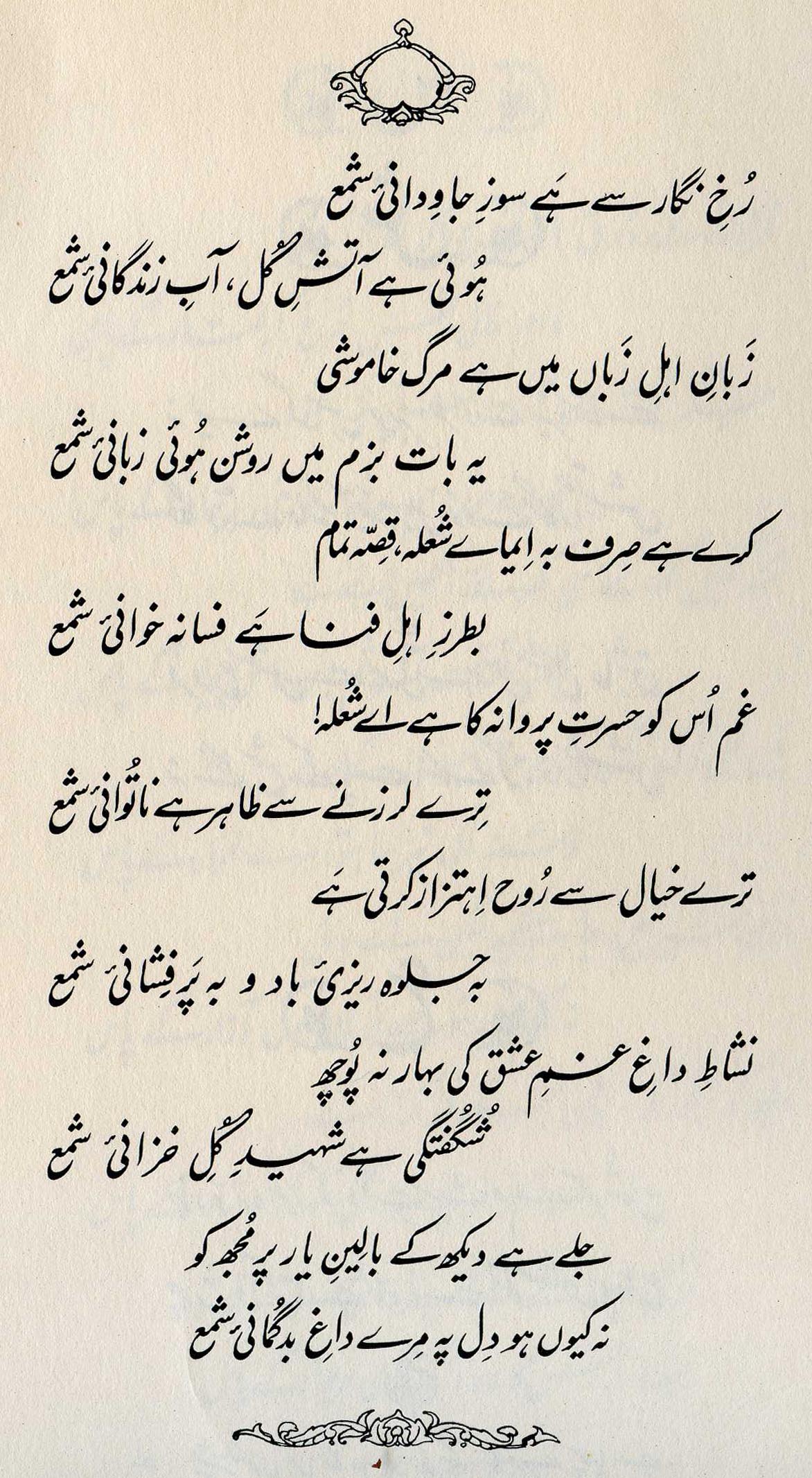
In this verse, and and and and and and -- all these are words connected by to the candle, but all are used unostentatiously []. (76)
== Nazm page 76 ; Nazm page 77


The meaning is that when a candle is extinguished, then they call it a 'dead candle' []. And when it continues to burn, then they call construe the flame as the 'tongue of the candle' []. The intention is that the falling silent of the is considered to be their death. (122)
In the idiom of the , the falling silent of the poetry-knowers [] is itself their death. In the gathering, this fact became known through the tongue of the candle. That is, just as in the gathering the candle's becoming extinguished is its death-- that is, when that happens, sadness and darkness spread [over the gathering]. In the same way the death of a poet [] is his silence. (158-59)
In this verse, the wordplay is such a tour de force that even Nazm is moved to admiration at how informally, with what ease and unforcedness, it is deployed. Just consider his inventory of the verse's wordplay: [tongue, language] and ['people of the tongue'; 'masters of language'] and [death] and [silence] and [gathering] and [illumined, radiant] and ['from the tongue', orally]-- and of course , the candle itself, with its 'tongue' of flame and its inevitable 'death'.
All this wordplay is beautifully integrated, and the most enjoyable part of it is the use of the 'people of tongue/language' []. In Urdu literary tradition these are the people who police the boundaries of proper usage-- they are the ones who are able to declare that a certain idiom or turn of phrase is acceptable or , 'rejected'. They are the educated poetry-knowing native speakers, the ones whom poets and commentators address when they say things like 'Only the will know the real pleasure of this'.
So in all this tangle of elegant multiple wordplay, what is actually being said? Except at a basic level, it's impossible to be too sure. At a basic level, the connection of the candle-- which in English too, fortunately, has its 'tongue' of flame-- and the , the 'people of tongue/language', is clear. Both of them will be dead if they lose their 'tongues'; in Urdu a 'silent' (or 'killed') candle is an extinguished one. This situation becomes illumined [] 'by the tongue' [] of the candle. In short, in the language of poets, critics, and candles, death is silence and/or silence is death.
This is not, after all, a very exciting or revelatory thing to say. The pleasure of the verse lies in its wordplay, and its sound effects-- especially the repeated word . With three slightly differing variations ( ) of the same word amidst all that related wordplay, the verse can hardly help but feel mysterious and even a bit hypnotic.
Other verses about the tongue of the candle: 75,3 ; 81,9x .
graphics/candlefire.jpg