Verse 61816aanii-esham((a
G9
In this meter the next-to-last long syllable may be replaced by two shorts.
1
the flourishing/springtime of the joy/growing/creation of the wound/scar of the grief of passion-- don't ask [about it]!
2
floweringness is a martyr/witness to the autumnal rose/snuffer of the candle
t>> : 'Liveliness, sprightliness, cheerfulness, gladness, glee, joy, pleasure, exultation, triumph'.
t>> : 'Growing; being produced; springing up, appearing; —anything growing, or produced; —a product; a creation; —a creature'.
'A rose; a flower; a red patch (on anything); --snuff [=snuffer-out] (of a lamp or a candle)'.
| References | |
|---|---|
| Arshi, Imtiyaz Ali | Ghazal# 75 |
| Raza, Kalidas Gupta | 191 |
| Nuskhah-e-Hamidiyah | 122-123 |
| Hamid Ali Khan | Open Image |
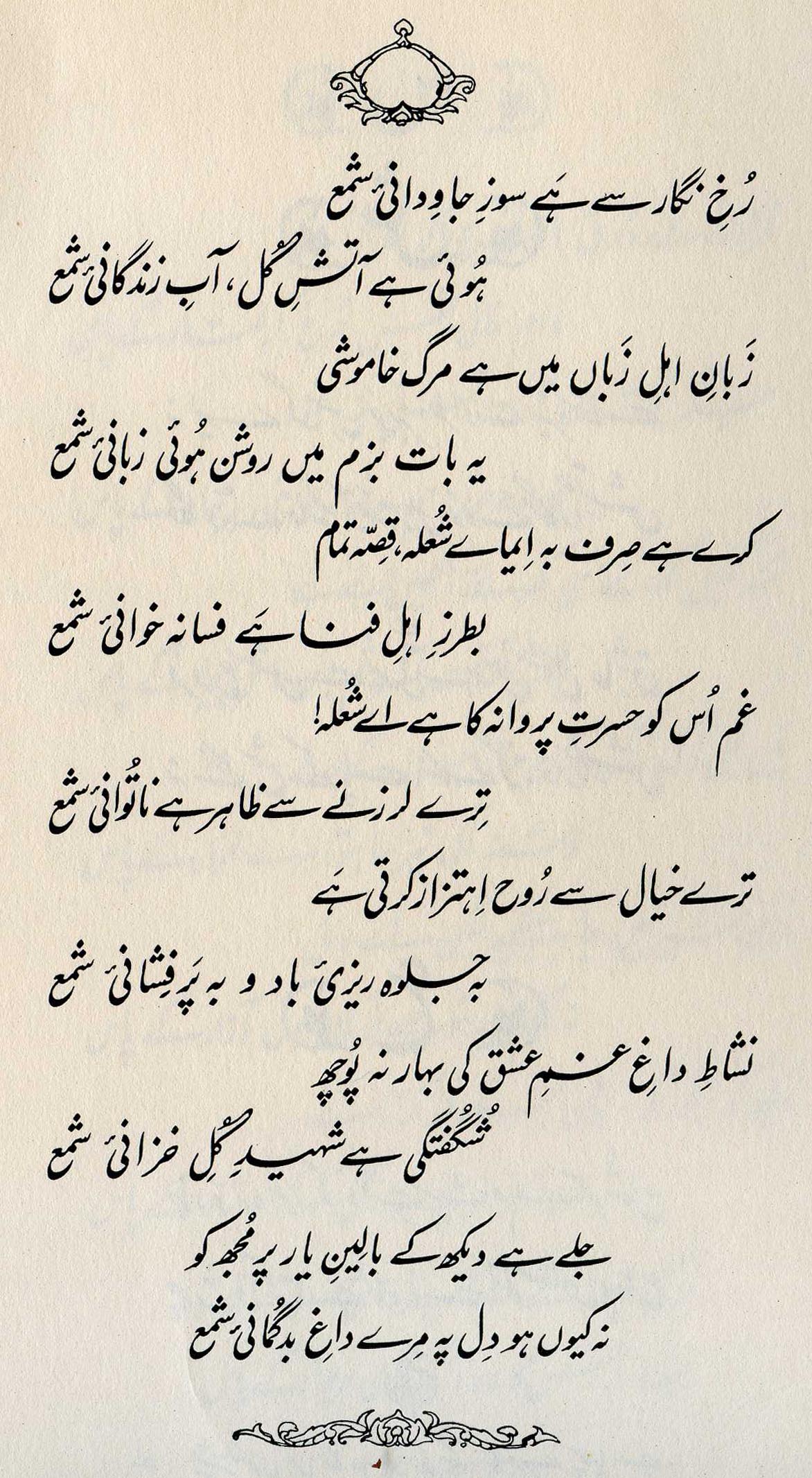
The meaning is that just as the flowering flame of flourishing/springtime [] creates autumn for the candle, in the same way the wound/scar of passion finishes off the lover. But in this wound/scar is a strange , and floweringness sacrifices itself for that autumnal rose. (77)
== Nazm page 77

He says, don't ask me about the state of happiness and joy of the wound/scar of the grief of passion. It has the mood of the spring season. The way a candle is extinguished by a 'rose'/snuffer, in the same way the lover is martyred by the wound/scar of passion. The meaning is that in the wound/scar of passion such is hidden that floweringness has given up a thousand lives for it. (123)
The one who's been slain by the grief of passion-- how can I describe the of his joy? Look-- floweringness dies for the autumn-stricken rose of the candle. That is, in passion all the is for the dying ones. And Mirza says in another place, 231,2 . (159)
Faruqi didn't comment on this one, but if he had, he would certainly have done for the first line another bravura analysis of the kind he did for 71,3 . So let me try to lay out the possibilities (only the final is compulsory):
(1) (2) (3) (4)
(1) as in the main translation above, following Arshi
(2) Joy, don't ask about the of the wound/scar of the grief of passion!
(3) Joy of the wound/scar, don't ask about the of the grief of passion!
(4) joy, wounds/scars-- don't ask about the of the grief of passion!
I had a go at this verse on pp. 108-09 of Nets of Awareness too. Not only are all these four possibilities quite legitimate, but some of them should actually be subdivided. In (3), for example, the opens up several further possibilities: is it ecstasy that is caused to me by the wound/scar; or ecstasy that is felt by the wound/scar itself; or ecstasy that pertains to the wound/scar in some more general way?
The admirable and characteristically Ghalibian thing is that no matter how we slice and dice the first line, it works excellently with the second line, showing lots of connection of both words and meaning. The verse is so rich in wordplay that a whole lovely extra dimension, as not only a flower but also a small cup-shaped (rose-like) candle-snuffer (on this see 39,6x ), is noticed only by Bekhud Dihlavi. (And what could be more 'autumnal' to the candle than a snuffer?)
As in so many verses of this ghazal, the imagery is so rich that we can hardly get an analytical knife into it. Wherever we choose to prod it, a flock of meanings fly out, but there are always more behind them. Maybe we can sum it up as Bekhud Mohani does: in passion, all the is for the dying.
C. M. Naim adds (Apr. 2014) that is also a name for the little lumps that form atop the wick of a burning candle; he says that these are also called the 'smile' of a candle [].
graphics/autumnrose.jpg