Verse 71816aanii-esham((a
G9
In this meter the next-to-last long syllable may be replaced by two shorts.
1
it 'burns', having seen me at the beloved's pillow
2
why wouldn't there be on my heart the wound/scar of the suspicion of the candle?
is an archaic form of ( GRAMMAR )
'To burn; to be burnt; to be on fire; to be kindled, be lighted; to be scorched, be singed; to be inflamed, to be consumed; to be touched, moved, or affected (with pity, &c.); to feel pain, sorrow, anguish, &c.; to burn or be consumed with love, or jealousy, or envy, &c.; to take amiss, be offended, be indignant; to get into a passion, be enraged, to rage'.
'Suspicion, mistrust, distrust; disaffection'.
| References | |
|---|---|
| Arshi, Imtiyaz Ali | Ghazal# 75 |
| Raza, Kalidas Gupta | 191 |
| Nuskhah-e-Hamidiyah | 122-123 |
| Hamid Ali Khan | Open Image |
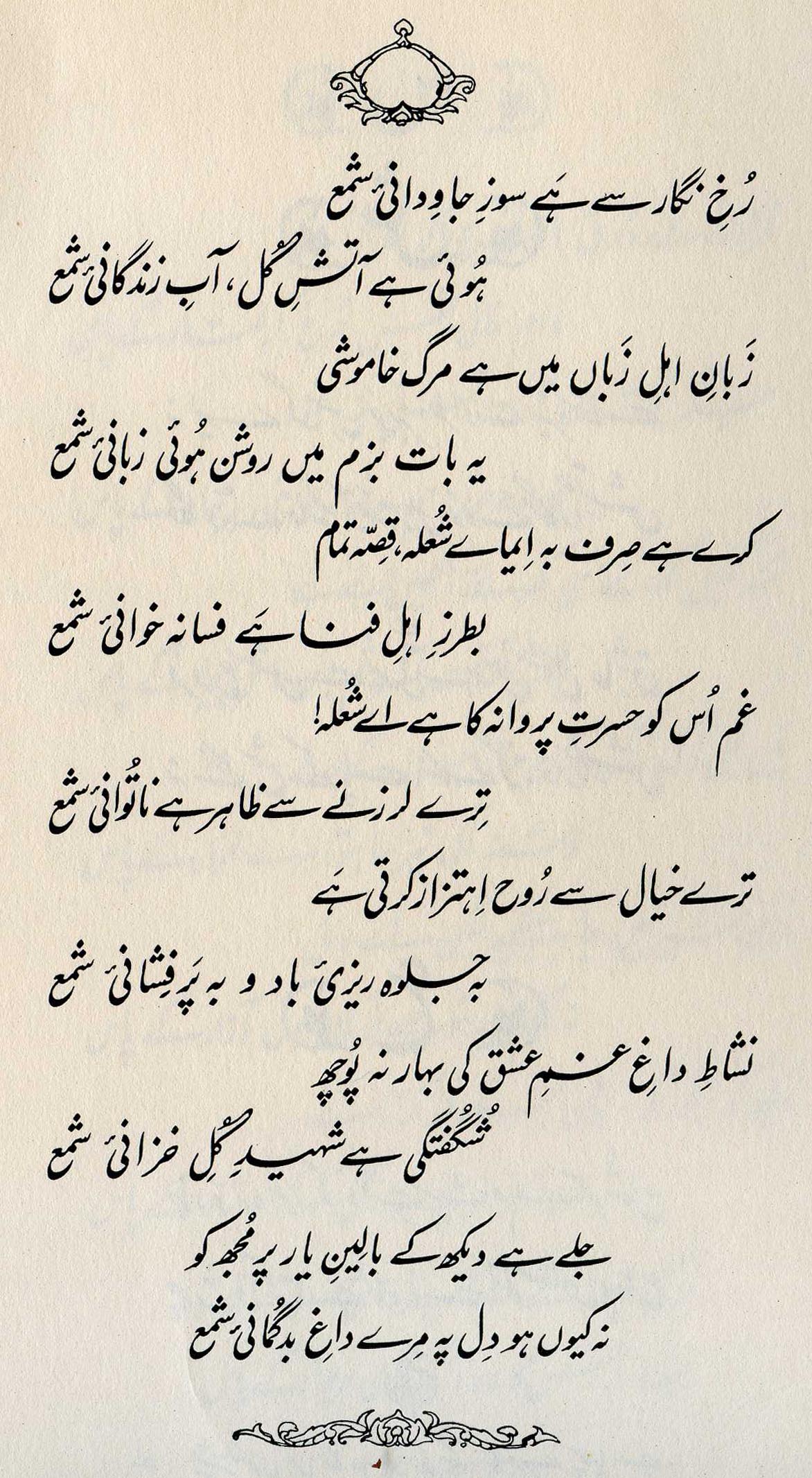
On the part of the candle there's suspicion, from seeing me at the beloved's pillow. It is struck by envy, and keeps on {feeling jealousy / burning}-- that is, in that place it considers itself special. (77)
== Nazm page 77

He says, it seems that the candle too is the beloved's lover, and considers me its Rival . Because having seen me near the beloved, it keeps burning with envy and jealousy. I have this suspicion about the candle. (123)
The candle {feels jealous / burns}. The lover considers, 'I am in the beloved's private chamber, the candle is {feeling jealous / burning} for this reason. Thus why wouldn't I be suspicious of the candle? That is, the candle is my Rival . When passion reaches a level of perfection, then a man begins to take offense at his own shadow. (160)
In the art of rhetoric [], the name of this is the verbal device of ' elegance in assigning a cause '.
Some commentators read the verse as claiming that (1) 'the lover is suspicious and jealous of the candle'; others read it as (2) 'the candle is suspicious and jealous of the lover'. Whereas in fact, the verse has been carefully framed with an to permit both readings. On reading (1), we take the first line as an accurate observation about the feelings of the candle; on reading (2), we take the first line as a wildly jealous personification of an ordinary candle.
In either case, the ambiguity of the in line two works perfectly. On reading (1), we take 'suspicion of the candle' [] to mean the lover's suspicion of the candle; on reading (2), we take it to mean the candle's suspicion of the lover. Both readings are absolutely natural-sounding and possible. And in the process, the back-and-forthness of the readings also amusingly illustrates the reactive, obsessive, other-directed nature of jealousy. The lover and the candle, eyeing each other darkly (so to speak) in the beloved's chamber, feeling injured by each other's presence-- it's a captivating scene to imagine.
The perfect convenience of the verb , which means both 'to burn' and 'to feel jealous', can't of course be fully captured in English. We can 'burn with envy', but that's not as versatile.
This is one of the very few ghazals in the divan that doesn't have a closing-verse . And since in this case Ghalib chose to include in his published divan every verse he had originally composed, it seems that that it never did have one.
graphics/jealouscandle.jpg