Verse 21816ilnahii;N rahaa
G3
1
I go, having taken on the wound/scar of longing/grief/regret of existence
2
I'm an extinguished/'killed' candle-- I didn't remain worthy of the gathering
'Grief, regret, intense grief or sorrow; --longing, desire'.
'Killed, slain'.
| References | |
|---|---|
| Arshi, Imtiyaz Ali | Ghazal# 29 |
| Raza, Kalidas Gupta | 161-162 |
| Nuskhah-e-Hamidiyah | 76-78 |
| Asi, Abdul Bari | 70-71 |
| Gyan Chand | 110-111 |
| Hamid Ali Khan | Open Image |
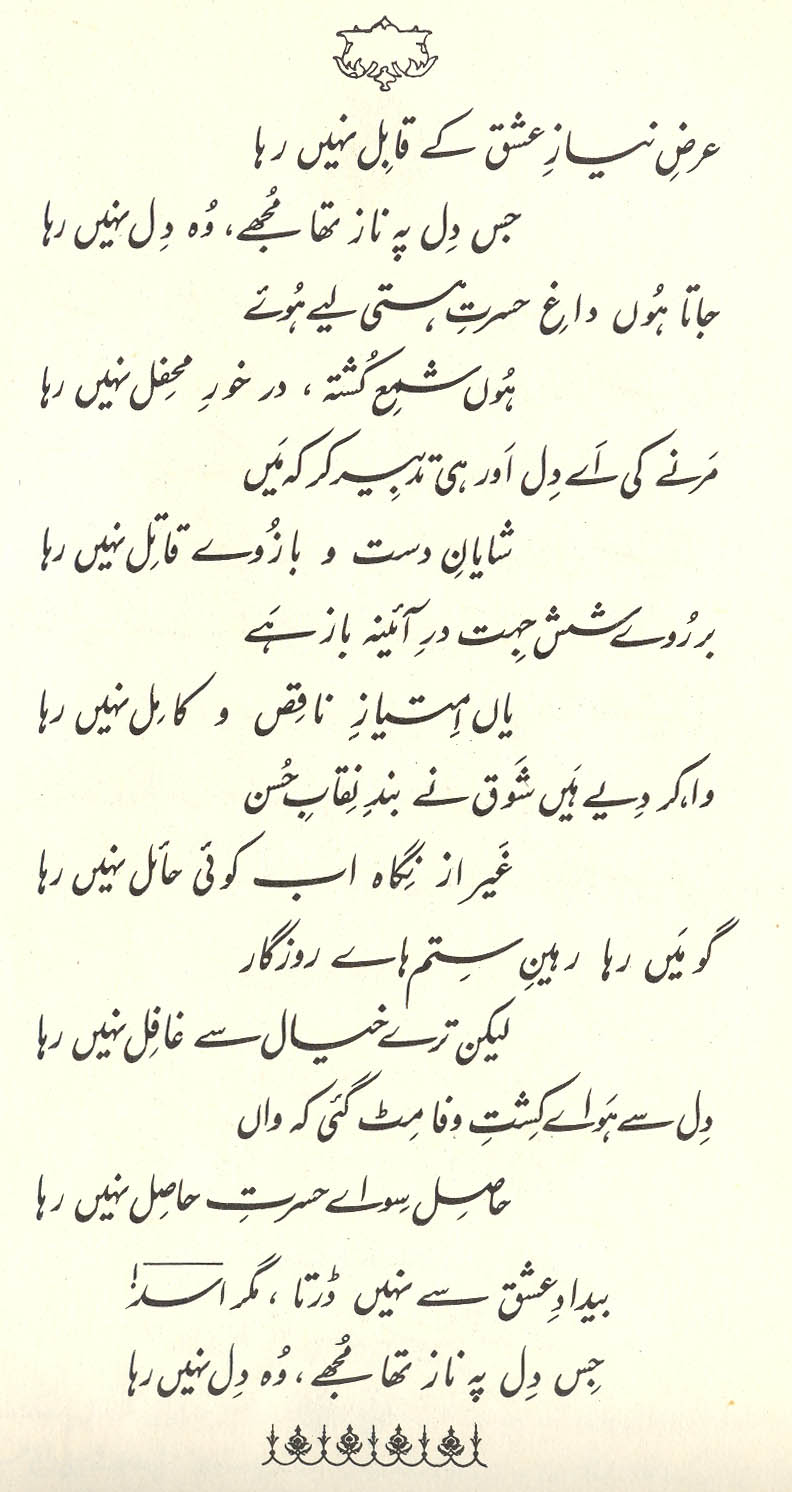
It is only a metaphor for existence. (38)
== Nazm page 38

Urdu text: Vajid 1902 {41}
He says, I leave the world bearing the wound/scar of the longing for existence; that is, I have given up my life under the compulsion of destiny. My heart didn't want to die. The second line contains a 'claim comprising a proof' []. That is, I am an extinguished candle, I am no longer worthy of the gathering. The convention is that when a candle is extinguished, the wick keeps glimmering for a long time, and it's as if it's longing for existence. (76)
That is, I myself feel sorrow at the death of my youth. Perhaps it is a 'killed candle', dying right in the flower of its youth. That is, when an extinguished candle is called a 'killed candle', then uncontrollably an image of death, and early death, has been created. It also creates an effect of complaint against the Lord-- that is, this candle did not go out voluntarily; rather, it has been put out. (94)
The 'killed' or extinguished candle bears in its heart the blackened remains of its wick, just as the dying lover bears in his heart the burnt-out (but still smoldering?) wound/scar of the vain longing for life. Both candle (in tears of wax) and lover (in tears of blood) have wept their hearts out-- and both remain unsatisfied even as their lives come to an end. Both have sacrificed everything they have: the candle has illumined the gathering with its own flaming tears and melting body, while the lover has 'turned his heart to blood' for the sake of the beloved. And what is their reward? A cold, lonely, burnt-out death.
But does the lover complain? He doesn't seem to. He simply observes that he goes to death as appropriately and matter-of-factly as an extinguished candle that is borne away. The candle is no longer fit for the gathering, and the lover has nothing left to offer either. Taking his unquenched (and unquenchable) longing with him, he departs.
This verse is about as close to pathos as Ghalib ever gets-- and that's not very close. The verse is not so much pathetic as it is detached and descriptive. There's not a hint of reproach, and no indication that anyone is to blame. It could of course be recited in a pathetic tone, but nothing in the verse itself encourages such a choice.
Moreover, thanks to its constructions, the first line is an intriguingly ambiguous one. In the case of the wound/scar of longing/grief/regret', we have an 'A of B'-- but is the A identical with B, or caused by B, or merely pertaining to B? Precisely the same possibilities arise for the 'longing/grief/regret of existence'. Thus we have an 'A of B of C'-- or is it an '(A-of-B) of C', or an 'A of (B-of-C)'? The permutations multiply, but they also blur together into a general effect of melancholy.
Note for grammar fans: This is another case of the skewed correlation between Urdu and English tenses (despite their seeming parallelism); for discussion, see 38,1 . In English, considering the present tenses in the verse, we'd say 'I haven't remained worthy'. Ghalib could easily have recast the present tenses into past forms; the fact that he chose not to, illustrates the skewedness that is so ubiquitous, especially in older Urdu.
graphics/burntoutcandle.jpg