Verse 51816ilnahii;N rahaa
G3
1
ardor has opened the ties/bindings of the veil of beauty
2
other than the gaze/sight/attention, now no hindrance/hinderer remained
'Look, glance, sight, view, regard; consideration; --look, aspect (of); --watching, observation, attention; --custody, care'.
'Intervening, interposing; preventing, hindering, restraining; --one who or a thing which interrupts, or prevents, preventer, hinderer; hindrance, obstacle, impediment'.
| References | |
|---|---|
| Arshi, Imtiyaz Ali | Ghazal# 29 |
| Raza, Kalidas Gupta | 161-162 |
| Nuskhah-e-Hamidiyah | 76-78 |
| Asi, Abdul Bari | 70-71 |
| Gyan Chand | 110-111 |
| Hamid Ali Khan | Open Image |
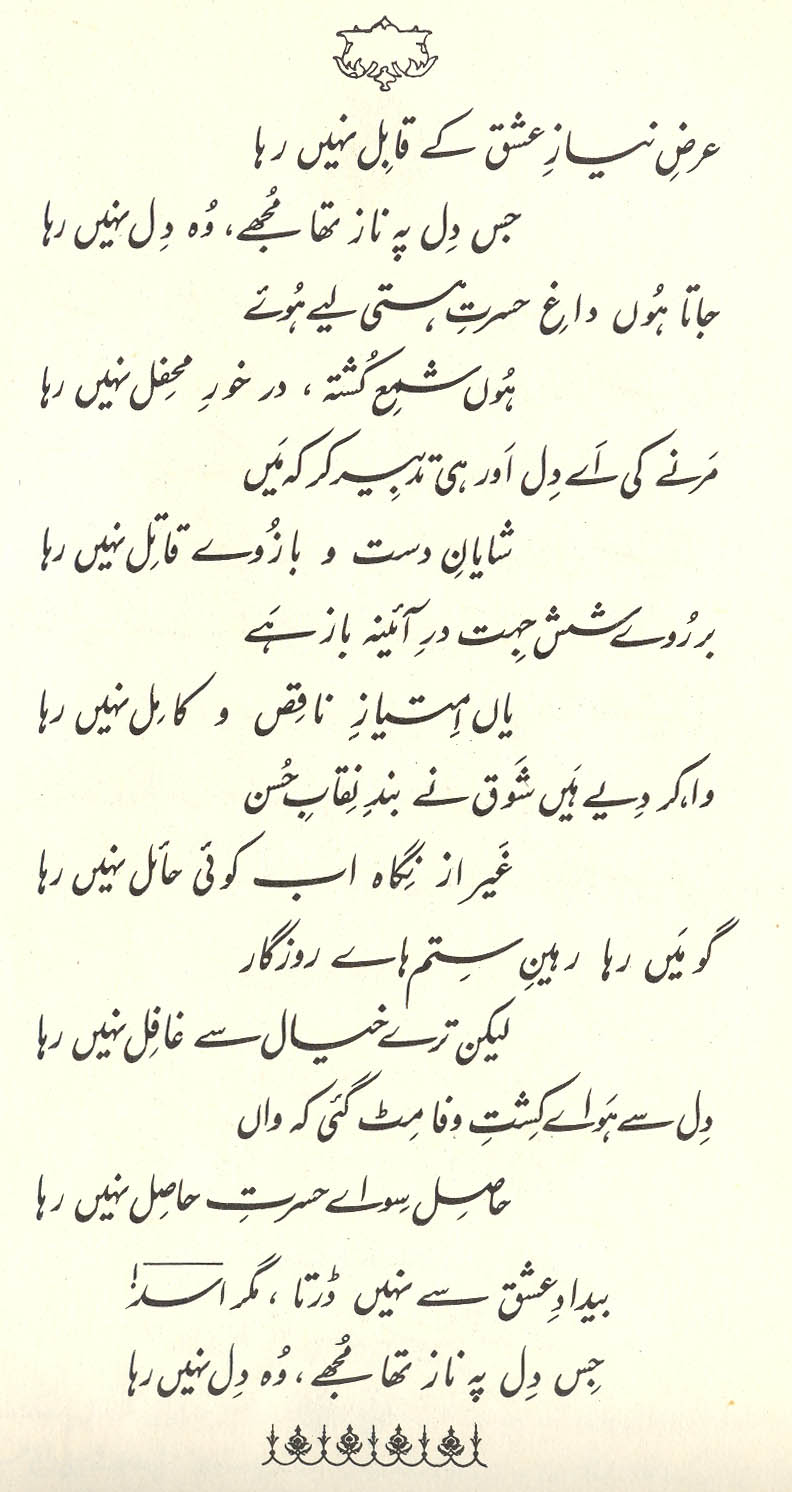
That is, the distinction between beholder and beheld that remains, this is the obstacle, because the eye cannot see it; and the veils that were there in addition to it, an extremity of ardor has lifted. (39)
== Nazm page 39

He says, ardor for self-display has opened the ties of the veil of beauty-- that is, every grain, every leaf, every drop is the expression of the Divine Glory. But the difficulty is that the beholder's outer eye cannot see it. Thus it's been said that except for sight, no veil remains between them. If the outer eye would open, then the outward veils can be lifted. (77)
The word 'ardor' applies to both the beloved's ardor for self-display and the lover's ardor for sight. The lover's ardor for sight, or the beloved's ardor for self-display, has opened the ties of the veil of the beloved's beauty, and now nothing is an obstacle except sight. Sight has been called an obstacle because the eye cannot see it. (95)
The real question is of course what kind of obstacle now remains between the lover and beauty. Does 'other than the gaze' show how small a barrier remains, or how large a one? For 'the gaze' itself might be a form of distancing, an immovable barrier. Or does the gaze merely signify the (illusory?) belief in duality when there is really only oneness? If there were no obstacle at all, would the speaker actually see beauty? Or would he cease to exist? After all, this is the poet who has given us the complexities of the famous 32,1 .
Moreover, isn't it also possible that the beloved' s radiance burns out the gaze like lightning, like the of 214,7 ? As usual, all such questions are carefully left unanswered-- and unanswerable. For it may well be the beloved herself, or the divine Beloved, who has permitted the opening of the veil, so the possibilities of mystery and bafflement, and revelation too, are very real.
Even the word 'other' [], with its overtones in the ghazal world of the Other who competes with the lover for the beloved's attention, is perfectly chosen.
Note for grammar fans: This is another case of the skewed correlation between Urdu and English tenses (despite their seeming parallelism); for discussion, see 38,1 . In English, considering the present perfect ('has opened') in the first line, in the second line we'd say 'has remained'. If Ghalib had so wished, he could easily have arranged the first line to say 'opened', to accord with the refrain; the fact that he didn't feel any need to, is evidence that this kind of skewed correlation is quite normal.
graphics/veil.jpg