Verse 71816ilnahii;N rahaa
G3
1
from the heart the desire for the cultivation/tillage of faithfulness was erased, since there
2
outcome/produce, besides/beyond the longing/grief/regret for/of outcome/produce, did not remain
'Tillage, cultivation ... a sown field; division of a crop'.
'Credit, good name; --affection, favour, love, mind, desire, passionate fondness; lust, carnal desire, concupiscence; --an empty or worthless thing'.
'Grief, regret, intense grief or sorrow; --longing, desire'.
'Product, produce, outcome ... ; result, issue, ultimate consequence; ... produce or net produce (of land, or of anything that is a source of revenue)'.
| References | |
|---|---|
| Arshi, Imtiyaz Ali | Ghazal# 29 |
| Raza, Kalidas Gupta | 161-162 |
| Nuskhah-e-Hamidiyah | 76-78 |
| Asi, Abdul Bari | 70-71 |
| Gyan Chand | 110-111 |
| Hamid Ali Khan | Open Image |
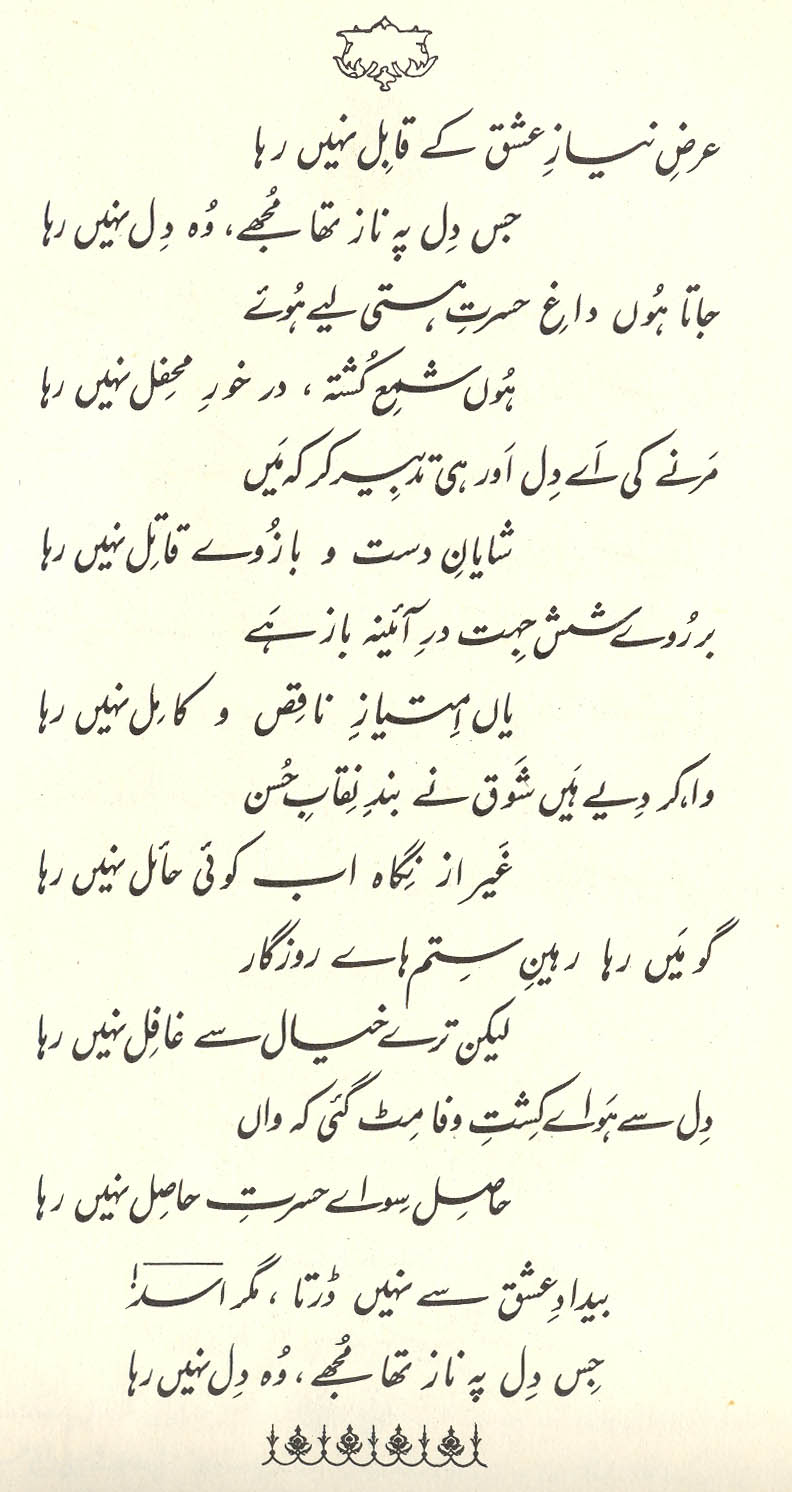
That is, the zeal for faithfulness no longer remains, so that I didn't find anything except the longing for faithfulness.
== Nazm page 39

He says, 'Now even the longing for the garden of faithfulness has been erased from the heart. Enthusiasm has waned. Courage has taken its leave, and the reason is that after faithfulness, I didn't find the tillage of faithfulness to be anything but longing and regret.' (77)
'Now we no longer have the enthusiasm for faithfulness, because its fruit has been nothing but longing and regret.' The implication of 'did not remain' is that in the world, or in the beloved, there used to be faithfulness, but now it no longer remains. (96)
'Faithfulness' can also be used in its general meaning-- that is, the faithfulness of friends, of near and dear ones, and of the beloved can be intended. (156)
The 'cultivation/tillage' in the first line suggests farming, while the second line evokes the 'harvest' or 'produce' that one might expect from it. The first line reports that the 'cultivation/tillage of faithfulness' has been erased from the heart-- the speaker won't be planting any more seeds of faithfulness, or cultivating any more such young plants.
What has caused the speaker to give up his farming? The reason is that 'there' [], in his heart, as the second line tells us, the result has been terrible: the only 'produce/harvest' is the 'longing/grief/regret of/for the harvest'. This sorrow can be either a longing for a sadly blighted 'harvest' (such as the beloved's favor) that could never be reaped, or a regret over an 'outcome' (such as the beloved's cruelty or fickleness) that did in fact occur.
In either case, the only fruit of the speaker's past 'cultivation of faithfulness' is a deep sorrow. Does this itself count as a 'fruit' or harvest, from his 'tillage'? The second line suggests that it perhaps does, since there's no other 'produce' remaining in the heart 'besides' or 'beyond' [] this sorrow.
With its agricultural imagery this verse reminds me of the brilliant 10,6 , in which the farmer's own hot blood is the essence of the lightning that falls on his 'harvest'. Isn't something similar being reported here? Surely it's the lover's own passionate cultivation of the stony ground of the beloved's heart that has reduced him to despair; a more prudent, worldly person would have shrugged his shoulders long ago and turned his energies elsewhere.
But there are other perspectives as well: in 12,1 the lover worships the lightning, but laments the 'fruit/result' []. And in one of my favorites, 214,6 , he gardens in the desert with great success, at least for a time-- by using bits of his liver to fertilize the roses.
graphics/harvest.jpg