Verse 11816ilnahii;N rahaa
G3
1
[it/I] did not remain capable of the offering of the submission of passion
2
the heart on which I prided myself-- that heart did not remain
'Petition, supplication, prayer; --inclination, wish, eager desire, longing, need, necessity; indigence, poverty; --a gift, present; --an offering, a thing dedicated'.
'Pride, conceit, consequential airs, whims'.
| References | |
|---|---|
| Arshi, Imtiyaz Ali | Ghazal# 29 |
| Raza, Kalidas Gupta | 161-162 |
| Nuskhah-e-Hamidiyah | 76-78 |
| Asi, Abdul Bari | 70-71 |
| Gyan Chand | 110-111 |
| Hamid Ali Khan | Open Image |
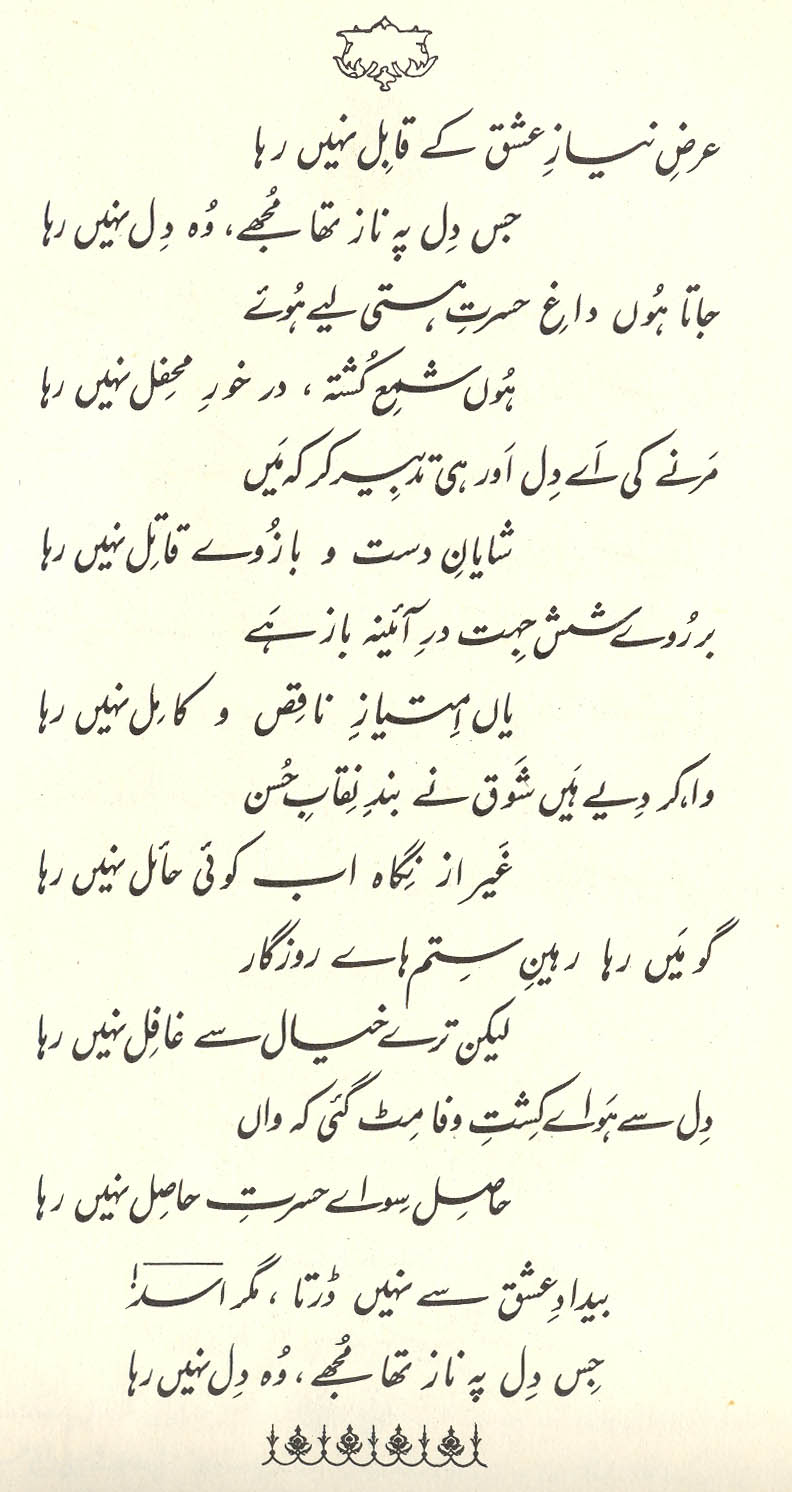
[1855, to Haqir:] It's a pity that you don't know the shape I'm in; if you look at me, you'll realize: 'the heart on which I prided myself-- that heart did not remain'.
==Urdu text: : Khaliq Anjum vol. 3, p. 1167
==another trans.: Russell and Islam , p. 78
That is, through enduring and enduring the shocks of faithlessness and inattentiveness, now that heart itself no longer remains to me, with which I would claim to offer the submission of love. (38)
== Nazm page 38

He says, the heart that would be presented in the humility of passion-- that heart is now no longer with me. That is, I have sustained so many of the shocks of separation, the griefs of faithlessness, the agitations of inattentiveness, that I am no longer able to perform the services of passion.
In the second line, he says proudly that in truth, my heart was worthy to be presented in the court of passion, and it was so presented, and at some time I indeed prided myself on that heart, but now it has endured so many shocks that it is capable of nothing. (76)
The poet says only this much: that the heart now doesn't remain fit for a lover-like show of submission. But he doesn't tell us any reason for this.... Enduring the beloved's cruelties, or dragging the chains of separation, the heart no longer remains capable. (93)
Because of the refrain , 'did not remain', one might expect this whole ghazal to have an elegiac mood, looking backwards to the days when the lover was less ravaged and burnt out, so that he had more to bring to his passion, and could consider himself a more worthy offering to the beloved. But instead, look at the variety of the verses: in the first three, Ghalib does indeed ring changes on the mood of nostalgia, but after that, his thought veers off into other realms entirely. In the closing-verse , 41,8 , however, he refers to this opening-verse in a most unusual way, literally reproducing the second line.
The present verse is one with an effect of simplicity, starkness, dignity, loss. All the meanings of -- a need, a longing, a supplication, a gift-- are appropriate here to express everything that the lover can no longer do. In theory, it's no surprise to the lover that he should 'lose' his heart; that's the name of the game, after all. But only after it's gone does he fully realize that the game in which he has had to stake his heart can't be played at all once the heart is gone.
The wordplay is classically simple but appropriate, and serves to point up the paradox-- the lover had felt pride or coquetry, , about the depth of his humility and supplication and lover-like behavior,
For a similar theme see 25,4 , in which the lover loses his heart even before the game gets started. And of course the general theme of progressive damage to the lover's heart, culminating in complete loss and death, is at the center of dozens of verses-- and of the ghazal world itself.
graphics/lostheart.jpg