Verse 81816ilnahii;N rahaa
G3
1
I do not not fear the injustice/cruelty of passion-- but/perhaps, Asad
2
the heart on which I prided myself-- that heart did not remain
| References | |
|---|---|
| Arshi, Imtiyaz Ali | Ghazal# 29 |
| Raza, Kalidas Gupta | 161-162 |
| Nuskhah-e-Hamidiyah | 76-78 |
| Asi, Abdul Bari | 70-71 |
| Gyan Chand | 110-111 |
| Hamid Ali Khan | Open Image |
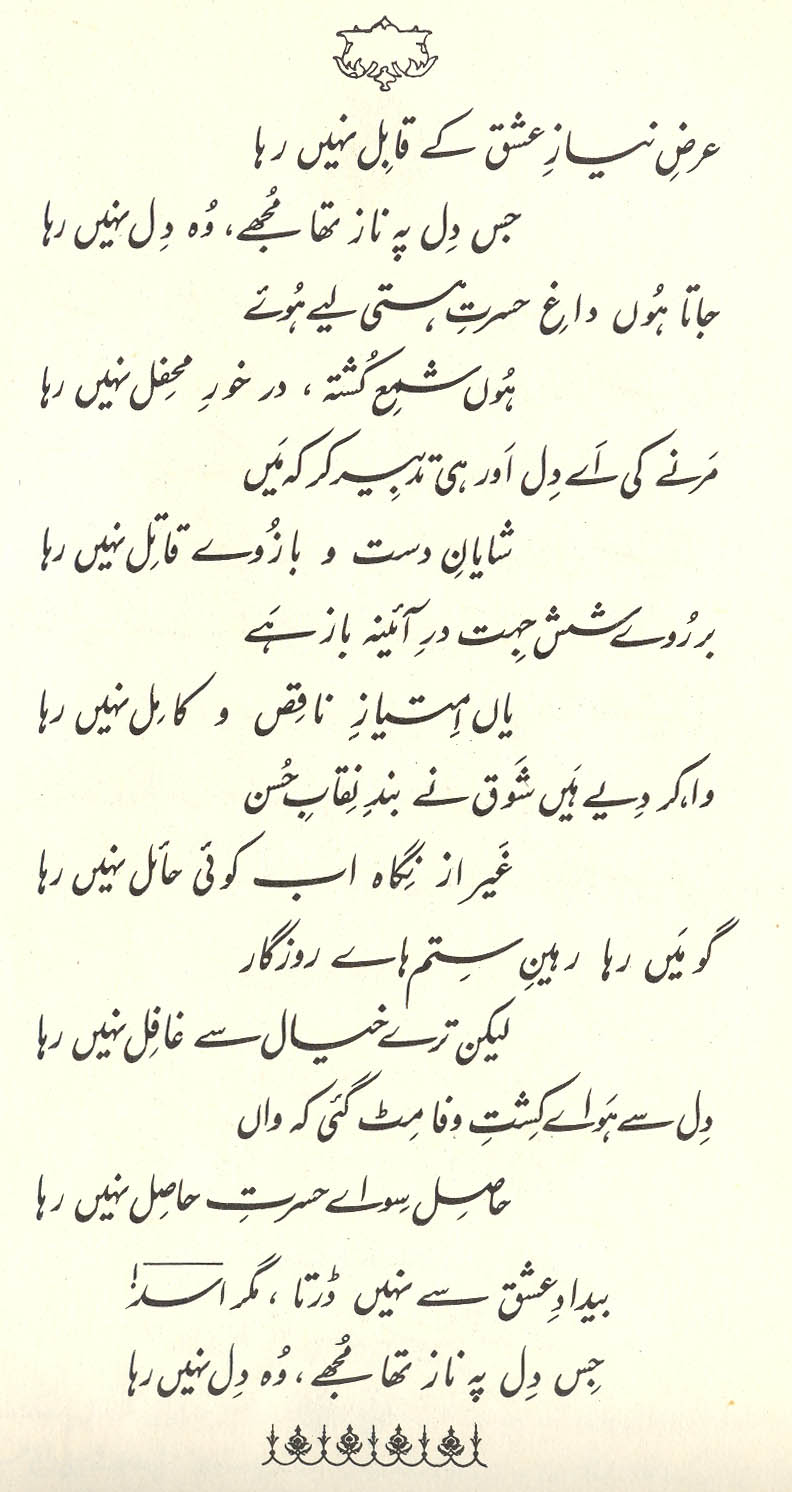
That is, when the heart itself didn't remain, then who would endure injustice? (39)
== Nazm page 39

He has used the second line of the opening-verse once again. He says, I'm not afraid of the injustice of passion, and this is not because I shun fear, but because, oh Asad, the oppression-enduring heart that was in my breast, and on which I prided myself, that heart no longer remains. Now who would endure injustice? (78)
I don't fear the injustice of passion. Rather, that heart that I prided myself on, because it wouldn't fall into the net of any beloved, now no longer remains. Thus I regret only that my claim not to have fallen into anyone's net will no longer be able to stand. Otherwise, the tyranny of passion is not such that I can't endure it. (96)
As Bekhud Dihlavi points out, Ghalib has re-used, word for word, the second line of 41,1 , giving the ghazal an elegant and unusual form of closure. For more on such line repetitions, see 49,1 .
The word here works its usual double magic. Its position suggests that it applies, through enjambment, to the second line. If it's taken to mean 'perhaps', then the lover is speculating on the reason that he doesn't fear the cruelties of passion: maybe it's because he no longer has any heart to feel them with. Or rather, he no longer has the proper, vulnerable kind of heart, the one he was proud of before-- he no longer has 'that' heart.
If is taken to mean 'but', then the lover is qualifying the bravado of his assertion of fearlessness: it's fine to have no fear, but this fearlessness has been bought at the price of losing the heart itself (or losing the passionate or other qualities that made it a heart to be proud of), so that the fearlessness becomes a hollow boast. For further discussion of , see 35,7 .
Note for grammar fans: This is another case of the skewed correlation between Urdu and English tenses (despite their seeming parallelism); for discussion, see 38,1 . In English, considering the present tense in the first line, we'd say 'has not remained'.
graphics/lostheart.jpg