Verse 3x1816ilkaa
G2
1
{although / to such an extent / since} the illusion/suspicion of the slaughtered one was turned-to-blood by the envy/jealousy of faithfulness
2
the wounds of the heart stole/absorbed the 'water' of the murderer's/murderous sword
'From the abundance; sufficiently; very, extremely, excessively; notwithstanding, although'.
'Inasmuch as; extremely, &c. = '.
'Returned; turned; inverted, reversed; converted; perverted; changed; --become; formed'.
'Thinking, imagining, conceiving (esp. a false idea); --opinion, conjecture; imagination, idea, fancy; --suspicion, doubt; scruple, caution; distrust, anxiety, apprehension, fear'.
'To steal, filch, pilfer, rob; to plagiarize; to misappropriate; to suck in or up, to absorb'.
'Water ... ; water or lustre (of a gem, &c.); lustre, sparkle, polish, brightness, beauty; spirit, mettle, blood, breed; character, reputation, honour; chastity, modesty, delicacy, sense of shame'.
'Water; water or lustre (in gems); temper (of steel, &c.); edge or sharpness (of a sword, &c.); sparkle, lustre; splendour; elegance; dignity, honour, character, reputation'.
| References | |
|---|---|
| Arshi, Imtiyaz Ali | Ghazal# 16 |
| Raza, Kalidas Gupta | 151 |
| Nuskhah-e-Hamidiyah | 59-60 |
| Asi, Abdul Bari | 64 |
| Gyan Chand | 95-97 |
| Hamid Ali Khan | Open Image |
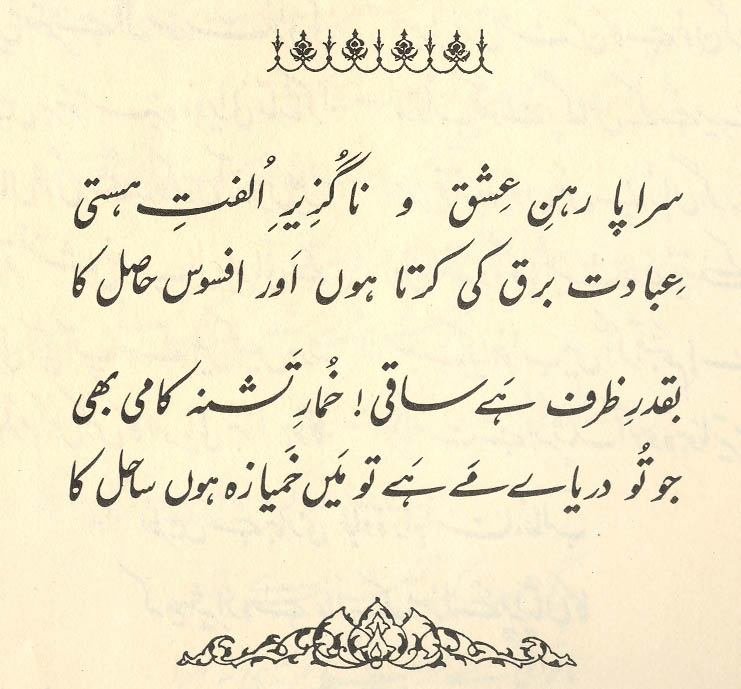
Since the suspicion of the wounded/slaughtered one was turned to blood by the jealousy/envy of faithfulness, the wounds in the heart stole away the water from the murderer's sword. It's clear that except for affinity of words, this verse doesn't seem to have any result/fruit [].
== Asi, p. 64
The wounded/slaughtered one's flood of tears deceives him into fearing that someone else might somehow drink the water of the murderer's sword. That is, that the murderer might with her 'water'-possessing sword murder someone else. Thus the wounds of his heart drink up all the 'water' of the sword, so that there would not be any of it left. The result is that having wounded him, the murderer's sword became 'water'-less; there's an additional meaning of showing his 'tough-lifedness' [].
== Zamin, p. 59
When water comes near a wound, then the wound absorbs the water, from which pus develops.... In Persian, the meaning of is 'water' and 'blade' both. Ghalib has taken both meanings in Urdu as well. In the slaughtered one's faithfulness to the beloved there was so much excess that because of jealousy/envy he couldn't endure that any other person would be martyred in order to give proof of faithfulness.
Thus the wound absorbed into itself the 'water' of the murderer's sword. From which it resulted that the wound became even more infected, from which the extremity of faithfulness became manifest; and this as well resulted, that at least apparently/outwardly, after the stealing of the 'water' of the sword, the sword became blunt, and didn't remain fit for murdering anyone else. The gist is that because of faithfulness and jealousy/envy, the slaughtered one took the blade of the sword inside himself.
== Gyan Chand, pp. 95-96
For background see S. R. Faruqi's choices . This verse is NOT one of his choices; I thought it was weirdly interesting and have added it myself. For more on Ghalib's unpublished verses, see the discussion in 4,8x .
As Gyan Chand points out, the idea that a sword has 'water' goes back to the Persian (and Urdu) , with meanings that include luster, brilliance, and well-temperedness. But most of the same meanings have come to inhere in too, at least by extension (see the definitions above). This verse assumes that a sword has 'water' in the liquid sense, such that its water can be taken away from it-- and the verse reports to us an incident in which such a water-appropriation occurred. Without the wordplay of and , the verse would be nowhere. For more on wordplay, see 193,2 .
But what exactly does it signify that the wounds of the heart 'stole' or 'absorbed' [] the 'water' of the murderer's sword (or the murderous sword)? If it was an act of theft, it would seem to show hostility, or at least possessiveness: the sword thus loses its 'temperedness' or 'virtue', and can't pierce (anyone else) so sharply in the future. If it was an act of absorption, it might show acceptance or even submission, as Gyan Chand points out. The image is so abstract and unusual that there isn't a codified, 'pre-poeticized' way to interpret it.
And as usual, Ghalib has cleverly set up the several possibilities of , in order to multiply our interpretive choices. We have at least several basic alternatives: 'Although the slaughtered one was envious/jealous and suspicious, nevertheless the wounds stole/absorbed the water of the murderer's sword'. Or: 'The slaughtered one was so envious/jealous and suspicious that the wounds stole/absorbed the water of the murderer's sword'. Or: 'Since the slaughtered one was envious/jealous and suspicious, the wounds stole/absorbed the water of the murderer's sword'. For more on the complexities of , see 53,4 .
Asi makes the excellent point that the verse really has nothing to offer except elaborate and entirely cerebral wordplay. Since the idea of a wound's either 'stealing' or 'absorbing' the 'water' of a sword can't be visualized, it doesn't really resonate. It has no real 'objective correlative' for us to imaginatively explore and enjoy. Thus it feels arbitrary rather than well-grounded. It does certainly show how radically the young Ghalib was exploring the possibilities of sheer wordplay.
graphics/sword.jpg