Verse 6x1816ilkaa
G2
1
there was entirely, for haste/pursuit/assault, a 'whole-extent' moving-around in the six directions
2
from the lagging-behind of the road-goers, there occurred a difference of halting-place
'To hasten, walk fast, run; to rush upon, to assault; to pursue, hunt, chase; to urge, force, put to the gallop; to twist, spin; to bend, render curved or convex; ... to contend, dispute, or wager; to bore; to spread, diffuse, pour out, pour in'. (Steingass p. 273)
'Court, open area (of a house, --the 'play-ground' of children), an area; a plain; a chess-board; a space (of place or time), period, time, duration, term; an interval, a while; delay'. (Platts p.760_
'Wandering up and down, wandering about; moving or springing from side to side (as combatants or competitors in an amphitheatre or place of exercise); moving round (as a horse in a manege), coursing'.
'The remaining or lagging behind (esp. from fatigue); --openness; exposure'.
'A place for alighting, a place for the accommodation of travellers, a caravansary, an inn, a hotel; a house, lodging, dwelling, mansion, habitation, station; ... --a day's journey; --a stage (in travelling, or in the divine life); --place of destination, goal; boundary, end, limit'.
| References | |
|---|---|
| Arshi, Imtiyaz Ali | Ghazal# 16 |
| Raza, Kalidas Gupta | 151 |
| Nuskhah-e-Hamidiyah | 59-60 |
| Asi, Abdul Bari | 64 |
| Gyan Chand | 95-97 |
| Hamid Ali Khan | Open Image |
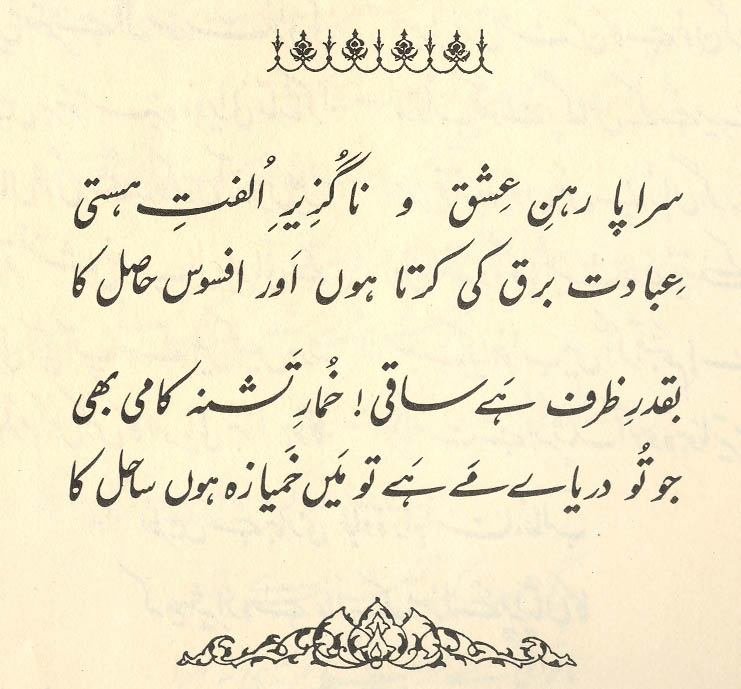
-- that is, for continual running, the six directions were only a single field. But since people became tired and stopped, for this reason a difference in destination became manifest.
== Asi, p. 64
That is, for running a course [], at one time the scope of the six directions was no greater than room to run a course. Among the runners, according to their courage someone could run this far and someone else could run that far. In this way the difference of halting-places became established, so that exactly this became the world and the people of the world.... If you would consider the verse to be mystical, then take this progress to be spiritual progress, and the halting-places to be stages of [Sufistic] progress.
== Zamin, p. 60
At one time, for running, the whole creation was a single field-- it was no more than a single destination. But the travelers became fatigued, and used to stop at various places. From this there came to be a specifying/establishing of halting-places; otherwise, our courage was such that we would leap over the whole world in a single bound.
== Gyan Chand, p. 97
For background see S. R. Faruqi's choices . This verse is NOT one of his choices; I thought it was interesting and have added it myself. For more on Ghalib's unpublished verses, see the discussion in 4,8x .
For discussion, and examples, of idiomatic expressions like , see 11,1 . For more on the 'six directions', see 41,4 .
What an excellent scene of confused motion the first line presents! Everybody was running around all over the place, in every one of the six directions (the four, plus up and down). People were wandering, or hurrying, or pursuing, or even assaulting (see the definition of above); nobody was doing anything else; this behavior occupied the whole 'extent' of time and/or space []. We have no idea what these people were up to, but they were pursuing their projects vigorously.
But that was then, and this is now. Gradually people grew tired, and in their fatigue they paused here and there, and ended up settling down. Wherever they settled down, they perhaps ended up deciding, or persuading themselves, that they were in fact in an acceptable (or even ideal?) place, and had no need to wear themselves out by continuing to travel.
Thus there occurred a 'difference' in their (theoretical and practical) 'halting-places'-- their stages of travel, and/or their destinations (see the definition of above). The present verse puts the matter in such a delicately neutral way that its application is very broad. To fill in some of the implications that Ghalib surely had in mind, compare the strikingly similar, but more powerful, 93,3x .
graphics/confused.jpg