Verse 4x1816aanikaltii hai
G9
In this meter the next-to-last long syllable may be replaced by two shorts.
1
in the color/style of a glass, I am a single corner of an empty heart
2
sometimes a Pari comes into my solitude/seclusion-- and emerges
'Glass; glass-ware; a glass bottle; a looking-glass, mirror, pier-glass, &c.; a pane of glass'.
'A glass, bottle, flask, phial, cup, caraff, decanter; glass; a looking-glass'. (Steingass p.775)
'Loneliness, solitude; seclusion, retirement, privacy; a vacant place, a private place or apartment, a closet, &c. (to which one retires for privacy); a cell (for religious retirement'.
| References | |
|---|---|
| Arshi, Imtiyaz Ali | Ghazal# 177 |
| Raza, Kalidas Gupta | 234 |
| Nuskhah-e-Hamidiyah | 272 |
| Gyan Chand | 394 |
| Hamid Ali Khan | Open Image |
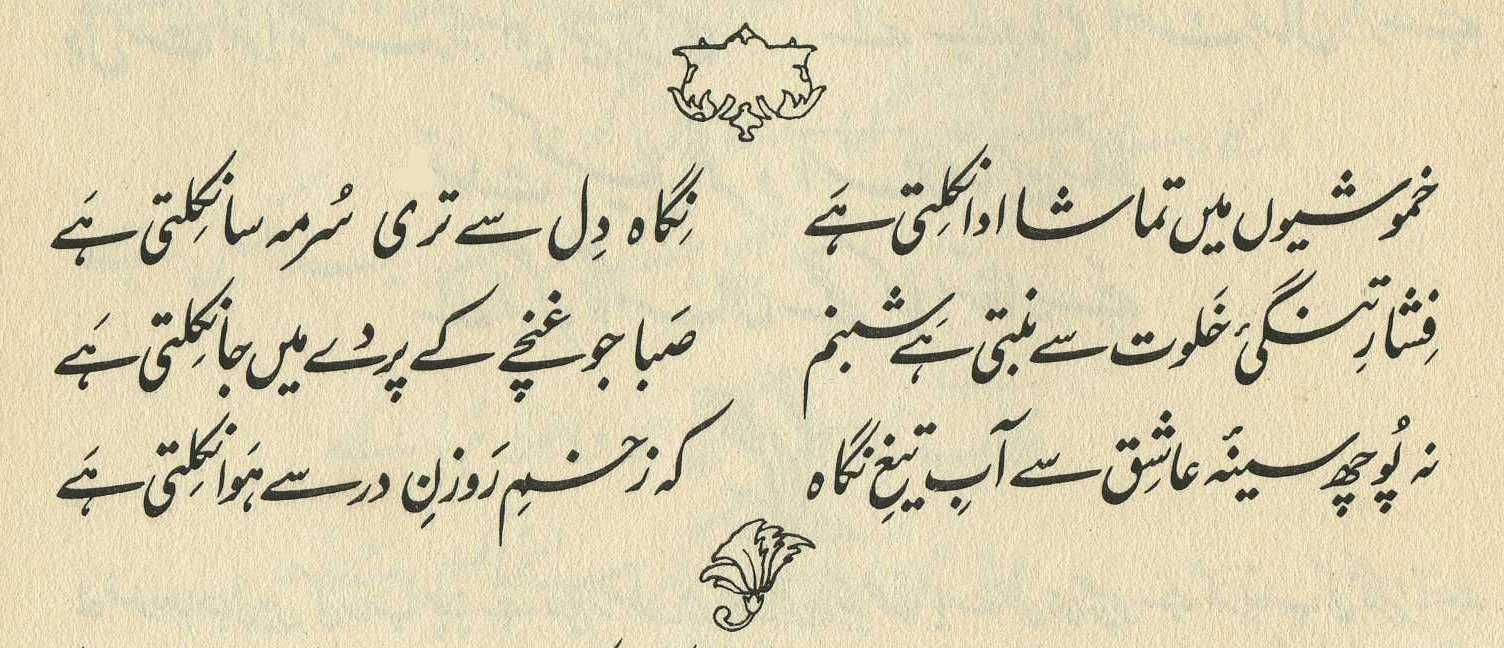
Giving for the empty heart the simile of an empty glass, he has used an with 'corner' so that an affinity with 'solitude' would be created, and by 'Pari' is meant 'wine'. The meaning is that the way a glass doesn't always remain filled, but sometimes has wine in it and sometimes is empty-- or rather, it is filled in order to be emptied-- this is my situation as well. For I am entirely heart-- the kind of heart that remains more or less empty of the means of pleasure (that is, wine). That is, I am never able to drink to my heart's content; from time to time I drink a little.
== Zamin, p. 396
Like an empty bottle [], I too am the corner of an empty heart. Sometimes into my solitude some beautiful one comes. In reality the beautiful one doesn't come herself, but rather a vision of her comes. To capture [] a Pari in a glass [] is an old theme .
== Gyan Chand, p. 394
For background see S. R. Faruqi's choices . For more on Ghalib's unpublished verses, see the discussion in 4,8x .
Gyan Chand matter-of-factly says that the capture of a Pari in a glass is an 'old theme '. That's surely true, since otherwise the verse wouild make very little sense at all. In A Two-Colored Brocade (Chapel Hill: Univ. of North Carolina Press, 1992), Annemarie Schimmel speaks of 'the story of the fairy or genie in the bottle, derived from the story of Solomon' as well known in Persia and 'especially prominent in the Indo-Persian tradition'; the art of conjuring up or summoning such a Pari was called (p. 278). More verses about a Pari in a glass: 223,2 ; 424x,4 .
A literal-minded person might well wonder about the nature of the 'glass', since is so versatile (see the definitions above). Schimmel takes it to be a 'bottle', which could indeed be used for confinement. In the present verse, it seems more like a wineglass, since the Pari can come and go. In {223,2}, it might be either a wineglass or a bottle. In {424x,4}, it's very distinctly a mirror.
It's the first time I've ever encountered this particular theme, so I have no other information or intuition about it. Partly because of the size and multifariousness of the ghazal world, and partly because of its distance from us, we all lack background almost all the time. My teacher, C. M. Naim, once gave his students the ultimate good advice about this problem, and I've always repeated it to my own students. He said most emphatically to one of us (and I remember his words exactly), 'Stop apologizing, and start where you are, and learn more! That's all anybody can ever do!'. Thank you, Naim, for this excellent gift of comfort, encouragement, and common sense.
The chief charm of the verse thus becomes the 'punch'-words of the rhyme and refrain . The speaker says that his whole being is a single corner of an empty heart-- so that it's like an empty wineglass, and thus can be imagined as alluring or somehow entrapping a Pari. And indeed, he tells us that sometimes it does work that way, and an occasional Pari does wander into it.
But of course, the enjoyable makes the Pari's arrival almost indistinguishable from her departure. What looks like a compound verb is probably a short form of ; if it's not, it's something highly idiomatic and idiosyncratic ('comes by this way'? 'passes through'?) that won't turn out in practice to be much different. The effect is in any case to present us with two actions in a sequence, or perhaps almost merged. (Compare for example in 97,3 , another case of the beloved's tantalizing behavior.)
Other people may be able to capture Paris in wine-glasses, but not the poor lover! In his case the newly-arrived Pari takes one look around the empty heart-corner, and realizes that this is a very unsatisfactory 'wine-glass'-- and loses no time in decamping.
graphics/pariglass.jpg