Verse 21816aadahse
G1
1
the wine-party is the wildness-chamber of whose intoxicated eye?
2
in the glass, the pulse of a Pari is hidden by the wave of wine
'A desert, solitude, dreary place;--loneliness, solitariness, dreariness;--sadness, grief, care;--wildness, fierceness, ferocity, savageness; barbarity, barbarism;--timidity, fear, fright, dread, terror, horror;--distraction, madness'.
| References | |
|---|---|
| Arshi, Imtiyaz Ali | Ghazal# 175 |
| Raza, Kalidas Gupta | 249 |
| Nuskhah-e-Hamidiyah | 263 |
| Asi, Abdul Bari | 267 |
| Gyan Chand | 390-391 |
| Hamid Ali Khan | Open Image |
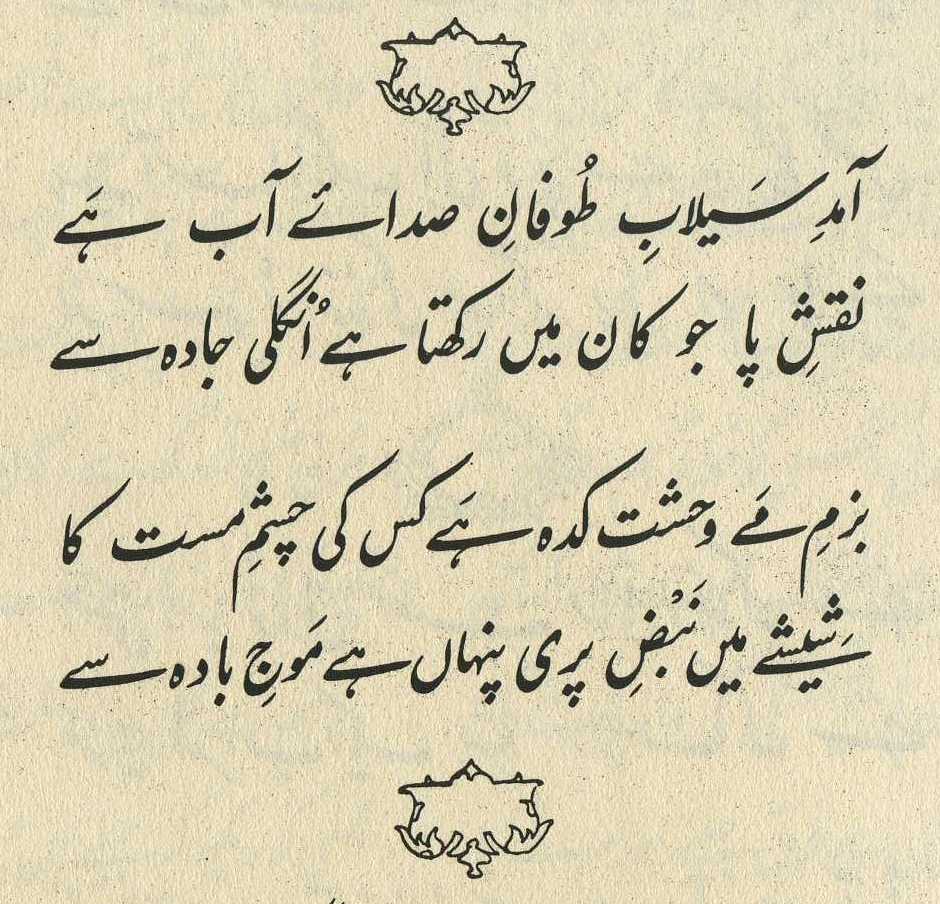
The meaning of 'of' is, whose intoxicated eye has made of the wine-house a wildness-chamber? And he has given for a wave of wine the simile of the pulse of a Pari so that the meaning will emerge that the Pari, having turned the wine-party into wildness/desolation, hid herself in the wineglass. (253)
== Nazm page 253

He says, 'The intoxicated eye of which beloved has made of the wine-party a wildness-chamber? Such that the wave of wine, the pulse of a Pari-faced one, has become hidden in the wineglass'-- as if a Pari, having made men wild, has become confined within a glass. (310)
A Pari hides from mankind. The pulse is within the body. In a state of wildness and madness the pulse becomes faster. A winehouse is a wildness-chamber, because when the drunkards drink, they are led astray. The wine-drinking party of the rakish ones becomes a wildness-chamber. But the poet says, whose intoxicated eye is this that has made it a wildness-chamber, since the Pari of the wave of wine is hidden? That is, the rakish ones have unrestrainedly made the whole gathering a wildness-chamber-- and not only that, but the wave of wine too, in the flagon, is trembling. The rakish ones have no care either for their own bodies, or for the wineglass and flagon. (458)
The structure of the verse can hardly fail to recall 1,1 , in which a similarly provocative question is posed in the first line. In both first lines, the relationship marked by the has all the ambiguity that an would. In the present verse, here are some of the ways we could read such a question:
=Whose intoxicated eye is enjoying the wine-party (as a participant)?
=Whose intoxicated eye is watching the wine-party (as an observer)?
=Whose intoxicated eye has generated the wine-party (as a creator)? (Compare 169,5 .)
And of course, calling the party a 'wildness-chamber' [] very clearly opens up the possibility that the owner of the 'intoxicated eye', whoever he may be, is also a madman (see the definition above), and is thus 'seeing' ravishing or terrifying visions that exist only in his own mind.
After such a first line, we wait with hope (but also somewhat grimly, since we know Ghalib) for clarification in the second line. When, after the delay imposed under mushairah performance conditions, we are finally allowed to hear the second line, it offers not a direct answer but an entirely unrelated statement: that in the wineglass, the pulse of a Pari is hidden by the wave of wine. But what exactly does that mean? Is the whole Pari there, or just her pulse? If her pulse is 'hidden' by the wave of wine, is that a tactic she's using, or a sign of her intoxication and powerlessness? Is she trying to achieve something in the wine-party, or trying to conceal herself, or just relaxing and getting drunk? For more on the possibilities of a Pari in a glass, see 227,4x .
Despite (and also because of) such questions, our first and largest task is to decide how to connect the two quite separate lines. Here are some possibilities:
=It is in fact the intoxicated eye of the hidden Pari that secretly controls (or observes, or enjoys, etc.) the wine-party.
=While it's the Pari herself who controls the wine and wineglass, who similarly controls the whole wine-party?
=The Pari seeks to control the wine-party, but is overwhelmed by the wave of wine and so is unable to do so-- so who has replaced her?
=The Pari provides the 'pulse' and heart for the wine-party, but who provides the 'eye' and mind?
=No one controls the wine-party, because the wine has the 'pulse of a Pari', meaning that it is able to possess the drinkers and drive them mad.
Strictly speaking, in Islamic story tradition only a Jinn can truly 'possess' people and make them do its bidding, speak with its voice, etc. But the fiery beauty of a Pari is also thought to be capable of driving a mortal mad. (For an amusing example, see Mihr Nigar's adventures in the Dastan of Amir Hamzah, chapter 46 .)
Compare the excellent 169,5 , which offers another view of a winehouse of the mind. And for a decidedly bleaker perspective, see 81,2 .
graphics/paripulse.jpg