Verse 21816aanahham
G1
1
he makes gatherings jumbled/overthrown, the card-player of Thought
2
we are the page-turning of the wonder/miracle/trick of a single idol-house
'Confused, jumbled together, turned upside down or topsy-turvy, entangled, spoiled; offended, angry, vexed, enraged, sullen'.
is an archaic form of ( GRAMMAR )
[of which ganjifah is a variant spelling]: * Glossary *
'A card-player; —a knave, trickster, cheat'.
'Turning, revolving, &c. (used as last member of compounds)'.
'Fascination, bewitching arts, wiles; magic, sorcery; deception; —deceit; trick; pretence; evasion; —freak; —a wonderful performance, a miracle; anything new or strange'.
| References | |
|---|---|
| Arshi, Imtiyaz Ali | Ghazal# 82 |
| Raza, Kalidas Gupta | 200-01 |
| Nuskhah-e-Hamidiyah | 138-139 |
| Asi, Abdul Bari | 157-158 |
| Gyan Chand | 252-254 |
| Hamid Ali Khan | Open Image |
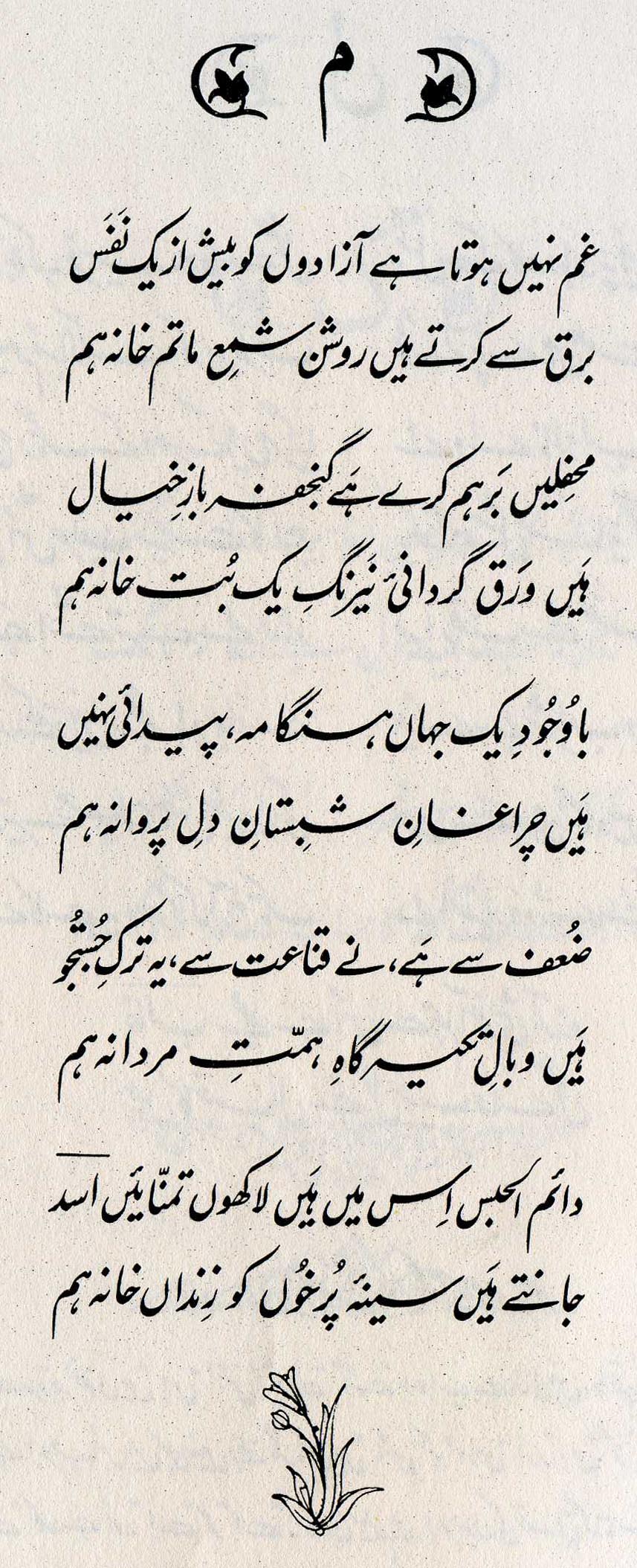
The gist is that gatherings of beautiful ones that have been broken up, always remain in our memory, as though we are the page-turning of the wonder of an idol-house. In this verse the page-turning of the cards has been given as a simile for the breaking up of pleasure gatherings, and it's a fresh simile. (82)
== Nazm page 82

The meaning is that gatherings of beautiful ones that have already been broken up, are still in my thought, and constantly remain in my thought. The 'page-turning' of cards means the way card-players repeatedly spread out the cards with their fingers and keep looking at them.... This simile is entirely new, and up to this day hasn't been seen in anyone else's poetry. (130-31)
He has called Thought a card-player and himself a 'page-turning', so that an interpretation of uncontrollableness has been created. That is, there is a sequence of pictures of former enchanting gatherings that uncontrollably pass before the gaze and then disappear. The way in an idol-house the glimpse of beautiful ones is now here, now gone. (170)
As in so many verses, the elegantly ominous first line gives no clue about where the second one might go. We are told of the activity of the 'card-player of Thought'-- and what he apparently does is shuffle the cards, 'overturn the gatherings'. We might identify ourselves with the powerful card-player, and savor the memory of the 'gatherings' we have known, even though they're gone. But of course, also means 'to confuse, to spoil, to make angry' (see the definition above). So the reshuffling of the cards, the breaking up of the 'gatherings', has ominous overtones.
In any case, under mushairah performance conditions we'd have to wait for a certain amount of time, before we were provided with the second line. And even after we'd heard it, we'd be left to decide for ourselves how it fits with the first line. (Are they two metaphorical views of the same situations? Two similar situations? Two contrasted situations? One cause and one effect-- and if so, which way round?)
Alas, that brilliantly bleak second line! The grammar is all too clear, and I can't see any way to escape it. We are not the card-player, we are not Thought itself (whoever or whatever it may be). What we are is the 'page-turning' process. We're not the shuffler, and not even the cards-- we're the shuffling. The momentary little patterns of our selves are constantly, meaninglessly rearranged by powers outside our comprehension. As a final touch, the scenes we consist of are not necessarily comprehensible (they are 'wonders' or perhaps 'deceits' or 'tricks'), and not even well-grounded-- they come from a 'single idol-house', a home of beautiful but false gods.
For a less terminally bleak view of a 'wine-house of thought', see 169,5 . For a thread that can bind together scattered pages (or even cards?) of our lives, see 10,12 . For another verse about the turning of pages, see 351x,1 .
Compare Mir 's take on humans as chess-pieces in an amateurish game being played by the sky: M 1297,2 .
The cards used for were varied in style. Here's a set that belonged to Warren Hastings:
graphics/ganjifah1.jpg
And here's a set of Mughal-style ones, perhaps from the Deccan, c.1850:
graphics/ganjifah2.jpg