Verse 11816aanahham
G1
1
grief is [habitually] not, to free ones, more than a single breath
2
with lightning, we light/'make radiant' the candle of the mourning-chamber
'Breath, respiration; --the voice or sound from the breast; --a moment, an instant (syn. )'.
| References | |
|---|---|
| Arshi, Imtiyaz Ali | Ghazal# 82 |
| Raza, Kalidas Gupta | 200-01 |
| Nuskhah-e-Hamidiyah | 138-139 |
| Asi, Abdul Bari | 157-158 |
| Gyan Chand | 252-254 |
| Hamid Ali Khan | Open Image |
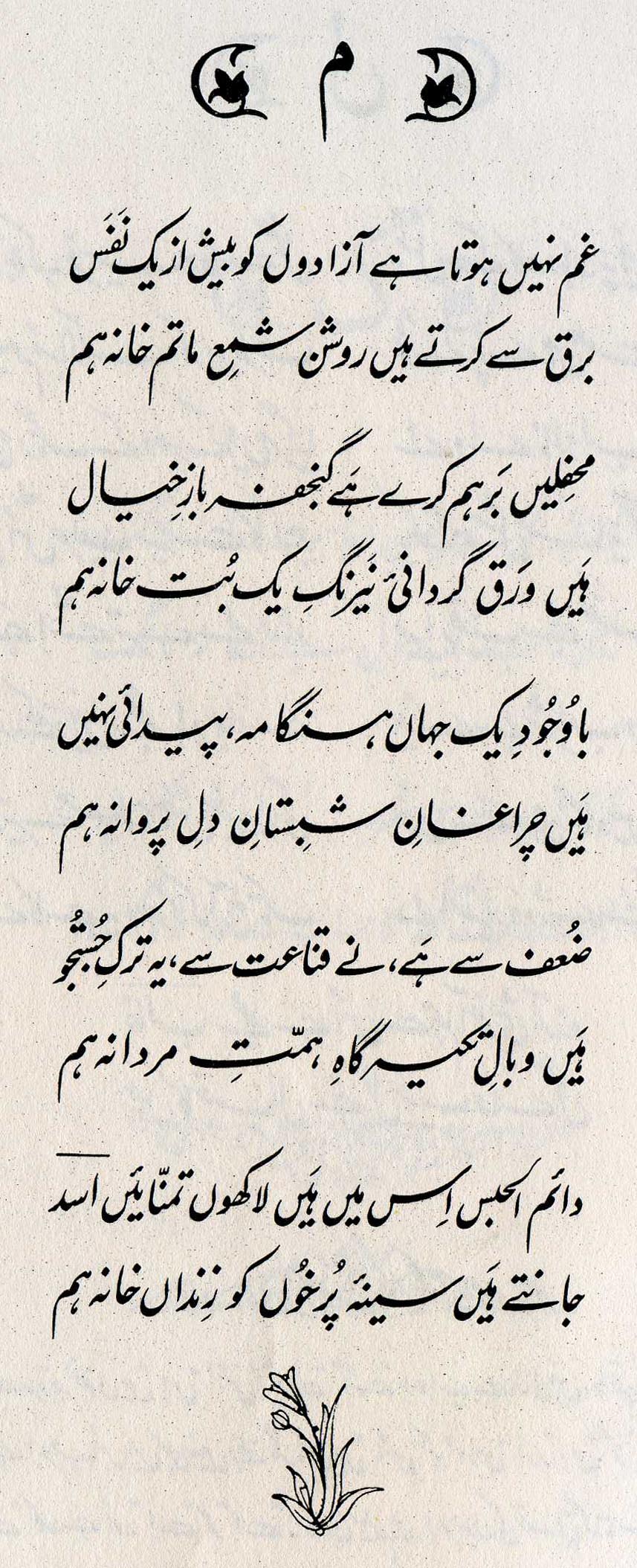
That is, if there is a candle in our mourning-chamber, then it is the lightning. When we don't grieve for more than a moment/breath [], then there's no need for light at all beyond a moment/breath. (82)
== Nazm page 82

It's clear that the flash of lightning doesn't last longer than a moment/breath []. Having declared us to be free, he proves in this way that 'grief is [habitually] not, for free ones, longer than a breath'. (75)
He says, we are free people. For us, the grief of the world is no more than a moment/breath []. As if in our mourning-chamber the lightning serves instead of a candle. The meaning is that the way lightning flickers for only a moment, in the same way, for us, the thought of grief comes and at once is erased; that is, its effect doesn't remain even for a brief period. (130)
People who are free don't grieve over misfortunes except for a moment/breath []. As if these people light the candle of the mourning-chamber with lightning. That is, the way lightning flashes for a moment and then vanishes, in the same way for those people, there is sorrow caused by the difficulties of the human condition, but only for a little while. (169-70)
This verse points to an uncommon state of affairs. We are free; that is, pure of worldly relationships. For this reason, grief too is unable to keep us captive for very long. Lightning falls on our mourning-chamber; we feel sorrow for a moment, but then at once return to our usual state of self-possession. And we acquire such control over our grief that with the lightning-brought fire we light the extinguished candle. Or we consider the flash of lightning to be the candle of the mourning-chamber. Or the fire started by the lightning becomes for us a means of removing the darkness.
Whether we call this verse exaltation or exaggeration, the intensity of arrogance and self-confidence that has been expressed in this verse; and for expressing it the glittering, or rather flashing, use that has been made of the candle lit by lightning in the mourning-chamber-- a similar example of this will not be easy to find. The following points are worth noting:
(1) Lightning flashes for a single momet. This vision of its speed of movement is established by 'more than a single breath' in the first line. The way our grief passes rapidly, in the same way the cause of this grief (the lightning strike) and the cause of its removal (the lightning flash) too are both unequalled in their rapidity of movement.
(2) The whole verse creates an image of radiance, sharpness, and speed. Between grief and pain there's a close relationship, and for pain too the metaphor of [a 'flash'] is used.
(3) Lightning, which is the cause of grief, is also the cause of its removal. The oneness of non-existence and existence, affirmation and negation, is scattered throughout all Ghalib's poetry. This verse is a beautiful example of it.
(4) One question that can arise is that if we are free, and we don't even feel grief for longer than a single breath, then in the second line what is meant by 'mourning-chamber'? 'Mourning-chamber' gestures toward the fact that we live in a house of melancholy and mourning. If this is the case, then what is meant by grief as lasting no longer than a single breath? To this question there are two replies. The first reply is that we light the candle of the mourning-chamber with lightning; this is proof that we feel grief for no longer than a single breath. As soon as the candle in our house is extinguished, and our house becomes a mourning-chamber, we invite the lightning to send down its fire. Lightning comes and sets fire to our house, making it illumined. The second reply is that 'mourning-chamber' is not used with its dictionary meaning, but rather in a metaphorical sense. In a 'mourning-chamber' there is no light, so any dark house at all can be called a 'mourning-chamber'.
(5) Another point is that the house is a mourning-chamber; accordingly, for the house it's a cause for grief that a candle should be lit, since light is the negation of the state of mourning. But for us, grief is no longer than a single breath. The proof is that we use lightning like a lighted candle. Now it's here, now it's gone. A single moment of light, then nothing but darkness.
== (1989: 98-99) 2006: 121-22
[See also his comments on M 866,8 .]
As Faruqi observes, this verse is truly nonpareil. His commentary shows what can be done simply (?) through close reading and careful attention. If you are fluent in Urdu, his whole commentary, Tafhim-e Ghalib , is the gold standard, and you'd be foolish not to make use of it.
All the other commentators that I've read follow the simple, short, one-dimensional track of Nazm, Hasrat, and the two Bekhuds: we free ones have a (non-specific) grief; we grieve for a moment; the lightning-candle measures, or signifies, the length of our time of grief. And that's the end of the matter, as far as they're concerned. For all five of these commentators, I've translated every word they wrote about this verse.
Unlike the other commentators, Faruqi opens up, and then explores, rich and multivalent possibilities. To consider merely the largest and most obvious question, what exactly is the role of lightning in the mourning-chamber? He suggests various possibilities, which are often not mutually exclusive:
=Lightning is the cause of our grief in the first place. This idea is not at all far-fetched; see for example 10,6 or 12,1 , in which lightning sets fire to the (literal and metaphorical) 'harvest'. If lightning sets fire to our house, the house itself will become a 'mourning-chamber' for us as we grieve over its destruction.
=Lightning is used to light the candle that illuminates the mourning-chamber. We free ones have such power that we can seize and use the lightning itself to light our candle. A great, dangerous natural power is dominated and controlled by our will. (This interpretation takes the second line of the verse literally.)
=Lightning itself takes the place of a candle, illumining the mourning-chamber. This interpretation takes the second line of the verse more metaphorically. We use the lightning itself as our candle, because we only need the light for a moment anyway-- either for experiencing our grief (as the other commentators would have it), or for symbolically demonstrating the end of our grief (as Faruqi would suggest).
=The fire that lightning starts in our house we treat as a 'candle' since it removes the darkness of our mourning. A burning house, after all, is a convenient source of light, and the fire will serve as well as any other light to demonstrate that the time of our mourning is over.
Faruqi's greatest contribution is his suggestion that lightning itself should be taken as the source of the 'grief' in the first place. That possibility complicates (and enriches) our understanding of the verse remarkably. Moreover, while the other commentators assume that the lighting of a candle in the mourning-chamber is a sign that mourning is taking place, Faruqi assumes that it's a sign that mourning is over. (Since mourning goes on for only a moment anyway, these two cases can in fact hardly be distinguished.) Whichever assumption we adopt, Faruqi pushes the verse into new subtleties in ways that Ghalib would surely have approved.
For another 'candle of the mourning-chamber', see 258x,4 .
graphics/lightningflash.jpg