Verse 11x1816aanahham
G1
1
the longing/grief of the presentation/breadth of desire/longing ought to be understood from this/'here'--
2
we are a 'two-worlds' Doomsday of dry/parched tongues-- like a comb
'Grief, regret, intense grief or sorrow; —longing, desire'.
'Presenting or representing; representation, petition, request, address; ... —Breadth, width'.
'Wish, desire, longing, inclination ... , request, prayer, supplication, petition'.
'Gathering, meeting, congregation, concourse; the resurrection; —commotion, tumult, noise (such as that of the resurrection); wailing, lamentation'.
'A comb; a (cock's) comb, a crest ... ; the shoulder-blade'.
| References | |
|---|---|
| Arshi, Imtiyaz Ali | Ghazal# 82 |
| Raza, Kalidas Gupta | 200-01 |
| Nuskhah-e-Hamidiyah | 138-139 |
| Asi, Abdul Bari | 157-158 |
| Gyan Chand | 252-254 |
| Hamid Ali Khan | Open Image |
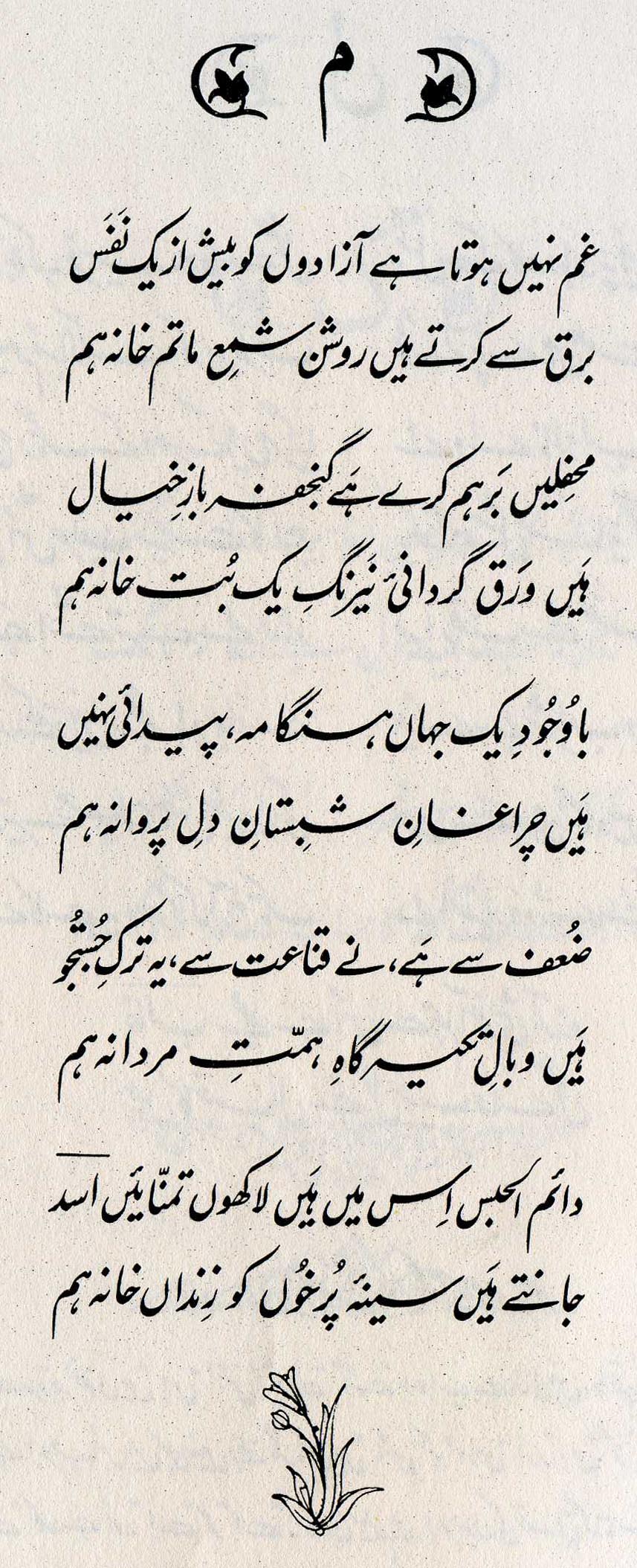
If you want to know the state of our , then know it from this: that like a comb that despite being provided with a thousand tongues has become a 'two-worlds Doomsday' of a dry tongue, similarly we too are silent. The tongues of the comb are its teeth; 'a two-worlds Doomsday of a dry tongue' has been said because of its two faces/sides.
== Asi, p. 158
He says that the way that in a comb thousands of dry tongues are brought together, in the same way we too have become an embodied gathering of dry tongues. From exactly this our can be estimated. But it is not established/proved that the poet is a 'Doomsday of dry tongues'. If his whole body-- or only the heart and liver-- were somehow found to be torn to pieces, then this simile could be proper.
== Zamin, p. 224
We want to present our petition in the presence of the beloved. The extent of this longing can be guessed from the fact that our tongue is dry like a comb; that is, this condition resulted from not being able to speak, and because of not being able to speak there's great restlessness. A comb has many 'tongues', but dry ones-- that is, it too writhes with the longing to speak.
== Gyan Chand, p. 254
For background see S. R. Faruqi's choices . For more on Ghalib's unpublished verses, see the discussion in 4,8x . This verse is from a different, unpublished, formally identical ghazal, 313x , and is included for comparison. On the presentation of verses from unpublished ghazals like this one along with formally identical divan ghazals, see 145,5x .
The phrase is one of a group of and constructions that emphasize sweepingness and magnitude; for discussion, see 11,1 . A 'two-worlds Doomsday' works well as an image, because Doomsday will be the end of both worlds (and more, if there are any more).
A comb has many teeth, or 'tongues', but they're all dry and stiff and immobile, so even in their desperate, urgent, jammed-together numerousness they're useless for speaking-- and calling them 'dry' suggests that they are 'thirsting' for speech.
The wordplay is also enjoyable: is a word with both verbal ('petition, plea') and spatial ('breadth, width') meanings. The former sense is picked up by ('prayer, petition'), and the latter sense by (literally, 'from here').
It's annoying that and have such overlapping meanings. In modern usage especially, both almost always mean 'longing'. This makes the first line sound tautological and vague, as if it relied on padding. But perhaps in Ghalib's day the different dimensions of their meanings (see the definitions above) were more commonly invoked.
graphics/comb.jpg