Verse 51816aanahham
G1
1
they're in 'life imprisonment' in it, all the hundreds of thousands of longings, Asad
2
we consider our blood-filled breast [to be] a prison-house
Wish, desire, longing, inclination ... ; request, prayer, supplication, petition'.
'To be performed, or accomplished, or effected ... — to come out or forth, to issue, to emerge; to appear'.
| References | |
|---|---|
| Arshi, Imtiyaz Ali | Ghazal# 82 |
| Raza, Kalidas Gupta | 200-01 |
| Nuskhah-e-Hamidiyah | 138-139 |
| Asi, Abdul Bari | 157-158 |
| Gyan Chand | 252-254 |
| Hamid Ali Khan | Open Image |
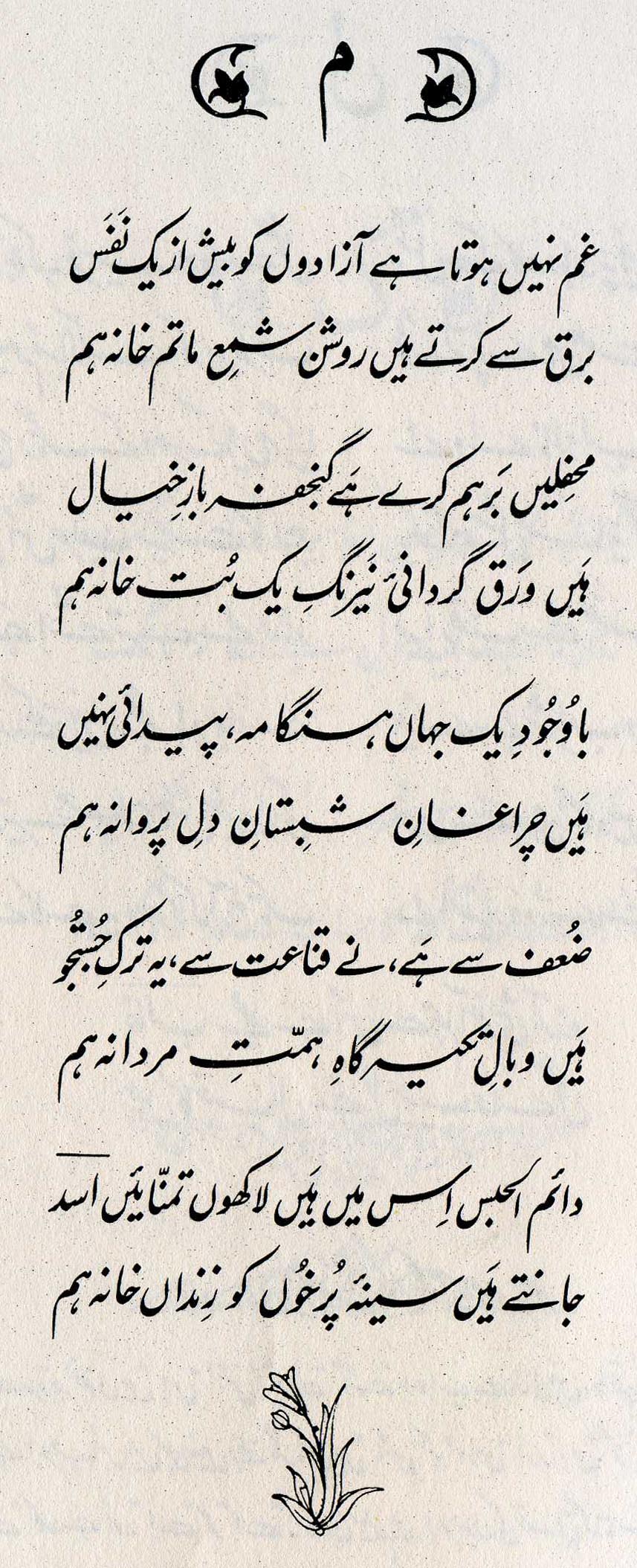
Those longings that will never {emerge / be fulfilled} [], he has construed as 'life-prisoner' inmates. (82)
== Nazm page 82

He says, 'We consider our blood-filled breast to be a jail-house []'. Because in our breast are all the hundreds of thousands of longings have been imprisoned for a whole lifetime; neither has any {emerged / been fulfilled} []so far, nor can any hope be held out of any of them {emerging / being fulfilled} [] in the future, for the whole life long. The meaning is that many longings are in our heart such that their emergence/fulfillment depends only on the grace of the Lord. (131)
He has called them 'life-prisoners' because those longings were never fulfilled []. Our blood-filled breast is a prison-house, in which all the hundreds of thousands of longings are imprisoned forever. (171)
And after the baroque, fascinating, heavy-duty verses {81,1-3}, and the cryptic {81,4}, here comes our light relief: an enjoyable little mushairah verse. We can't tell what's being referred to in the first line, and must wait (under mushairah performance conditions) in some perplexity for the second. Even then, we don't receive full information until the very end of the line. But then suddenly when we've got it, we've got it, and there's no need for further reflection. These qualities, by my definition, are the very essence of a 'mushairah verse'.
The verse makes enjoyable use of bureaucratic terminology: the fancy Arabic-based officialese of . It's something like 'life imprisonment', except that it refers to the 'life-prisoner' who is never to be released. To apply it to a set of longings imprisoned in a blood-filled bosom is entertaining in itself. This is the only occurrence of the expression in the divan , so perhaps it deserves some ' fresh word ' credit as well.
Moreover, there's the deftly invoked and exploited, 'doubly activated' meaning of (see the definition above)-- both 'to emerge' (as would a prisoner), and 'to come true, to be fulfilled' (as would a longing). For a famous example of wordplay involving both meanings, see 219,1 . Most piquantly, the word itself doesn't even appear-- and yet its presence, hovering over the verse, is strongly felt, and is reflected in the commentary (both Nazm and Bekhud Dihlavi in fact use the word). The wordplay of is what energizes the doubly morbid idea that the longings will never 'come out' of their prison, nor will they ever 'come true'. Another examples in which the double sense of is implied: 132,3 .
The clever use of gives a finishing touch to the verse. Anybody could speak of 'lakhs of longings', hundreds of thousands of them. But the oblique plural ending specifically shows completeness-- 'all the hundreds of thousands'. It thus nicely reinforces the idea that none of them ever have come out; the whole supply of them, all that ever existed, are still trapped there, clamoring and suffering and filling the breast with blood, like prisoners banging vainly on the bars.
graphics/prisoncell.jpg