Verse 13x1816aanahham
G1
1
the wildness/madness of the disconnectedness/incoherence of the twists and turns of existence-- don't ask!
2
we are a disgrace/honor of growth/flourishing, like a hair of a madman's/mad head
'A desert, solitude, dreary place; —loneliness, solitariness, dreariness; —sadness, grief, care; —wildness, fierceness, ferocity, savageness; barbarity, barbarism; —timidity, fear, fright, dread, terror, horror; —distraction, madness'.
'Honour, esteem, reputation; —shame, disgrace, infamy, ignominy'.
'To grow, to wax great'. (Steingass p.151)
| References | |
|---|---|
| Arshi, Imtiyaz Ali | Ghazal# 82 |
| Raza, Kalidas Gupta | 200-01 |
| Nuskhah-e-Hamidiyah | 138-139 |
| Asi, Abdul Bari | 157-158 |
| Gyan Chand | 252-254 |
| Hamid Ali Khan | Open Image |
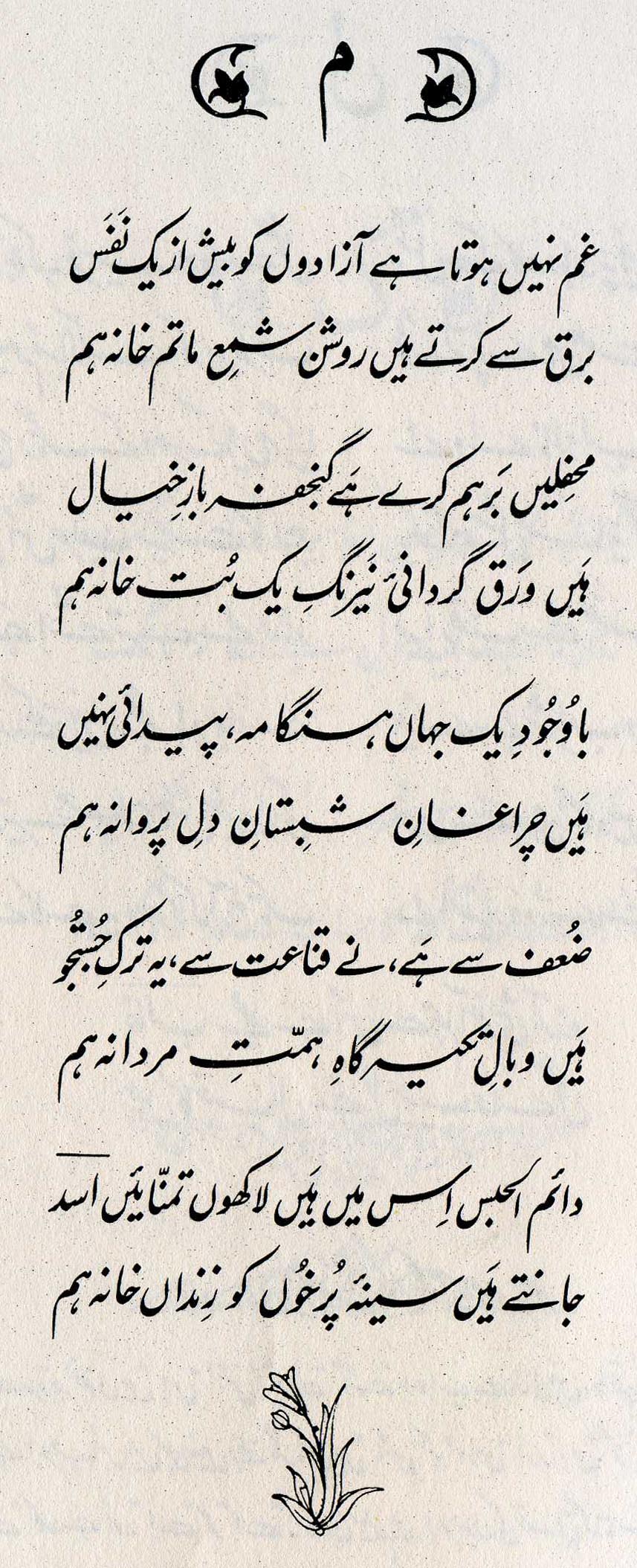
Why do you ask us about the wildness of the disconnectedness of the twists and turns of existence? Like the hair on a madman's head, their growth/flourishing is a cause for disgrace. That is, the way in the hair of madmen there are tangles and twists and turns, in the same way there are twists and turns in our existence-- and because of this very disconnectedness, wildness has occurred, because of which we are a disgrace to growth/flourishing.
== Asi, p. 158
If the hair would go on growing, then it's also necessary to keep it clean and trim with a comb and brush. This is madness: that a person would not be aware even of his body. Then, the person the events of whose life would be tangled like the hair of a madman's head-- his gro wing to maturity, his childhood and youth and old age, if they are not the growth/flourishing of a madman's head, then what are they?
[There are also Sufistic possibilities.] For the world of existence, our advancements are causes of disgrace in exactly this way-- the way a madman's grown-out hair makes his appearance even more wretched. So to speak, we are the grown-out, tangled hairs on the head of disconnected existence.
== Zamin, p. 225
In existence there are many twists and turns, there's a great disconnectedness, there's a unique state of wildness/madness. We ourself are an example of the disconnectedness of existence. The way the hair of a madman's head is constantly tangled and dirty, in the same way we too are a disgrace to existence.
== Gyan Chand, p. 255
For background see S. R. Faruqi's choices . For more on Ghalib's unpublished verses, see the discussion in 4,8x . This verse is from a different, unpublished, formally identical ghazal, 313x , and is included for comparison. On the presentation of verses from unpublished ghazals like this one along with formally identical divan ghazals, see 145,5x .
The first line uses the 'inexpressibility trope'. We shouldn't ask about the chaotic 'wildness' of life-- but why exactly? Is it so inexpressibly cruel and evil, something unjustly inflicted on us from outside? Or is it something neutral and inevitable, something we choose when we choose the lover's way of life, and thus to be (ruefully) accepted without discussion? Or is the inexpressibility simply hyperbolic ('The speed of the train? Don't even ask!')? And what exactly is it we're not supposed to ask about in the first place-- the 'wildness' in itself (whatever that may be); or the general way that life happens to us (like 'drinking from a firehose' perhaps); or something about our reaction to this kind of life?
The second line adds one more question: is the situation depicted in the first line something that reflects either 'shamefully' or 'honorably' (through the multivalence of ) on us? The 'shame' side of appears more prominent no doubt: a madman's hair is disgracefully and barbarously tangled. But surely the 'honor' side hovers in the background: the way the madman's tangled hair keeps growing even under difficult conditions could be seen as a tribute to the principle of 'growth/flourishing' itself. For more on the nuances of , see 3,5 .
In addition, it's an 'A,B' verse, so that we have to decide for ourselves how to connect the two lines. Do both lines describe the same situation, in different metaphorical terms? Or do the two lines describe three similar situations (life, ourself, a madman's hair)? Or do they envision a kind of contrast-- life does certain things to us, but we react in certain ways? Or is one line a cause and the other an effect? (And if so, which way around?)
And on top of that, the verse is crammed with fully five constructions, each of which opens out into a series of possibile connections (identity with? possession of? cause or effect relationship with? some other kind of association?). For more on this, see 16,1 .
Moreover, the particularly wide range of meanings of (see the definition above) works effectively to keep open all these ambiguities. It's a state, after all, that can be located either in the world, or in the human psyche. It can range from 'fierceness' to 'fear', from 'sadness' to 'barbarousness'.
Interpreting verses like this is like following along through the twists and turns of life, or tracing out the tangles of a madman's hair.
graphics/tangledhair.jpg