Verse 3x1816aadahse
G1
1
I see, through the wildness/madness of ardor that is bent upon turmoil
2
an omen/augury of disgrace, from the tears of the head that is given over to the desert
'An omen, augury, presage'.
'Given, bestowed, imparted; —having given (used chiefly in comp., e.g. , 'heat-imparted,' inflamed)'.
| References | |
|---|---|
| Arshi, Imtiyaz Ali | Ghazal# 175 |
| Raza, Kalidas Gupta | 249 |
| Nuskhah-e-Hamidiyah | 263 |
| Asi, Abdul Bari | 267 |
| Gyan Chand | 390-391 |
| Hamid Ali Khan | Open Image |
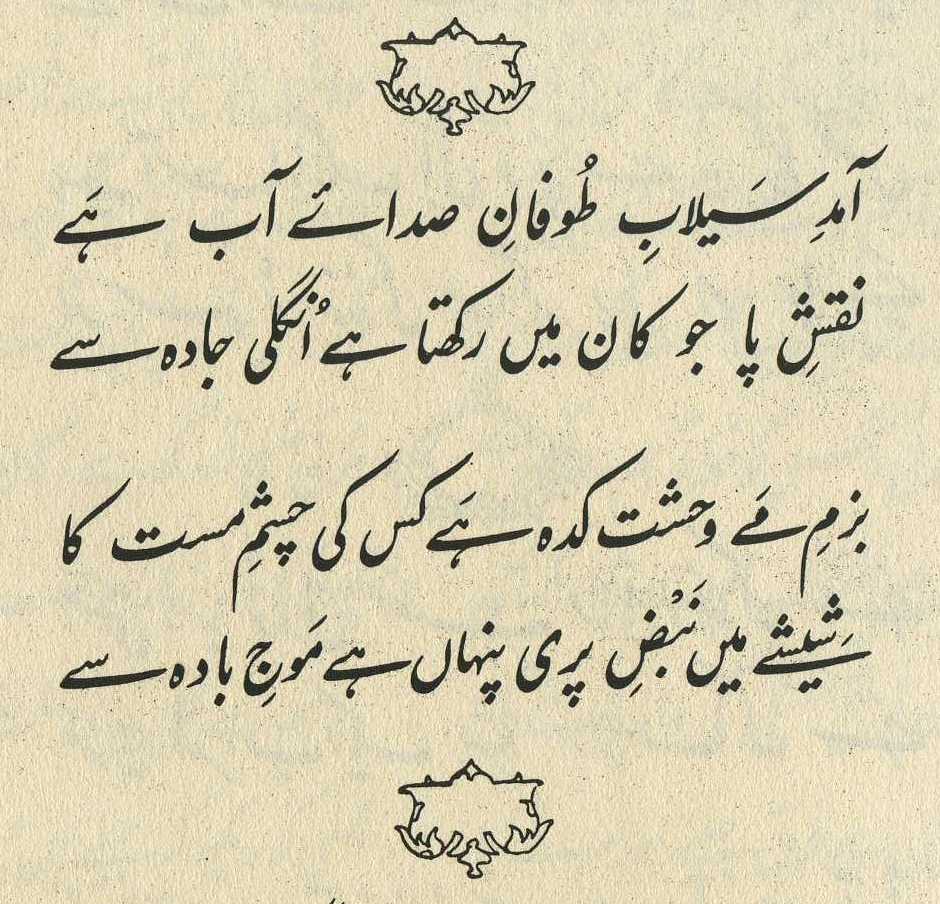
That ardor that is bent upon turmoil and agitation-- because of its wildness, I am finding the signs of disgrace. Because the situation is that tears are flowing to such an extent that they have reached to the wilderness, and it's obvious that now my condition will become apparent to the world. For this reason the omen of disgrace is visible.
He has composed in one or two other places as well: 194,2 .
== Asi, p. 267
In the head, the wildness of ardor has gathered, and is bent upon turmoil. By way of a gift, I flung the water of tears on the desert, and looked at the omen. The omen turned out to be: 'Wildness/madness will make you disgraced!'.
== Zamin, p. 390
The madness fomented by turmoil and confusion is at full force. Tears are flowing in such abundance that they have created the aspect of a wilderness []. Madness too will draw me toward the wilderness. And from both of them-- that is, the madness of passion and the flowing tears-- signs of disgrace can be seen. = intent on the desert.
== Gyan Chand, p. 390
For background see S. R. Faruqi's choices . For more on Ghalib's unpublished verses, see the discussion in 4,8x .
This opening-verse is the first of three verses in this ghazal that use the same rhyme -word: it is joined by 223,4x and 223,5x (though in the original ghazal they were not all sequential). It's not so unusual for Ghalib to use the same rhyme-word twice in a ghazal, but three times is extraordinary.
There's got to be some kind of wordplay and meaning-play going on here with the idea of the tears and the desert (compare the brilliant 17,2 ). Is it that the 'head that has been given over to the (dry) desert' is, paradoxically, the source of the (wet) tears? In any case, as Gyan Chand points out, to be 'given over to' the desert means to be intent upon it, focused on it. Could there have been some kind of divination that involved tears?
Or if we redo the groupings, is it that the tears themselves are described as having 'heads that have been given over to the desert'? The groupings are also flexible in the first line (is it the 'wildness of ardor' that has 'come into turmoil', or is it the 'wildness' of 'ardor that has come into turmoil?), but there it doesn't seem to make any appreciable difference. If it's the tears that have given themselves over to the desert, is that a form of death-wish?
There may be something specific about the process of taking omens [] that Ghalib meant to evoke. If so, knowledge of it was apparently gone before the commentarial tradition began.
graphics/deserttears.jpg