Verse 21816aar-ebistar hai
G2
1
the teardrop with/of the given-to-the-desert head is the light of the eye of the garment-hem
2
the heart that has fallen helpless/'hand-and-footless' is the glory/beneficiary of the bedding
'Without hands and feet'; without power or authority; without resources; helpless'.
'Fallen, lying flat or horizontally; lying waste or untilled (land); poor, wretched, helpless'.
'Breast, bosom, chest... ; --fruit'.
'Happy, enjoying long life and prosperity; receiving a daily allowance; glorying, boasting'. (Steingass p. 172)
'Prosperous, successful, happy, enjoying long life and prosperity; blessed with a family of sons; --male issue, son, child'.
| References | |
|---|---|
| Arshi, Imtiyaz Ali | Ghazal# 160 |
| Raza, Kalidas Gupta | 266-267 |
| Nuskhah-e-Hamidiyah | 243 |
| Asi, Abdul Bari | 240 |
| Gyan Chand | 372-373 |
| Hamid Ali Khan | Open Image |
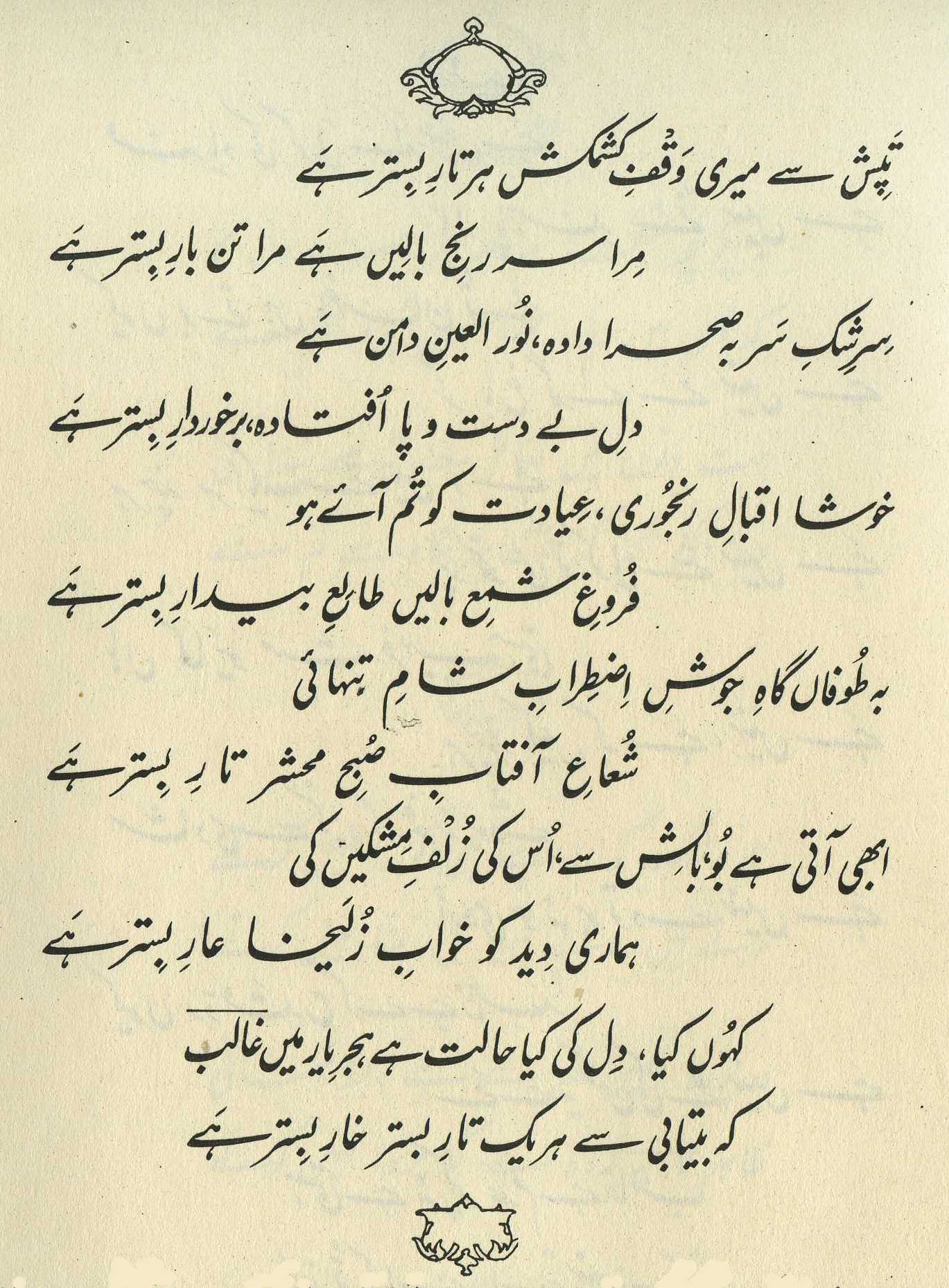
The tear is the pupil of the eye of the garment-hem, and the bedding is the desired object of the invalid; that is, the tear always remains in the garment-hem; and from the sick heart's always remaining fallen on the bedding, it has acquired affection for the bedding. (217)
== Nazm page 217

He says, 'Every one of my tears is the pupil of the eye of the garment-hem; and my sick heart has become the cherished offspring of the bedding'. The meaning is that because of excess of weeping, the garment-hem has acquired affection for the tear; and the bedding of sorrow has come to have heartfelt affection for the sick heart. (277)
The tear, which always keeps desert-wandering in the wilderness of the garment-hem, is the pupil of the eye of the garment-hem; and my heart, sorrowful and oppressed, is the cherished one of the coquetry of the bedding. That is, I always remain sick and always weep; the tears keep falling on the garment-hem, and the oppressed heart can't move from the bedding-- as if for the tears the garment-hem, and for the heart the bedding, are the embrace of a mother.... Saying 'light of the eyes' is also because the glance goes afar off; thus its being lowered with the force of the tears makes this desert-wanderer the light of the eye of the garment-hem. (383)
'Desert' and 'garment-hem' indeed have a wordplay , because they say 'the outskirts of the desert' [], but... in this verse there's no cause to suppose that 'garment-hem' is a metaphor for 'desert'....
The weeping person's intention or thought was that he would weep so many tears that they would become a stream of tears and reach to the desert. Or the tears would have emerged so forcefully that it would be as if their intention would reach to the desert. But they came only to the garment-hem and stayed there. Their coming to the garment-hem and staying there can be that in reality the tears didn't have enough strength to reach to the desert. Or else that the garment-hem was so wide that the tears got lost in the midst of it. In both cases, the poet's tone can be called sarcastic; and this sarcasm is directed toward himself. The tears remained only in the garment-hem, as though they were very dear to the garment-hem....
In Urdu they use to mean 'offspring' or 'dear son'. But in Persian this meaning doesn't exist.... is a Persian construction. According to Ghalib's point of view, to suppose that in this construction the Urdu meaning is present will be entirely incorrect.... Ghalib's opinion was that if a Persian word would come to have an Urdu meaning, then it shouldn't be in a [Persian] construction.... Thus keeping in view Ghalib's normal practice, in this verse the term ought to be considered to have its Persian meaning alone.
In various Persian dictionaries [the meanings include:] (1) happy and prosperous; (2) having a long life; (3) receiving a daily stipend; (4) proud and boastful; (5) household goods, utensils, etc.; (6) one whose desires have been fulfilled and whose needs have been satisfied; (7) obtaining advantage from, receiving from, somebody (Steingass, , ).... For the verse under discussion, the most suitable meanings are (3) and (7)....
But neither should the Urdu meaning of be neglected. A son is also called a 'light of the eyes'. Thus between and [as son] there's the pleasure of a . Ghalib's mischievousness has taken advantage of the word [as , 'paternal grandfather'] as another as well....
Both lines are divided into two parts, and the first parts of both lines are metrically identical, and internally rhymed ( , ); in this way an attractive parallelism arises in the verse....
The teardrop emerges from the eye, and there is water in it. In this regard to call the tear the 'light of the eye' gives extra pleasure. One of the special features of the heart is 'fallenness' []; in this regard, to call the heart 'hand-and-footless' is also not devoid of pleasure.
== (1989: 316-19) 2006: 345-48
The two lines are intriguingly parallel, in ways that help the reader put them together. As an extra treat, the first line has , and the second line has - , in the same metrical position: one that spans the midpoint of the line. The effect is to give the verse a particularly rich sense of internal rhyme.
The body wordplay is obvious: 'teardrop'; 'head'; 'eye'; 'heart'; 'hand and foot'; 'breast' []; there's also almost another 'head' [] in 'teardrop', for was also sometimes pronounced , and whether or not the aural rhyme existed, the visual wordplay would remain intact. Other forms of wordplay are pointed out by Faruqi.
The verse is awkwardly constructed. Both lines seem to depict the plight of a worn-out, debilitated lover who can no longer wander madly around the desert, scattering tears everywhere. Now he can only sit with lowered head, shedding tears into his own garment-hem, or lie helplessly in his own bedding. Both the garment-hem and the bedding are imagined as delighted with the lover's presence. (Compare the very different relationship between the lover and the bedding in the previous verse, 194,1 .)
But how much do we care what the garment-hem and the bedding feel? More to the point is the question of how the speaker (who may or may not be the lover himself) feels, and how we in the audience are meant to feel, about the lover's worn-out condition. In 81,4 , such mortal weakness is unmanly and contemptible. In 51,3 , the dying lover is a 'martyr to faithfulness' who deserves praise and congratulations. In the present verse, it's impossible to detect any such feeling-tone; and really the verse isn't powerful enough to inspire any great interpretive efforts.
For another use of , see 223,3x .
graphics/bistar.jpg