Verse 41816aar-ebistar hai
G2
1
in the typhoon-place of the turmoil of the agitation of the night of solitude
2 a
a thread of the bedding is a ray of the sun of the dawn of Doomsday
2 b
a ray of the sun of the dawn of Doomsday is a thread of the bedding
'Agitation, perturbation, restlessness, distraction, anxiety, anguish, trouble, chagrin; precipitation; flurry'.
'A place of assembly or congregation; ... the day of the place of congregation, the day of judgment'.
| References | |
|---|---|
| Arshi, Imtiyaz Ali | Ghazal# 160 |
| Raza, Kalidas Gupta | 266-267 |
| Nuskhah-e-Hamidiyah | 243 |
| Asi, Abdul Bari | 240 |
| Gyan Chand | 372-373 |
| Hamid Ali Khan | Open Image |
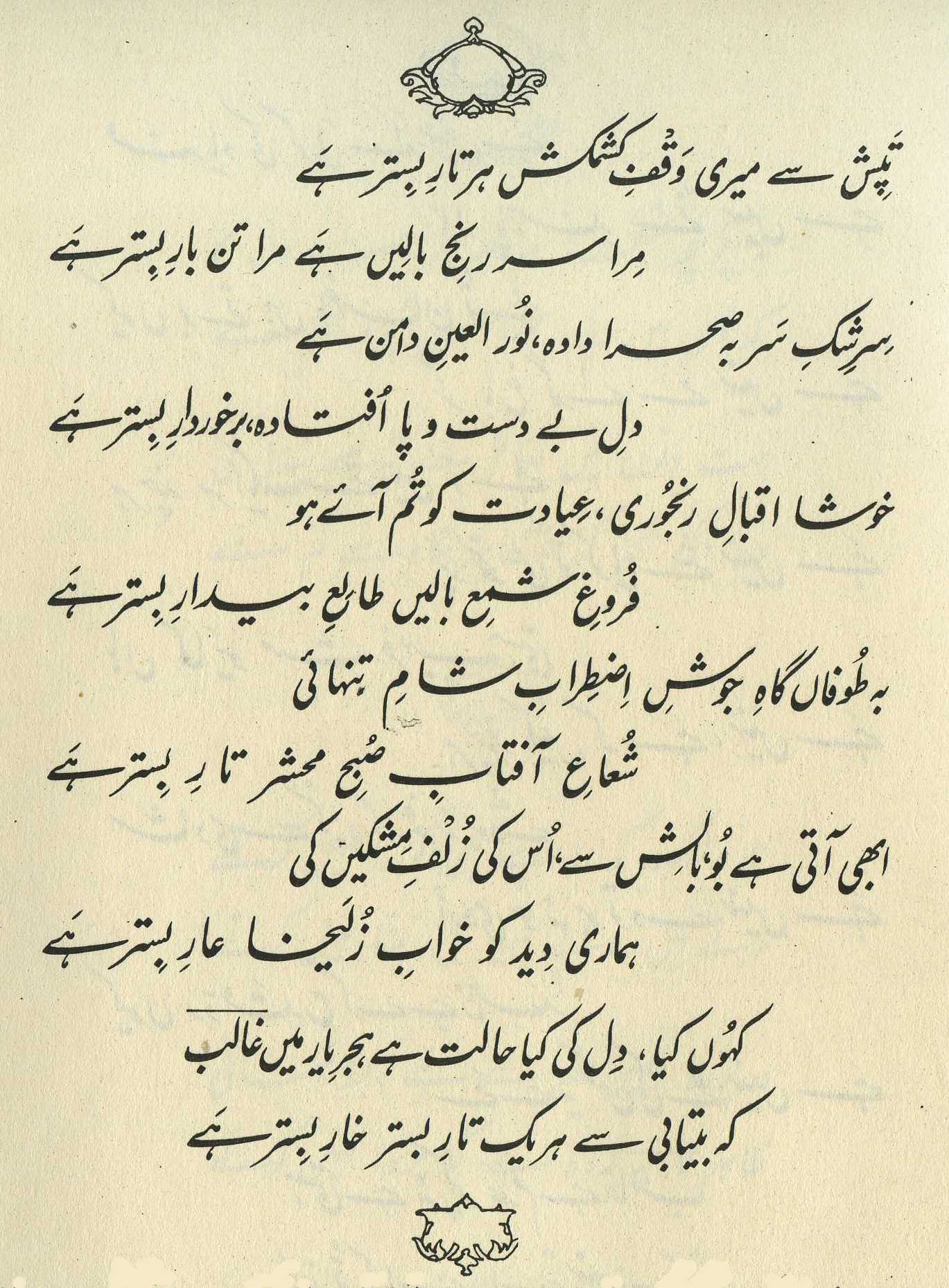
In the first line there are four constructions one after the other, and in the second line there are three; and in Urdu the itself is an imitation [of Persian], not that there would be so many of them in a row! For there to be more than three constructions is among the faults, but nevertheless these don't seem as bad as the in . But even this isn't as bad as the use of a Persian verb in an Urdu construction-- for example, in [the second line of 88,3 ]; or in [the second line of 15,7 ]....
The meaning of the verse is that in the night of grief there is so much agitation and darkness that it's as if every single thread of the bedding is a ray of the sun of Doomsday. Every single white thread is glittering in that darkness the way a ray of sun does-- but this ray is of the sun of Doomsday, because of the turmoil of restlessness. (218)
== Nazm page 218

He says, 'In the night of separation there is so much agitation, and such darkness, that every single thread of the bedding has become a ray of the sun of the dawn of Doomsday'. That is, every single white thread in this dark night is glittering the way a ray of the sun glitters. But this ray is a ray of the sun of Doomsday, because the turmoil of restlessness has become present in it. (277)
[Disagreeing with Nazm:] Poets of that time used to use such a without hesitation. And even today in the work of the elders of Lucknow it sometimes passes before our eyes. It's true that the rule has been accepted that to have more than three constructions in one place is a fault. But it's hard to find rules that would govern in every situation. Where constructions seem heavy to judges of poetry, they are faults; and where they would increase the glory of the poetry, to call them faults is no proof of poetic judgment. First the poetry ought to be considered, as to whether in hearing or reading it seems bad or not. (384)
This verse is structurally very similar to the previous one, 194,3 . In each case the first line sets up a situation, and the second line provides an extremely elaborate, baroque, 'A is B' illustration of that situation. In each case, the equation in the second line includes a total of four constructions. In each case one term of the equation is the lover's bedding; but that's hardly surprising, since it's the refrain of the whole ghazal. In each case the other term of the equation is something unexpectedly bright and radiant that is juxtaposed strikingly with situations associated with 'bedding'-- with sickness, ill-fortune, darkness, sleep or the restless lack thereof.
If placed beside the previous verse, however, this one shines like-- well, a ray of the sun of the dawn of Doomsday. It makes a much richer and poetically more compelling effect-- not at all by virtue of its structural properties, but by virtue of its theme and semantic context. In {194,3}, the second line is devoted to celebrating the astonishing fact that the beloved has come to visit the sick lover. Such a visit is a fine thing no doubt, but it's limited in its possibilities and meanings; even if we suppose the beloved to be God, a polite sickbed-visit from God is not the most thrilling possibility the imagination could entertain.
In the present verse, by contrast, the two lines offer a far more complex set comparisons. The differences are marked: the 'typhoon' (line 1) is contrasted with the 'sun' (line 2); the 'night' (line 1) with the 'dawn' (line 2); 'solitude' (line 1) with an 'assembly' or 'gathering' (line 2). But the similarities are also strong: the 'turmoil' and 'agitation' of the lover's night (line 1) are also conspicuous qualities of Doomsday (line 2).
And above all, the 'A is B' equation becomes incomparably richer in the present verse. The commentators prefer (2a), the more straightforward reading: the darkness of the lover's night is so radical and complete that even the dim whiteness of the bedding glimmers in his eyes like the dazzling light of the intense sun that will rise on Doomsday.
But how sad that they overlook the chilling, thrilling reverse reading of (2b), in which the lover's night of darkness, turmoil, and agitation is so intense that by comparison he hardly notices the coming of Doomsday-- the dawn of the Doomsday sun is, to him, no more than the dim gleam of one more thread in his bedding. (Doomsday-rays as bedding-threads are thus trivial and humble companions; they are small means in his pursuit of far more important ends.) The equation of Doomsday-rays with bedding-threads can be either a metaphor (this is how he himself perceives things) or else, more strikingly, a flat statement of cosmic reality. Compare for example 62,8 .
graphics/threadsun.jpg