Verse 31812aakahu;N
G3
1
I, and a hundred thousand liver-rending songs/voices
2
you, and that single non-hearing, such that-- 'What can I say?!'
'Voice, sound; modulation; song; air'.
'To hear, listen, attend to; to obey'. (Steingass p.764)
| References | |
|---|---|
| Arshi, Imtiyaz Ali | Ghazal# 86 |
| Raza, Kalidas Gupta | 134-36 |
| Nuskhah-e-Hamidiyah | 143-144 |
| Asi, Abdul Bari | 163 |
| Gyan Chand | 260-261 |
| Hamid Ali Khan | Open Image |
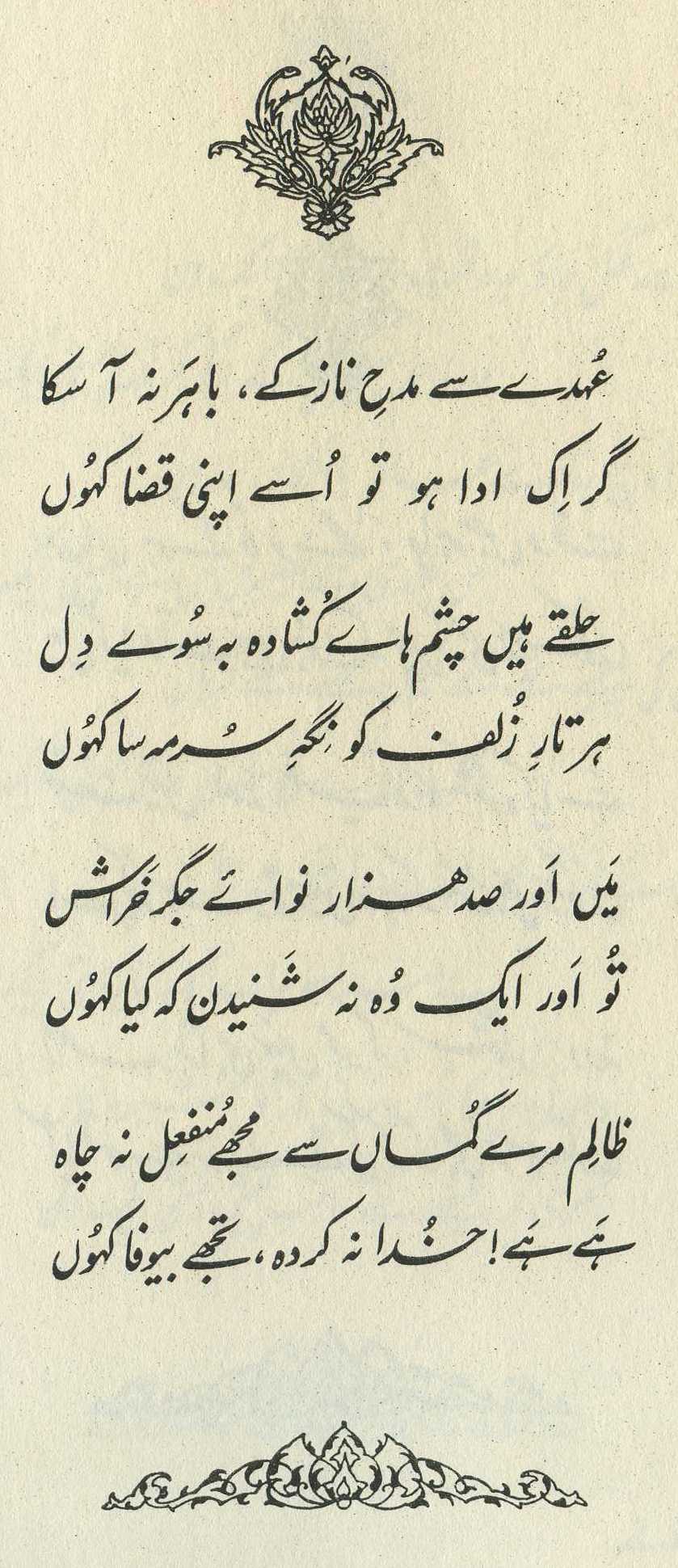
From this verse one ought not to wrongly think, 'A person like Ghalib-- and to make this kind of error in Urdu and Persian! One which the rawest of beginners, and the most rustic of rustics, would not consider correct!' In a context of sarcasm, the shortening of words seems good. Consider that the author has here said -- but this interpretation is far-fetched, there's no doubt of that. (88)
[See also his comment in the discussion of 194,4 .]
== Nazm page 88

He says, 'I am, and hundreds of thousands of liver-rending laments. You are, and a single obliviousness [] that I cannot express.' (139)
When 'in a context of sarcasm the shortening of words seems good', then what's the meaning of declaring this interpretation to be 'far-fetched'? Nor has any reason at all been presented [by Nazm] for declaring that is only Hindi . (181)
The clever hatchet job done by Nazm, as he pretends to defend Ghalib against other critics, is amusing to read. As usual, it's duly objected to by Bekhud Mohani. The issue here is that Ghalib has converted the Persian , 'non-hearing', which begins with a long syllable, into his own invented form , which does not. This is the kind of obviously rule-breaking liberty that native speakers take when they feel playful or innovative. Since Ghalib always claimed for himself (and for no other Indian) the creative freedom of a native speaker of Persian as well as Urdu, such a liberty is not surprising.
This one would also make a good mushairah verse, since it packs such a terrific wallop right at the end. The two lines contrast each of their elements: 'I' versus 'you'; 'a hundred thousand' versus 'one'; powerful utterances versus a radical refusal to hear them. And all this extreme contrast yields a single conclusion, the inexpressibility trope: 'What can I say?' Literally, the phrase is , 'what would I say?', but it has the same idiomatic force and resonance as its English counterpart.
And just as in English, the phrase 'What can I say?' can be applied to any kind of impossible, indescribable situation, so that our first impulse is to read it in that generalized way, as a marker of helplessness, a verbal counterpart of hand-wringing. But in another flash we also see how its literal meaning too is ideally relevant here-- 'Because you refuse to hear me at all, how can I speak? What can I say? What can I say other than 'What can I say?'?' Such a simple, colloquial, ruefully amusing verse-- and such an elegant expression of inexpressibility. For more on , see 15,11 .
Or, alternatively, the 'What can I say?' could be the evasive, indifferent response of the beloved herself, who hasn't been listening at all and thus can't come up with more than a vaguely snide exclamation in response to the lover's plea.
For more on 'you and I' verses, see 71,2 .
graphics/ignoring.jpg