Verse 11812aakahu;N
G3
1 a
I could not come beyond/outside the obligation/position of the praise of coquetry
1 b
through obligation/position, I could not come beyond/outside the praise of coquetry
2
if there would be a single/particular/unique/excellent blandishment/payment, then I would call it my fate/decree
'An engagement, obligation, agreement, a contract, bargain; responsibility, suretiship, becoming security (for); a commission; an office, business, employment, duty, occupation, appointment, post, trust, obligation'.
(from Persian) 'Grace, beauty; elegance; gracefulmanner or carriage; charm, fascination; blandishment; amorous signs and gestures, coquetry'.
(from Arabic) 'The act of bringing to completion, &c.; completion; perfection; performance; fulfilment; accomplishment; acquittance; payment or discharge of a debt, &c'.
'Divine decree, predestination; fate, destiny; fatality, death; decree, mandate, judgment, order, charte, edict; office, or sentence (of a judge); judicature; jurisdiction, diocese; administration of justice; performance, fulfillment (of a duty, &c.)'.
| References | |
|---|---|
| Arshi, Imtiyaz Ali | Ghazal# 86 |
| Raza, Kalidas Gupta | 134-36 |
| Nuskhah-e-Hamidiyah | 143-144 |
| Asi, Abdul Bari | 163 |
| Gyan Chand | 260-261 |
| Hamid Ali Khan | Open Image |
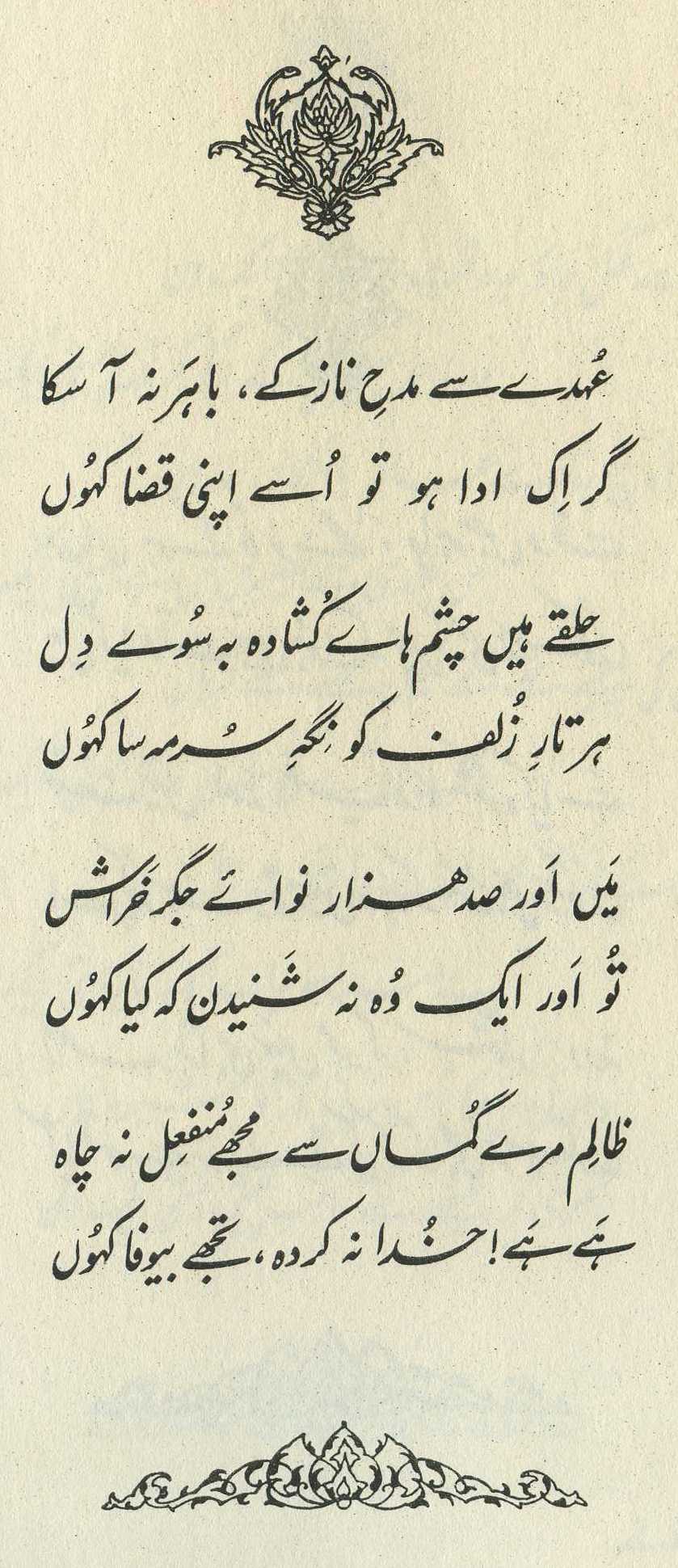
It's a clear verse. In the first line 'I' is omitted . (87)
== Nazm page 87

That is, if there would be only one , then I would call it my -- that is, I would praise her in that way. But here there are thousands of airs and graces. Between and there is wordplay []. (79)
I was not able to perform the praise of her airs and graces the way they deserved. And the reason is this: that if there were only one , then I could call it and fulfill the duty of praiser. She is from head to foot-- which ones should I praise? (139)
I was not able to praise your coquetry as I ought to have. If there had been one , then I would have called it my . That is, one after another keeps appearing, and there are hundreds of thousands of them for the praise of which there are no words at all. (181)
From the point of view of theme-creation , he has composed a verse of a very lofty standard. (496)
When I disagree with the commentators, it's usually because I find them wedded to only one possible interpretation and ignoring all others. This time, I actually think they're wrong. I exempt Nazm from my argument, since he thinks the verse is so 'clear' that he doesn't have to discuss it at all. But Hasrat and the two Bekhuds-- and I've translated every word they say about this verse-- represent a strong consensus: all the other commentators that I've read agree with them.
Yet it's really hard to read in any other way than as 'outside/beyond'. The obvious sense in the first line is that the speaker couldn't move beyond the obligation/position of praise of coquetry-- he could only confine himself to praising coquetry.
But the commentators read this, without any warrant, as a confession of the speaker's inability to praise coquetry properly. Then they combine this with a reading of the second line that relies on an imaginary after , and on mentally substituting the contrafactual for the future subjunctive. I think they have just all borrowed from Hasrat and, like him, have not devoted much attention to this verse.
Which is a pity, because it's a very enjoyable verse, and really rather complex. We have of course to ask ourselves what the relationship is between the two lines; for as in so many verses, Ghalib has given us no indication. When we look carefully, here are a few possibilities:
(1) The second line is an explanation of the role described in the first line. ('I could never be more than a mere praiser of beauty; for if I would rashly aspire to be an actual lover, then even one bit of flirtation [] would destroy me.')
(2) The second line is an illustration of the praise of beauty described in the first line. ('I'm a dutiful praiser of beauty, so whenever there's a single example of airs and graces [], I respond by exclaiming 'I'm devastated!'.')
(3) The second line is an illustration of the bureaucratic position [] described in the first line. ('Since it's my prerogative to arrange for the awarding of praise to beauty, whenever there's a payment of such a debt to beauty [from Arabic], I declare that it's by my decree [].')
Doesn't (3) provide a wonderful and unexpected fillip of pleasure? Check out the definitions of the relevant words (given above), and you'll see that Ghalib has carefully arranged for this alternative reading. All three of the relevant terms not only have a marked affinity, but are also perfectly placed within the semantic patterns of the verse to make this alternative reading unignorable.
It could even be said that in an attenuated way, and echo each other. But just in general, isn't this a verse full of brilliantly arranged wordplay?
graphics/courtdecree1853.jpg