Verse 41812aakahu;N
G3
1
cruel one, don't desire that I would be {confirmed in / afflicted by / ashamed before} my doubt/suspicion--
2
alas alas, the Lord forbid!-- that I would call you faithless!
'Doubt, distrust, suspicion; surmise, conjecture; (in comp.) thinking; suspecting ... ; —opinion, fancy, notion, supposition, imagination; —presumption; probability; —conceit, pride, haughtiness'.
'Done, performed; made; --suffering or receiving the effect (of an act), affected (by); disturbed, afflicted; --abashed, ashamed'.
| References | |
|---|---|
| Arshi, Imtiyaz Ali | Ghazal# 86 |
| Raza, Kalidas Gupta | 134-36 |
| Nuskhah-e-Hamidiyah | 143-144 |
| Asi, Abdul Bari | 163 |
| Gyan Chand | 260-261 |
| Hamid Ali Khan | Open Image |
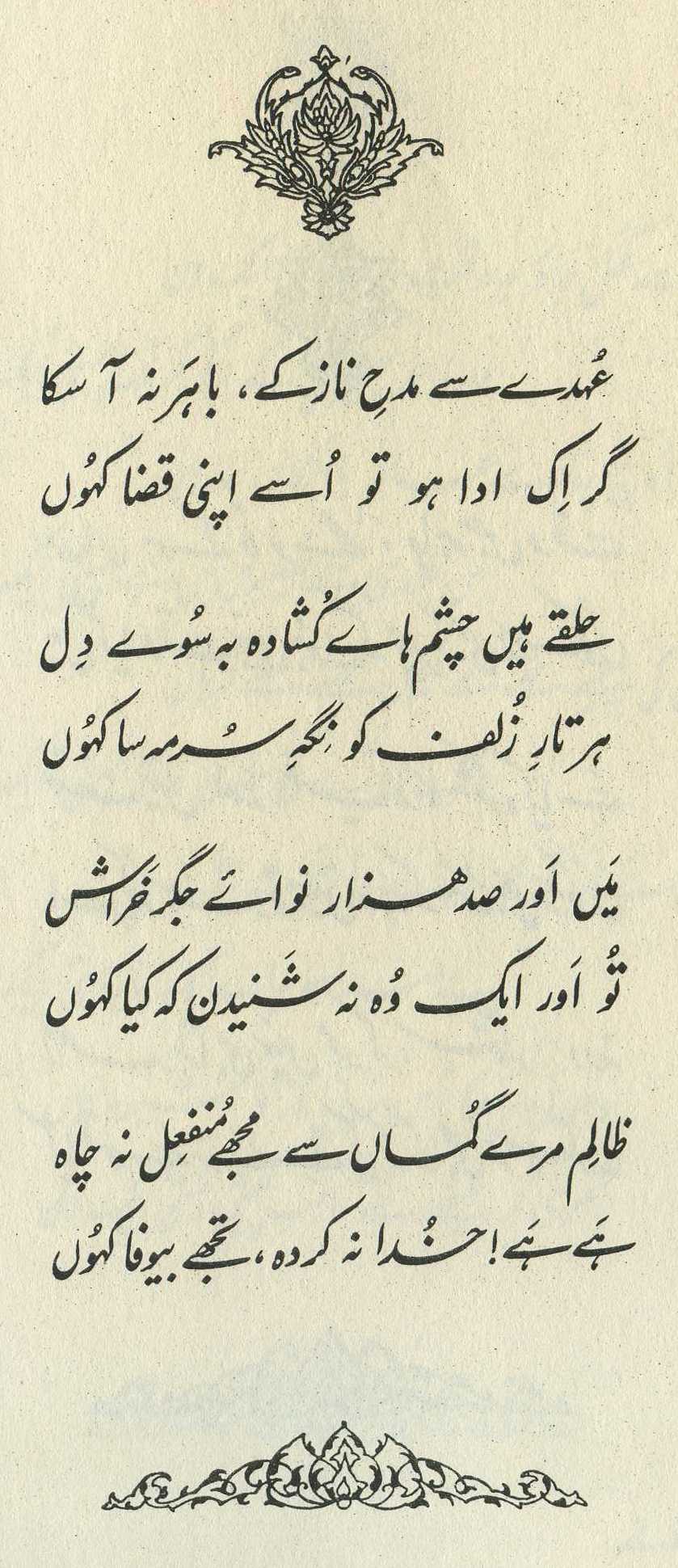
That is, my doubt calls you faithess, and I call you faithful. Don’t act in such a way that I will be forced to be confirmed in my suspicions. The meaning is, don’t act faithlessly-- God forbid that I too should be forced to call you faithless. (88)
== Nazm page 88

'Don't make me ashamed before my doubt. Dammit [], I-- and to think you faithless!' (79)
He says, 'Oh cruel one, don't act in such a way that I would be forced to be confirmed in my doubt. God forbid that I would call you faithless!' The meaning is that my doubt calls you faithless, and I am calling you faithful. Don't act in such a way that I would be forced to be ashamed before my doubt-- that is don't act faithlessly. God forbid that I too would be obliged to call you faithless! (139)
Her faithlessnesses have begun to appear very clear. But even today the heart doesn't want to call her faithless. 'Alas, God forbid!' gives information about the heart's dilemma. (182)
Compare 141,4 . (260)
The first line requires a bit of care and thought, because of the complexity of its use of (see the definition above) and the versatility of . (1) If means 'done, made', then the first line urges the beloved not to cause the lover to be confirmed in his doubt. (2) If it means 'affected' or 'afflicted', then the line urges the beloved not to cause the lover to suffer as a result of his doubt. (3) If it means 'abashed, ashamed', then we have the situation imagined by Hasrat and by Bekhud Dihlavi, such that 'my doubt calls you faithless, and I am calling you faithful'; you thus shouldn't 'act in such a way that I would be forced to be ashamed before my doubt-- that is don't act faithlessly'. Compare the similarly complex use of in 141,4 , to which Arshi rightly points.
The complexity of the grammar of the first line is effectively contrasted with the exclamatory, vigor and idiomatic fluency of the second line. Alas, alas, God forbid! --that the lover would call her faithless! How intolerable, impossible, unbearable! The lover begs the beloved not to force such a fate upon him. The grammar makes it clear that the lover's fear is not so much that she actually would be faithless, as that he would have no choice but to realize that she was faithless. He dreads having to recognize her in his heart as faithless, and-- worst of all-- to actually speak the words and call her so.
According to the tone and emphasis, the reading of the second line can vary most effectively. Which is the real focus of grief?
(1) 'that I myself would call you faithless' (as opposed to someone else-- or everyone else-- doing so)
(2) 'that I would (actually) call you faithless' (as opposed to suppressing my doubts and constantly giving them the lie)
(3) 'that I would call you faithless' (as opposed to the countless other beloveds who are faithless, as I well know, but from whom I expect nothing better)
(4) 'that I would call you faithless' (such a deadly, irrevocable, hope-destroying word!)
So in fact the second line, in its own way, is fully as multivalent as the first. Ghalib can make subtlety out of even the simplest phrases.
graphics/zippedlips.jpg