Verse 21816aanikaltii hai
G9
In this meter the next-to-last long syllable may be replaced by two shorts.
1
from the compression/scattering of the narrowness of privacy, dew is created
2
when the morning-breeze, having gone into the pardah/veil of the bud, emerges
'Squeezing, pressing (with the hand); compression, constriction; --a scattering; diffusion (= )'.
'A scattering; diffusion; compression, constriction, squeezing; the piercing of one thing with another'. (Steingass p.930)
| References | |
|---|---|
| Arshi, Imtiyaz Ali | Ghazal# 177 |
| Raza, Kalidas Gupta | 234 |
| Nuskhah-e-Hamidiyah | 272 |
| Gyan Chand | 394 |
| Hamid Ali Khan | Open Image |
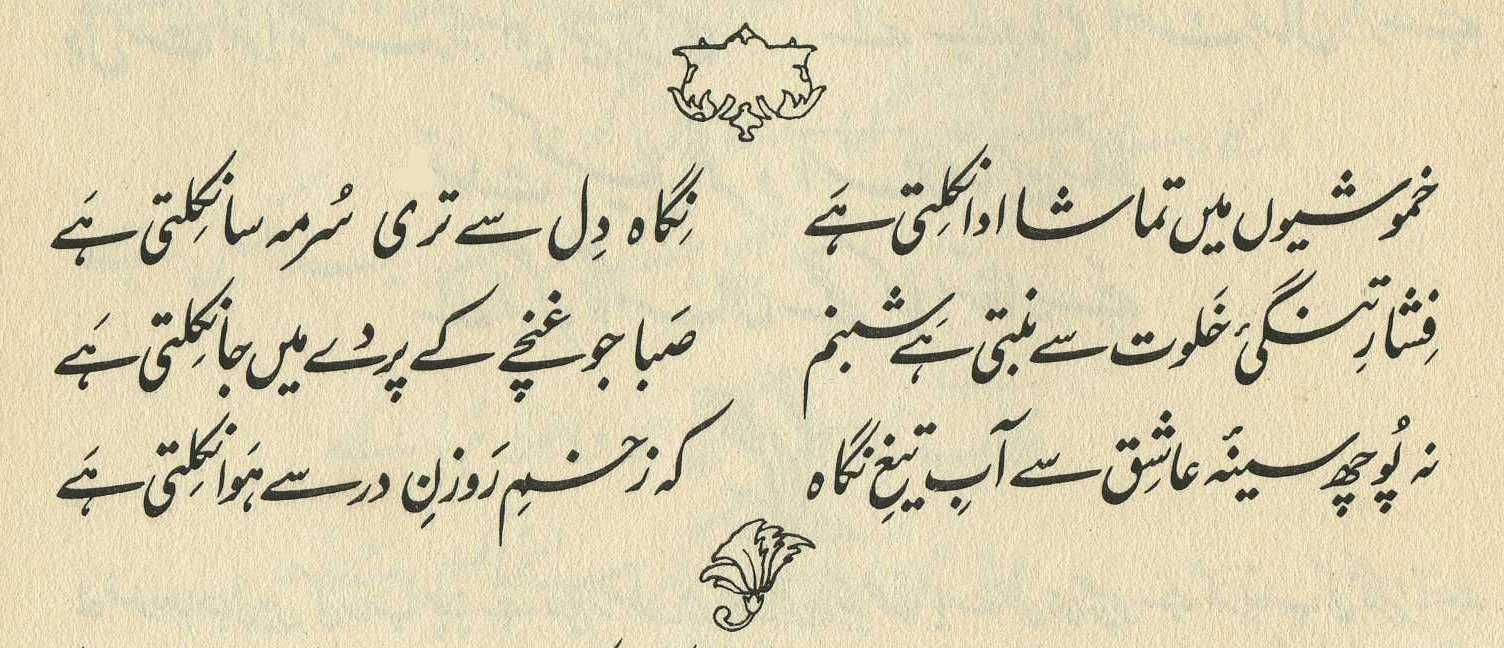
From the compression of the privacy of the bud, the spring breeze becomes dew; as if the bud, having found it in a narrow alley, so twists it that out of shame it perspires. In this verse, apparently without the author's intention, one idea has emerged: [the double meaning of in] . This kind of is contrary to the author's style; for this reason, it seems that the idea was created without his intention. But it's not devoid of pleasure. (255)
== Nazm page 255

He says, 'If the spring breeze wanders around lost in the privacy of the bud, then the bud takes it in its embrace and so squeezes it that out of shame it 'turns to water' [] and becomes dew'. (312)
Drops of dew are visible on the buds; the poet makes a poetic explanation, that what you consider to be 'dew' is that when the morning breeze, having gone into the pardah of the bud, emerges, the bud so squeezes it that that very breeze turns to dew. (462)
Alas, the commentators give the poet no credit for his brilliant, doubly-activated use of . It's the first word in the verse, and by no coincidence it has two meanings (see the definitions above) that are both opposite and apposite. It's perfectly plausible that drops of liquid would appear during a process of 'squeezing' or compressing something, as happens for example when paneer is made. But it's also possible that drops of liquid would appear in a kind of 'scattering', as the breeze bursts its way out of the tightness of the bud and perhaps forces the bud open, or at least vigorously shakes free some organic fluid or 'perspiration' from the heart of the flower.
Thus the first line tells us either that dew comes from a compression inside the bud, or that dew comes from a breaking up (and 'scattering') of the compression inside the bud. Both readings are grounded in the two senses of , and further enabled by the that follows it (is that 'of' to be read as 'done by', or 'done to'?). By no coincidence, both readings work perfectly well with the rest of the first line. If we're going to be able to choose decisively between them, we'll have to wait-- as long as possible, of course, under mushairah performance conditions-- for the second line to give us some clarifying details.
And does it? Of course it doesn't; we're nearly through the divan by now and we all know by now how Ghalib loves to mess with our minds. The second line, by no coincidence, gives equal emphasis to both processes: first, the morning breeze's going into the bud-- where all kinds of compression can easily take place, entirely screened from our view; and second, the morning breeze's emergence-- which can easily be imagined as the kind of rough, abrupt, almost violent struggle that would be accompanied by a spray of droplets. (For an example of this kind of urgent, bursting-out departure, see 6,2 .)
In fact, we could almost consider this a verse of erotic suggestion. (For other such verses, see 99,4 .) The commentators generally take the bud to be the aggressor, the 'squeezer' or embarrassment-creator, and the morning breeze to be the victim of pressure or shame. But the verse seems to be set up the other way around: it's the 'going in' and 'coming out' of the breeze that shapes the action, with no indication of any special agency possessed by the bud. The fact that the bud lives in 'privacy' and 'narrowness' and 'pardah' contributes to a kind of feminized passivity for it. And of course we know that the breeze is tough and shameless, it's a survivor, it will long outlive the bud. In fact it's destined to scatter, all too soon, the petals of the dying rose.
graphics/rosebuddew.jpg