Verse 5x1816aanikaltii hai
G9
In this meter the next-to-last long syllable may be replaced by two shorts.
1
with the circle of the twist of curls, is rectitude/'straightness' taught
2
from the mouth of a snake, {speaking / 'so to speak'}, the morning-breeze emerges
'Rectitude, justice, fidelity, loyalty, honesty, probity, integrity, uprightness; truth, veracity; candour, sincerity; justness: straightness'.
'Teaching; learning; taught'.
'A snake, serpent'.
''The east wind, or an easterly wind'; a gentle and pleasant breeze; the morning breeze; the zephyr'.
| References | |
|---|---|
| Arshi, Imtiyaz Ali | Ghazal# 177 |
| Raza, Kalidas Gupta | 234 |
| Nuskhah-e-Hamidiyah | 272 |
| Gyan Chand | 394 |
| Hamid Ali Khan | Open Image |
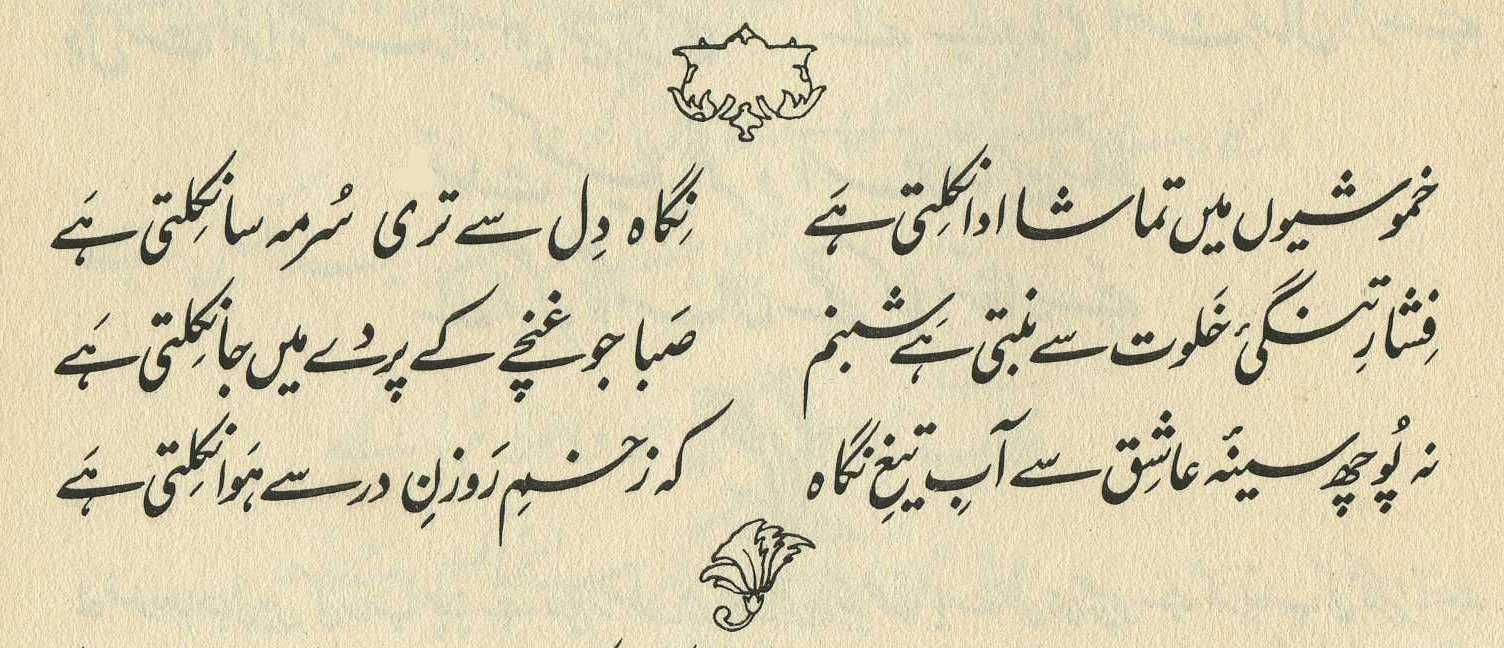
The circle of curls is a snake's mouth, which has the quality of straightness-teaching. And its teaching of straightness is as if from the snake's mouth the morning breeze would emerge, or that raga would be created that is called 'Saba'.... That is, although the circles of the curls are crooked, from out of their very twists, straightness becomes manifest. So to speak, from the snake's hiss the raga called 'Saba' is created. That is, the snake's poisonous breaths give the invigorating pleasure of the gusts of the morning breeze. And through this simile the poet's point is that often from evil, good comes into being.
== Zamin, p. 396
Through the circle of the twist of her curls, the beloved is teaching straightness to the breeze/air. The illustration [] is that from a snake's mouth an air/breeze would be emerging. In the snake there are twists and turns, but from its mouth the current of air emerges straight out. From passing through the circle of curls, even/also the strength/coils [] of the breeze will emerge [and depart].
== Gyan Chand, p. 394
For background see S. R. Faruqi's choices . This verse is NOT one of his choices; I thought it was interesting and have added it myself. For more on Ghalib's unpublished verses, see the discussion in 4,8x .
We know from 227,2 that was in Ghalib's mind, and somehow he came up with that striking second line. Surely it took the young poet's fancy, and then he would have needed to find a first line that could set things up for it. The first line juxtaposes the 'twistiness' of the beloved's curls with 'straightness'-- not just as wordplay, but through a claim that the former 'teaches' the latter. That paradoxical-seeming claim certainly makes us eager to hear the second line.
When-- after a suitable mushairah -performance delay-- we're finally allowed to hear it, the cryptic and paradoxical quality is only increased. We're left to figure out for ourselves what this aphoristic assertion implies. It presents itself, after all, as overtly metaphorical-- as a 'so to speak' illustration or poetic 'proof'. But how does it instantiate or establish the first line?
Zamin wants to take the line literally; he offers two suggestions. The snake's body is twisty, but (1) when it hisses, the puffs of air come straight out, like the (unidirectional) flow of the morning breeze; or (2) when it hisses, the sound comes straight out like the enjoyable raga 'Saba'.
Gyan Chand's metaphorical take is surely more satisfactory: The twisty 'snake' of the beloved's curls gives rise, when she breathes, to the charming flow of the morning breeze. Or else the breeze emerges when she speaks, so that the 'so to speak' [] offers fine wordplay.
The whole effect, however, remains a bit off. I keep feeling that there's some kind of idiomatic usage or proverb or double meaning that still eludes all of us. For why does a breeze emerge from the snake's mouth in the first place? What does that correspond to, or evoke?
graphics/snake.jpg