Verse 21816aa;Nmeraa
G5
In this meter the first long syllable may be replaced by a short; and the next-to-last long syllable may be replaced by two shorts.
1
give me leave/permission to lament, cruel one-- may it not be that
2
from your face would be manifest my hidden grief!
'Facilitation, license, indulgence.' (Platts. p.590)
'Let it not be, by no means, away! God forbid! lest'. (Steingass p.1148)
| References | |
|---|---|
| Arshi, Imtiyaz Ali | Ghazal# 30 |
| Raza, Kalidas Gupta | 163 |
| Nuskhah-e-Hamidiyah | 81-83 |
| Asi, Abdul Bari | 71 |
| Gyan Chand | 111-115 |
| Hamid Ali Khan | Open Image |
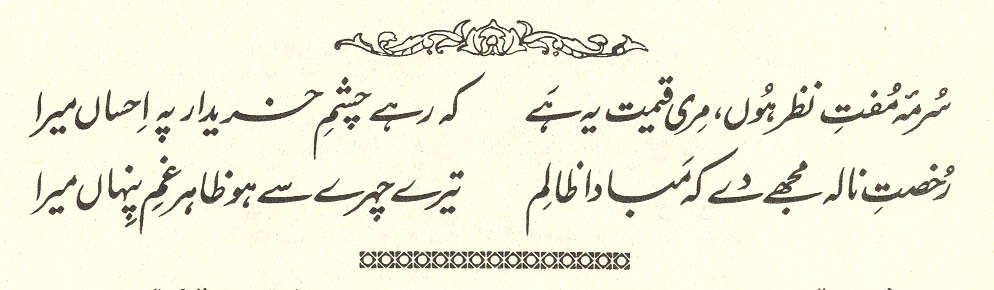
That is, if permission to lament is not granted, then I will suppress it, and its effect will reach to you.
==Urdu text: Yadgar-e Ghalib , p. 143
That is, if laments are not expressed, their effect of hidden grief will be felt only in the heart, and from my heart will spread to your heart. (41)
== Nazm page 41

That is, may it not happen that I would die from the suppression of grief, and you would feel sorrow, and in this way from your face my hidden grief would be manifest. Or there's this meaning-- may it not happen that I would suppress my grief, and from the effect of that your heart too would be wounded, the effect of which would show from your face. (43)
That is, if there's no permission to lament, then we will suppress our laments, and the effect of that will definitely reach to you. The lament emerges from the heart, and in the state of suppression is is extinguished like smoke in the heart itself. There's a famous proverbial saying that 'a heart finds a way to a heart'. Its effect will reach your heart, and as a result that effect will be manifest from your face. (81)
Solution 1: Torment me with full ardor; but indeed, give me permission to complain, lest it happen that the Lord would give justice to the silent, and you would suffer for my endurance....
Solution 2: May it not happen that suppression of complaints would take my life, and after my death you would feel grief, and love would show its effect, and you would be forced to wring your hands [with grief]. (101)
In 10,3 , the forbidden turns the straw that the lover has taken between his teeth (in token of submission) into a reed-flute. The lover's suppressed lament thus has power over a straw. But in the present verse, the lover's suppressed suffering would apparently have enough power to reveal its presence on the beloved's face instead of his own.
But how, exactly? The commentators do their best, but we don't really have a mechanism. Since when does the lover have such power over the beloved's face (and thus, apparently, over her heart)? If he really did have such power over the beloved, and knew it, why would he then suffer so extravagantly? There's a lack of instrumentality here that seriously weakens the verse. Something in the verse needs to tell us, or suggest to us, what mechanism for such grief-transfer is being invoked.
In 6,6 , it's a single unshed tear-drop that turns into a typhoon, not the many that were actually shed; in the even more extreme 5,4 , a mere 'passing thought' of wildness accidentally burns up the desert; in 10,3 too (the one cited above)-- in all these cases the physical mechanism is readily apparent. The progression from drop to ocean, from burning thought to burning fire, from straw to reed-flute, offers just the kind of 'objective correlative' connection that's lacking in the present verse.
graphics/grief.jpg