Verse 21821aa;Nu;Thaa))iye
G3
1
on stone, is the assignment/warrant of the livelihood/estate of the madness of passion
2
that is, now/still take up [the burden of] entreaty/obligation to children
'A writing conferring immunity or exemption; commission, warrant, decree, assignment, letter; draught, cheque'.
'Living, life; —that whereby one lives, means of living, livelihood, subsistence; landed property'.
'Kindness or service done (to); favour, obligation; — grace, courtesy; — entreaty, humble and earnest supplication; — grateful thanks, praise'.
| References | |
|---|---|
| Arshi, Imtiyaz Ali | Ghazal# 130 |
| Raza, Kalidas Gupta | 340 |
| Nuskhah-e-Hamidiyah | 178-179 |
| Asi, Abdul Bari | 215-216 |
| Gyan Chand | 330-331 |
| Hamid Ali Khan | Open Image |
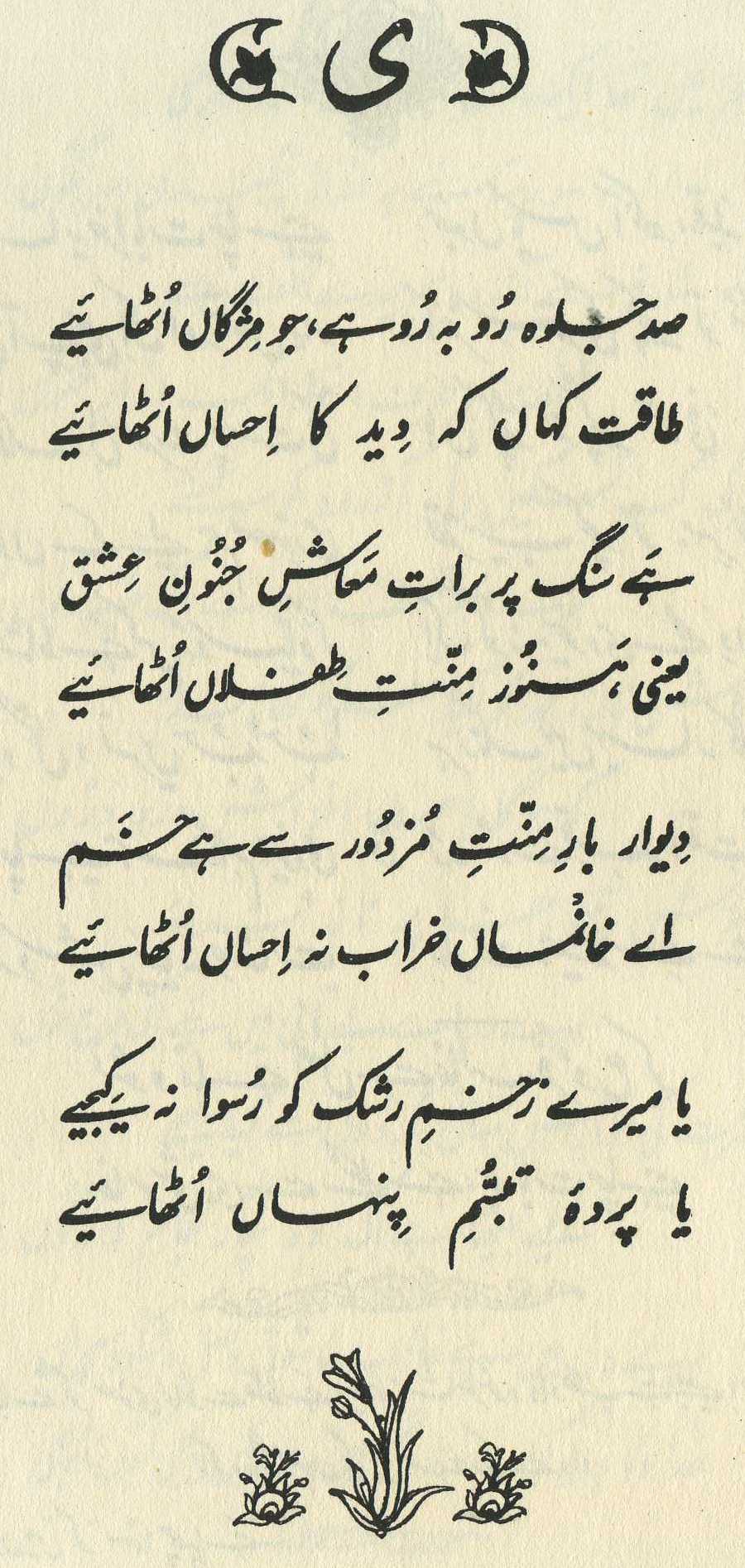
Decrees, orders, etc. are called . That is, the decree of livelihood for madness is on a stone. The gist is that the livelihood of madness has been fixed upon the stones of children. (139)
== Nazm page 139

An authorization for a salary is called . He says, on stones are written the authorizations for salaries of the livelihood of the madness of passion. Thus still, for some days more, you ought to keep lifting [the burden of] the entreaty/obligation to the stone-throwing boys. The meaning is that in the madness of passion, you ought to 'eat' stones [] from the hands of boys. (195)
= Order (check).... The livelihood of the madness of passion is dependent on the stones of boys. For this reason, you ought still/now to lift [the burden of] the entreaty/obligation to boys. That is, we considered that in passion, one would not be compelled to be obligated to anybody. But this opinion turned out to be wrong. (259)
On the general metaphor of 'lifting a burden' of kindness or obligation, see the discussion in 130,1 . The need to do so is, in Ghalib's view, most unfortunate; on the deep desire for 'independence' see 9,1 .
Above all, this verse is a masterpiece of idiomatic wordplay and implication . Normally, something that is 'graven on stone' is inscribed in a very solid, formal, lasting way; you're quite fortunate if the decree or warrant that provides for your livelihood, your 'landed property', is not merely written on flimsy paper but actually engraved on stone for posterity. The word -- a decree, order, authorization for a salary-- is a formal and pompous one; the commentators make a point of defining it, since they feel that their readers may not know it. So from the first line, we might well conclude that some lofty, immemorial decree confers on the mad lover a special, privileged estate.
Then, under mushairah performance conditions, we'd eventually get to hear the second line, and at the last moment, with the word 'children', it would all be turned around. The 'stone' that records the 'decree' turns out to be the kind thrown at madmen by thoughtless boys; in the ghazal world, as we all know, boys follow madmen around, ridicule and taunt them, and harass them with showers of stones. So 'on stone' turns out to mean not 'graven on stone', but something like 'dependent on stones'. Once we have this basic image, several kinds of implication make themselves felt.
=In Urdu idiom, people 'lift a stone upon' somebody [] when they throw stones at him (as in 35,10 ), the way in English attackers 'lift a hand against' somebody. Thus even though the verse teasingly saves its refrain -required for the lover's obligation to the boys, the verb strongly carries over to our awareness of the boy's actions that incur that obligation.
=The is specifically for , or 'livelihood', something that one lives on. As Bekhud Dihlavi points out (or perhaps he just unselfconsciously uses the phrase), when one is struck by a thrown stone one idiomatically 'eats a stone' []. (One also 'eats a beating' [], and so on.) The stones are both a warrant for one's livelihood, and literally what one is 'fed'. The mad lover's 'livelihood' thus consists, wonderfully and appropriately, of the special prerogative of 'eating' stones. (Should the stones even perhaps be salted, as is envisioned in 77,1 ?)
=The doubleness of -- is it 'still', or is it 'now', that one should shoulder the obligation to the boys? If the former, the impatient lover is being persuaded and enjoined to continue his endurance of a difficult (but also auspicious?) situation; if the latter, the lover is just now being informed of either his rise (he now has been granted a decree for a fancy, new, special livelihood) or his fall (he now has nothing left to live on but stones) in the world.
=And of course, the largest 'implication' is the whole information content of the verse. If we didn't already know about how boys throw stones at madmen, the verse would be completely opaque. The whole connection between the stones and the boys is made only by us, not by the verse itself.
For more on stone-throwing, see 35,10 .
graphics/stones.jpg