Verse 41821iirnahii;N
G5
In this meter the first long syllable may be replaced by a short; and the next-to-last long syllable may be replaced by two shorts.
1
Grief of eternal hopelessness, remain agreeable/palatable!
2
I am happy if the lament is not abasement-enduring before Effectiveness
'Digesting; stomaching, swallowing, putting up with; --digestible; palatable; agreeable, pleasant'.
is a metrically compressed form of , the future imperative for ( GRAMMAR )
'Infirmity, weakness, helplessness; ... infamy, disgrace'.
'Drawing, pulling; carrying, bearing, enduring; drawer; bearer, &c. (used as last member of compounds)'.
'The making of an impression; impression, effect; operation'.
| References | |
|---|---|
| Arshi, Imtiyaz Ali | Ghazal# 89 |
| Raza, Kalidas Gupta | 359 |
| Nuskhah-e-Hamidiyah | 113-114 |
| Asi, Abdul Bari | 164 |
| Gyan Chand | 262 |
| Hamid Ali Khan | Open Image |
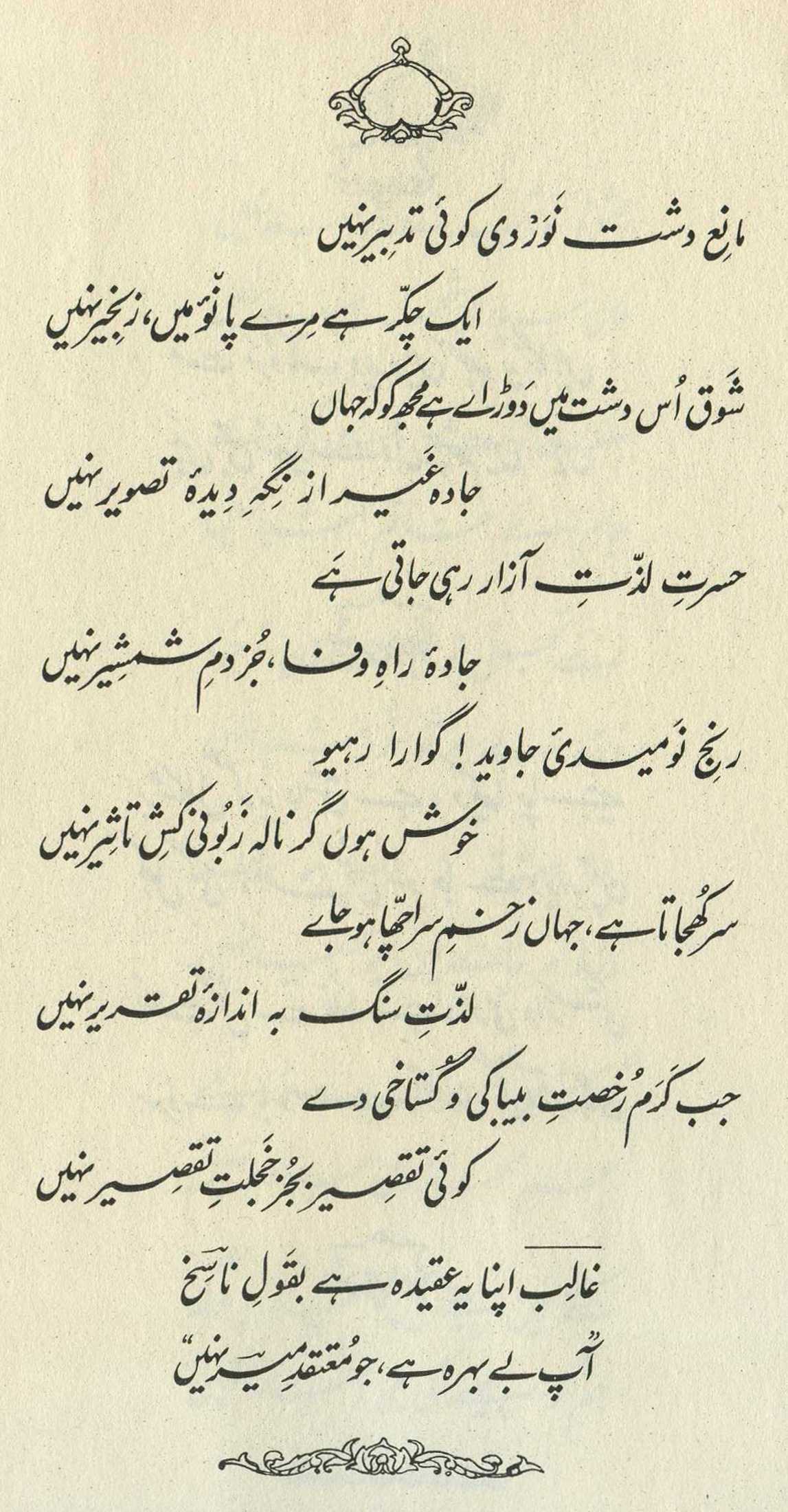
The poet makes manifest that his grief is a friend. May despair and hopelessness alone remain allotted to me! May the Lord not bring to pass the humiliation and disgrace to my lament, that would bring it effectiveness and fulfill my hopes. (91)
== Nazm page 91

He says, I accept the grief of hopelessness forever and ever. That is, I am very happy if my lament is not a pleader/petitioner before Effectiveness. (144)
I accept grief and hopelessness forever. I am happy that my lament is not indebted to Effectiveness. I can't stand to see my lament be humbled/lowered. (188)
This is another of a surprisingly large and coherent body of verses that are organized around the idea that loss and despair should be seen as a twisted sort of triumph. The underlying notion is that one should never be indebted, or borrow things, or humiliate onself before a giver or lender. Rather than that, one should stick with what one already has, and stubbornly insist on preferring it-- so that a despair that is one's own is better than a derivative success acquired through self-abasement before 'Effectiveness'. For more on this line of thought, see 9,1 .
But then, this all sounds remarkably like a rationalization. What it really amounts to, after all, is a kind of sour-grapes admission of eternal defeat and despair, and the impossibility of changing them. The use of with its wide range of meanings, both active and passive, both grim ('swallowing, putting up with') and favorable ('agreeable, pleasant'), encourages us to reflect on such possibilities (see the definition above).
Ultimately, the lover no doubt means it both ways at once. It's terrible to have to keep 'swallowing' one's suffering-- there's no getting around it. Yet the lover's unshakable stubbornness and determination are also, as always, sources of pride. He alone can mediate between those two wild abstractions, 'Grief of Eternal Hopelessness' (or 'Eternal Grief of Hopelessness', if we read one slightly differently) on the one hand, and 'Effectiveness' on the other. Isn't that a more thrilling and lofty concern than mere anxiety over, say, how to pay the rent? (After all, as we saw so clearly in 20,7 , there are no good alternatives-- the only choice is 'grief of passion' versus 'grief of everydayness/livelihood'.)
graphics/noaccess.jpg