Verse 71821iirnahii;N
G5
In this meter the first long syllable may be replaced by a short; and the next-to-last long syllable may be replaced by two shorts.
1
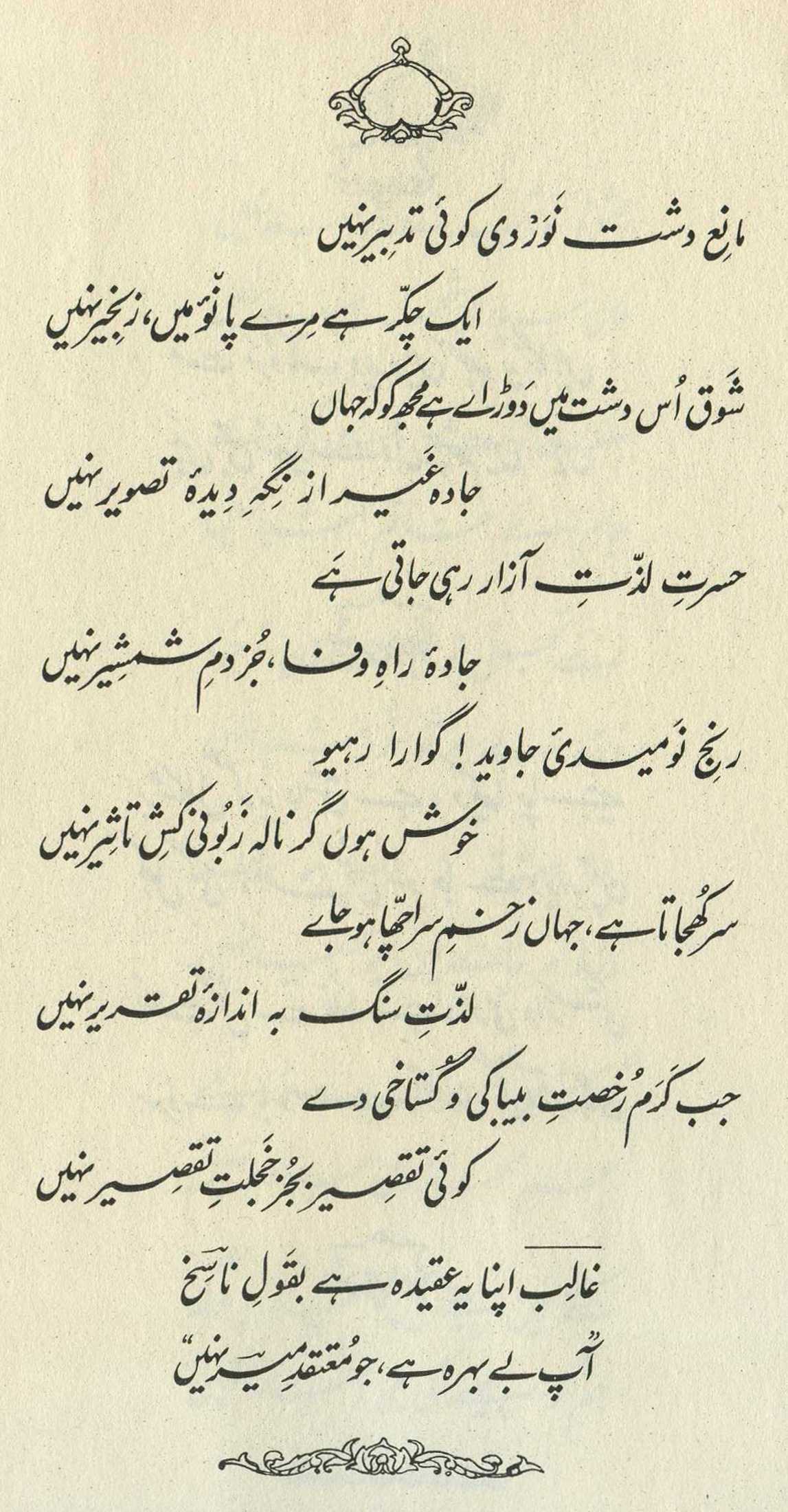
Ghalib, this is my creed/belief, in the dictum/saying of Nasikh
2
he himself is portionless/destitute, who is not a believer/follower of Mir
'A belief, faith, firm persuasion; a creed; an article of belief; a doctrine; a religious tenet'.
'Having no share, part, or lot (in), without portion or profit; destitute, unfortunate'.
'Believing; firmly persuaded, confident, certain, or sure (of); follower (of a creed or sect); an adherent, a faithful friend or servant'.
'Chief, leader, master, head ... ; a title by which the Saiyids (or descendants of the family of Muhammad) are called'.
| References | |
|---|---|
| Arshi, Imtiyaz Ali | Ghazal# 89 |
| Raza, Kalidas Gupta | 359 |
| Nuskhah-e-Hamidiyah | 113-114 |
| Asi, Abdul Bari | 164 |
| Gyan Chand | 262 |
| Hamid Ali Khan | Open Image |
In one gathering, he was praising Mir Taqi. Shaikh Ibrahim Zauq too was present; he gave priority to Sauda over Mir. Mirza said, 'I used to consider you a 'Mirian'/winner [], but now I've realized that you're a 'Saudaian'/madman [].
[ : 'One who surpasses or outstrips another (in any business, or game, &c.); a winner (at play); —(among schoolboys) he that first comes to the master to say his lesson'. (Platts p.1105)]
[ : 'Melancholic, atrabilarious; insane, mad; —an atrabilarian, a hypochondriac; a madman'. (Platts p.696)]
==Urdu text: Yadgar-e Ghalib , p. 97
Ghalib and Mir , both these elders, are from Akbarabad [=Agra]-- that is, at an age when they had already learned the language, they came to the royal capital [Delhi]. [Evidence for this is provided from various sources.] Now if you call Ghalib a Dihlavi, then it's necessary to call Mir [because of his later residence] a Lakhnavi. But the language of these two Ustad s is saying that neither is the former a Dihlavi, nor is the latter a Dihlavi.
And the state of the language can be learned from a single word; there is no need for further examination. In the late Mir's idiom, in all his divan s, here and there is the word with the meaning of , although this word was never in the language of Delhi. The late Mirza Ghalib says, . In a letter he writes, . In one place he writes, . Although among his contemporaries these words [] were on nobody's tongue in Delhi or Lucknow. It is fair to say that both these elders are a source of pride to the language of Akbarabad [=Agra]. [Merely] because two or three words are unfamiliar, their language cannot be called into question.
In short, connoisseurship in his art, and love of his homeland, both required that Ghalib should join with Nasikh in the creed that the person is portionless who is not a believer/follower of Mir. In the same way, Atish too has supported him: [example]. Mirza Rafi' Sauda , who is his contemporary-- he too supports the Ustad-ship of Mir: [example]. Among contemporaries it's rare that one should admire another, but Mir himself admired Sauda. He says: M 84,4 . And another verse of this kind, Azad has noted: M 592,7 .
It's famous that Sauda is the Ustad in the ode , and Mir in the ghazal, and the former's ghazals are weak, and the latter's odes. This notion is not at all supported by investigation. Sauda's ghazals are absolutely not weak, although he composed fewer ghazals than Mir, and many odes. And to call Mir's odes weak is mistaken, because Mir didn't even want to compose odes-- he composed only two or three odes, and those too were short.... Beyond doubt, the style that Mir achieved in the ghazal has not been granted to anybody else.
Another point that here is not without literary advantage is that all the early and later poets have admired Mir and Sauda, and still do admire them. And merely because of their lofty theme s, and by reason of the informality of their language, their image is seated within everyone's hearts, and no one doubts their Ustad-ship.
[But] those matters that will now be established about their Ustad-ship, have violated the pages of [the handbooks of prosody and rhetoric] and . Both these elders [Mir and Sauda] have neither cared about errors in idiom, nor bothered about rules of grammar. Azad wrote down some such verses, but for the most part his gaze didn't fall on them. Those errors are these: (1) [examples of unidiomatic usages]; (2) causing and to [metrically] shorten: [examples]; (3) often there is vulgarity/obscenity [] in the ghazal: [examples]; (4) they held wrong ideas about Urdu grammar: [examples]; (5) Mir Sahib is a meaning-making [] poet and a theme-composing [] Ustad, but when he inclines toward verbal affinities [] and , then he rivals [the lesser poets] Amanat Lakhnavi and Shah Nasir Dihlavi: [examples]; (6) flaws in the refrain : [examples]; (7) wrong ideas about rhyme : [examples]; (8) constructions from which some shallow [] aspect would emerge; a poet ought certainly to avoid them as well. Mir says: / . That is, there are blisters like pearls. (92-95)
== Nazm page 92 ; Nazm page 93 ; Nazm page 94 ; Nazm page 95


Ghalib and Mir were both Akbarabadis. They spent their language-learning time in Agra (Akbarabad). Then Mir came to Delhi. After that, he arrived in Lucknow, and passed his whole life there. To the point that he is even buried in Lucknow. (262)
In the [manuscript] the first line of this verse is also like this: [he is the Zuhuri of Rekhtah , in the words of Nasikh]. [For this variant see the Anvar ul-Haq edition, p.114 .]
In this ground one more verse too has been composed by Ghalib: 92,8x . (306)
The original verse by Nasikh to which Ghalib refers, and from which he borrows his second line, is:
[there's no doubt at all, Nasikh, about Mir's Ustad -ship
he himself is portionless/destitute, who is not a believer/follower of Mir]
Source: , (Delhi: Maktaba Jamia Ltd., 1972), p. 173.
In Ghalib's original ten-verse ghazal the ninth verse was the closing-verse that I've presented as 92,8x , which Ghalib chose not to include in his divan . This present verse was the tenth, and just as Mihr says, there is a variant form of the first line that says of Mir, 'he is the Zuhuri of Rekhtah '-- a much punchier form of praise than the bland 'Ghalib, this is my creed/belief'. But the variant form is not a closing-verse, so perhaps when Ghalib chose to omit {92,8x} he also decided to re-work the present verse into a closing-verse.
Most of the other commentators don't have much to say about this verse except the usual prose paraphrase, but Nazm launches into a sweeping four-page discussion. His central point is duly repeated by his faithful follower, Shadan. As Shadan notes, the basic starting point of Nazm's critique is to show, with a barely concealed snideness, that neither Mir nor Ghalib was a 'real' Delhi person who spoke the 'real' language of Delhi-- so that it's not surprising that Ghalib praised Mir, since they were both provincials from the same home-place [], Agra.
Nazm then goes on to explicate his own views about the virtues and flaws of Mir's (and Sauda's) ghazals. Since his discussion has a literary and historical interest of its own, I've translated almost all of his main points, omitting mostly the many examples. Nazm's views inspire me with many thoughts and observations, but I'll save them for another context, since his commentary doesn't have much to do with the verse itself.
This verse makes clear the depth of the admiration professed (and probably really felt, though not unambivalently) by Ghalib for Mir. The most conspicuous feature of the verse is in fact the use of two words from the religious domain, both from the same root: in the first line, and in the second. This not only sets up a verbal and phonetic resonance, but also emphasizes the degree to which the verse is presenting itself as a kind of quasi-religious statement of faith.
However, compare 36,11 , for a far more tendentious and ambivalent 'tribute' to Mir. (And remember, a ghazal in any case is not a literary treatise.)
graphics/mir1786.jpg