Verse 51821iirnahii;N
G5
In this meter the first long syllable may be replaced by a short; and the next-to-last long syllable may be replaced by two shorts.
1
the head itches where the head-wound would become well
2
the pleasure/relish of the stone is not {within the range / in the style} of speech
'Measure, measurement...; degree, amount; valuing, valuation, value; rough estimate; conjecture, guess; proportion, symmetry; elegance, grace; mode, manner, style, fashion, pattern'.
| References | |
|---|---|
| Arshi, Imtiyaz Ali | Ghazal# 89 |
| Raza, Kalidas Gupta | 359 |
| Nuskhah-e-Hamidiyah | 113-114 |
| Asi, Abdul Bari | 164 |
| Gyan Chand | 262 |
| Hamid Ali Khan | Open Image |
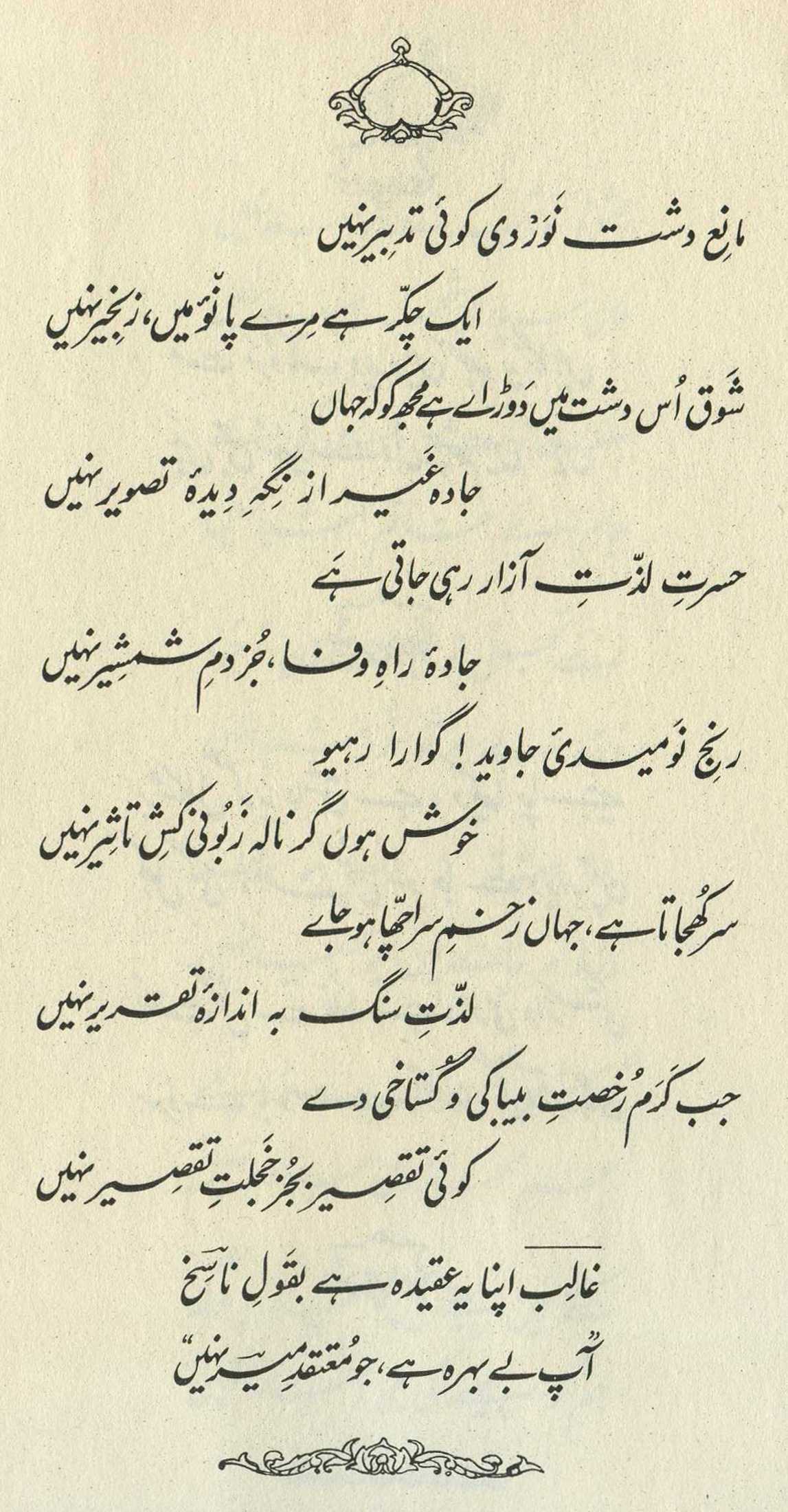
In this verse, 'where' has the meaning of 'at the time when'.... 'Not to be within the power of speech' means that to the extent that speech has scope/capacity, the pleasure of the stone is somewhat more than that. (91)
== Nazm page 91

That is, it's beyond expression, or it cannot be expressed. (82)
He says, when this head-wound becomes well, again an itch starts in the head. The pleasure of experiencing [] a stone is beyond the scope of speech. The enjoyableness in this verse is that a wound always itches after it has healed. Mirza Sahib has constructed this as an ardor for experiencing a stone again. (144)
Why does the healing head-wound itch? Here are some possible reasons:
=Because all wounds itch when they're healing; this is a natural part of the pain of the wound, and of its healing-- and one which the lover thoroughly enjoys.
=Because the head is 'itching' (we happen to have exactly the right idiom in English) to experience another such thrilling, morbidly 'pleasurable' wound from another thrown stone.
=Because the head yearns to talk but cannot, so the itching is an improvised substitute for speech-- it wants to compel the lover's attention, and to demand, through its bodily language, another such wound.
=Because the head disdains to talk; it knows that mere speech is entirely incommensurate with the exquisite pain/pleasure of the wound, so the only remotely adequate expression of this pleasure/pain is the indescribable, wildly expressive, more-than-verbal itching.
These four possibilities obviously also make use of the complex meanings of both and in the second line. On one reading, the pleasure of the stone is not something that is with(in) the 'range' or 'measure' or 'power of conjecture' of speech-- that is, speech is inadequate to grasp and convey it, speech just can't wrap its mind (or tongue) around it. On another reading, it's not something that's 'in the style/manner' of speech, that's 'like' speech-- that is, its very nature is to be expressed not in words but through the direct physicality of itching.
A small touch that I particularly enjoy is the future subjunctive verb at the end of the first line-- the head itches when the wound 'would become well' []. Such a grammatical form signals an outcome that is in doubt; it doesn't affirm that the wound either 'is' or 'will be' healed. Thus it quietly reminds us that in fact the wound surely won't be healed-- it won't have time to be, before either it's reopened, or a new wound is added to it. For if the lover isn't duly stoned as a madman by a pack of boys (see 35,10 ), he won't hesitate for a moment to rip the wound open with his own fingernails (as in 19,1 ).
graphics/stones.jpg