Verse 31821iirnahii;N
G5
In this meter the first long syllable may be replaced by a short; and the next-to-last long syllable may be replaced by two shorts.
1
the longing for the relish/pleasure of trouble/pain has {kept on / 'remained'} going away
2 a
the path of the road of faithfulness is nothing but the edge of a sword
2 b
there is no path of the road of faithfulness, except the edge of a sword
| References | |
|---|---|
| Arshi, Imtiyaz Ali | Ghazal# 89 |
| Raza, Kalidas Gupta | 359 |
| Nuskhah-e-Hamidiyah | 113-114 |
| Asi, Abdul Bari | 164 |
| Gyan Chand | 262 |
| Hamid Ali Khan | Open Image |
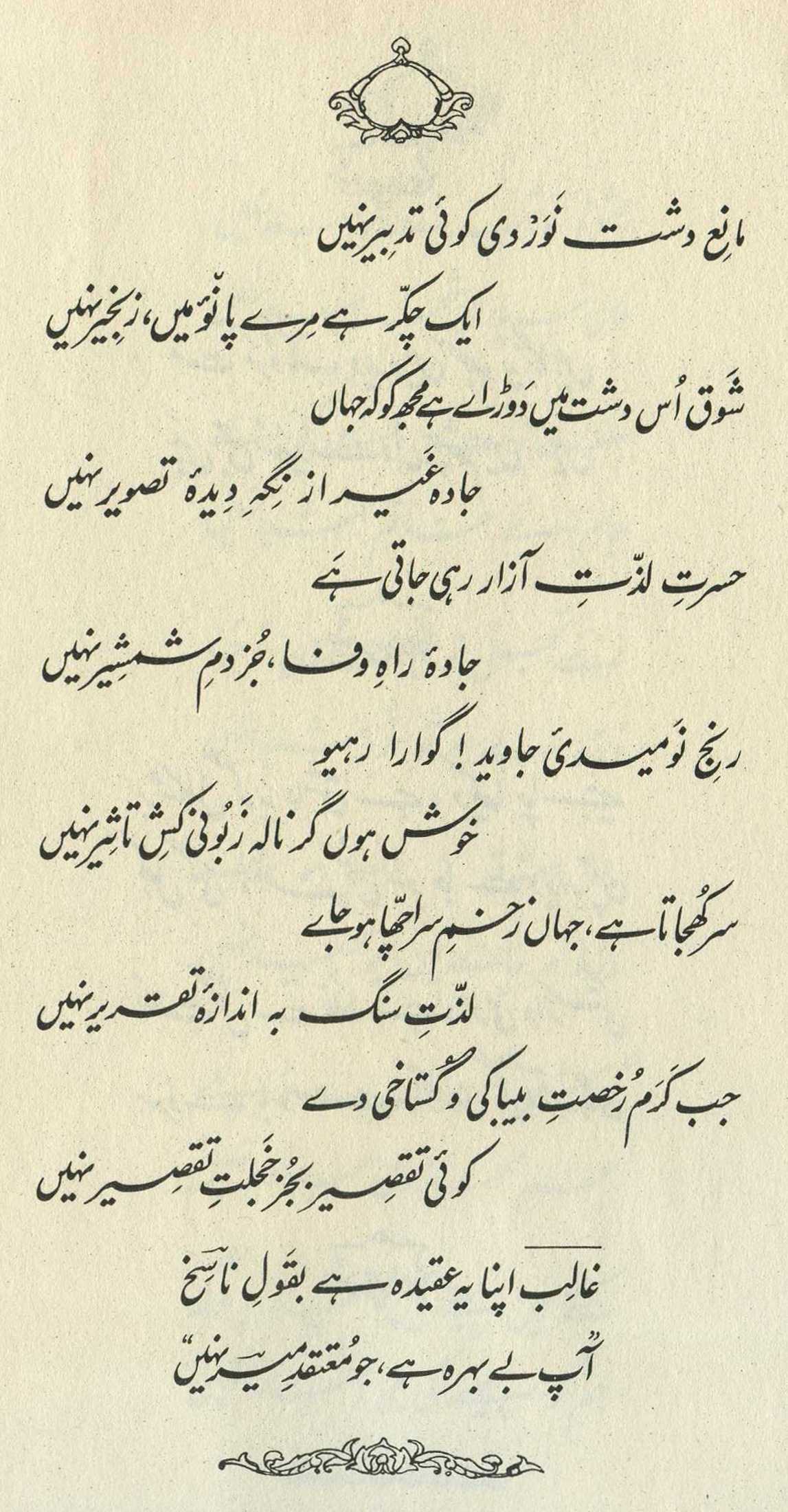
For , that is, 'path', he has given the simile of the edge of a sword. The meaning of the verse is that there is such pleasure in the pain and trouble of passion that one wants to open the heart to it fully and enjoy it; but since the path to faithfulness is entirely the blade of a sword, at the very first step death can be seen. Thus, it’s a pity that the longing for the pleasure of pain remains only within the heart.
==Urdu text: Yadgar-e Ghalib , pp. 146-47
The poet regrets that the path of the road of faithfulness is nothing other than the blade of a sword. That is, this is that path that is crossed in a moment/breath [], and the pleasure of pain is not obtained to one's heart's content. (91)
== Nazm page 91

Alas, that the footpath of faithfulness is like the blade of a sword! If only it were an even more difficult and harsh road, then the longing for the pleasure of pain would not remain in the heart. We would be able to endure pain to our heart's content. (188)
On the possibilities of , see 101,1 . On the phrase , see 112,4 .
As in the previous verse, 92,2 , , 'path', is used in a context of extreme abstractness. This seems to be a pattern: for more examples, see 9,4 . The phrase is reminiscent of 10,12 .
I've interpreted as an inverted form of , 'has remained going [away]'. Another way to do it would be , 'in a state of having remained, habitually goes [away]'. In either case, this verb provides an excellent pivot around which the verse turns. Its paradoxicalness goes well with the 'relish of trouble' or 'pleasure of pain' in the first line. Since the 'pleasure of pain' is complex and contradictory-looking anyway, it's not surprising that the longing for it should simultaneously seem to 'remain' and 'go'. And equally conspicuously, there's a lovely wordplay between and the , 'road', in the second line.
One more bit of implicit wordplay can be seen operating, consciously or unconsciously, in Nazm's commentary. The word means the edge of a sword-blade. But it also means 'breath' and 'moment'. In a verse like this, about things that are all too short-lived, things that we long to extend beyond their intolerably brief lifespan, how can we not also enjoy the penumbra of associations around ? For more on Ghalib's own clearly multivalent use of as both 'sword-edge' and 'breath', see 1,3 .
There's striking sound-play in the verse as well. Each line begins with a conspicuous sequence of three nouns joined by two constructions. And these two long noun phrases both have no vowels except short and long . By contrast, the second part of each line is dominated by long sounds. The effect is to create a sort of 'phonetic parallelism' between the lines that makes them somewhat echo each other and calls attention to the grammatical and semantic parallels between the two lines. And contrasts too-- the first line ends in almost too many verbs, while the second ends without one.
This engraved and enamelled , with an ivory hilt, is from Lucknow, early 1800's:
graphics/shamshir.jpg