Verse 14after 1816aa;Nkiye hu))e
G3
1
again Sight gazes/stares at a single/particular/unique/excellent new/early springtime of coquetry
2
having made the face, through the brightness/splendor of wine, a garden
is an archaic form of, here, ( GRAMMAR )
'Face, visage; countenance; air, mien; likeness, portrait'.
'Illumination, light, brightness, splendour; flame; --glory, fame, honour'.
| References | |
|---|---|
| Arshi, Imtiyaz Ali | Ghazal# 190 |
| Raza, Kalidas Gupta | 301-02 |
| Nuskhah-e-Hamidiyah | 284-286 |
| Hamid Ali Khan | Open Image |
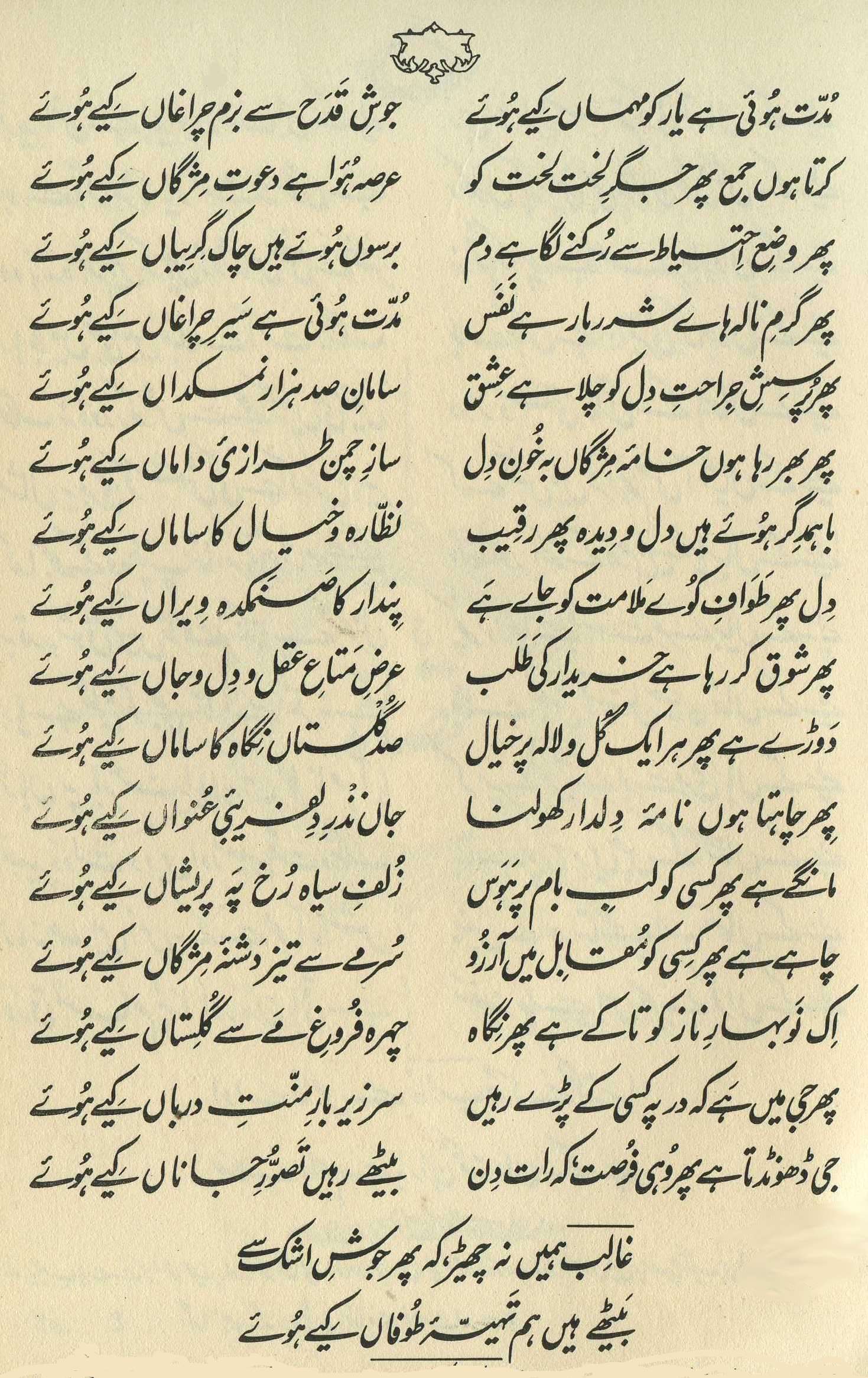
Like the first verse, the meaning of this verse too is that all these things have passed away; now again in the heart the same kind of ardor has grown up. But the late author has said because of the affinity between wine and ['A vine; creeper; branch of any tree growing like a vine; grapes'-- (Platts p.305)]. Otherwise, this word doesn't capture the meaning; here he should have said 'searches for' []. (264)
== Nazm page 264

He says, again the gaze is staring at a new spring of coquetry, and it wants to make the face, by means of the radiance of wine, into the equal of a garden, and have it [=the face] come before it [=the gaze]. (323)
[Disagreeing with Nazm:] Janab Tabataba'i didn't pay close attention. If the late author had said this because of the affinity between wine and , then there would remain no basis of discrimination between ordinary poets and this one unique in the age. The claim that the word doesn't capture the meaning is such that it causes proper taste to put its hands over its ears. Here makes it distinctively clear that it has been said because of its meaning, and by using this word the author has created a turmoil in the emotions of the poetry-understander. That is, up to then, people said again and again, . From their saying and saying it a uniform picture had taken shape, such that-- God forbid! There was one single picture that came and stood before them.
Now, in the picture world, he is seeing the beloved in such a way that on her face, from the effect of drinking wine, a redness is showing itself, and she has become from head to foot coquetry, and from head to foot a springtime. When this form/aspect came into view, then in the heart additional ardor was created. (500)
[See his discussion in Mir's M 1590,2 .]
On the structure of this ghazal as a kind of loosely 'continuous' one, see 233,1 .
The wordplay with that Nazm points out makes for an enjoyable affinity . But his notion that what Ghalib is really trying to convey is a process of 'searching' rather than 'gazing' is not very persuasive.
For the verse carefully doesn't tell us exactly how it is that 'Sight', or the Gaze, has turned, by means of the radiance of wine, a face into a garden. Here are some possibilities:
='Sight' has made the beloved's face into a garden because she has been drinking wine, which has made her face radiant and glowing, so that Sight envisions or experiences it as a garden.
='Sight' has made the lover drink wine, which has made him see the beloved's face as (like?) a garden; thus Sight can enjoy afresh a 'new springtime of coquetry' etc.
='Sight' has made the lover drink wine, so that his face becomes flushed and his mood turns mellow and romantic-- so that since in this flourishing state he carries his own garden with him, everywhere he looks he sees springtime and coquetry.
graphics/winegarden.jpg