Verse 10after 1816aa;Nkiye hu))e
G3
1
again thought runs on every single rose and tulip
2
having made a hundred gardens provisions for the look/gaze
d is an archaic form of ( GRAMMAR )
'Furniture, baggage, articles, things, paraphernalia; requisites, necessaries, materials, appliances; instrument, tools, apparatus; provision made for any necessary occasion, necessary preparations; pomp, circumstance'.
| References | |
|---|---|
| Arshi, Imtiyaz Ali | Ghazal# 190 |
| Raza, Kalidas Gupta | 301-02 |
| Nuskhah-e-Hamidiyah | 284-286 |
| Hamid Ali Khan | Open Image |
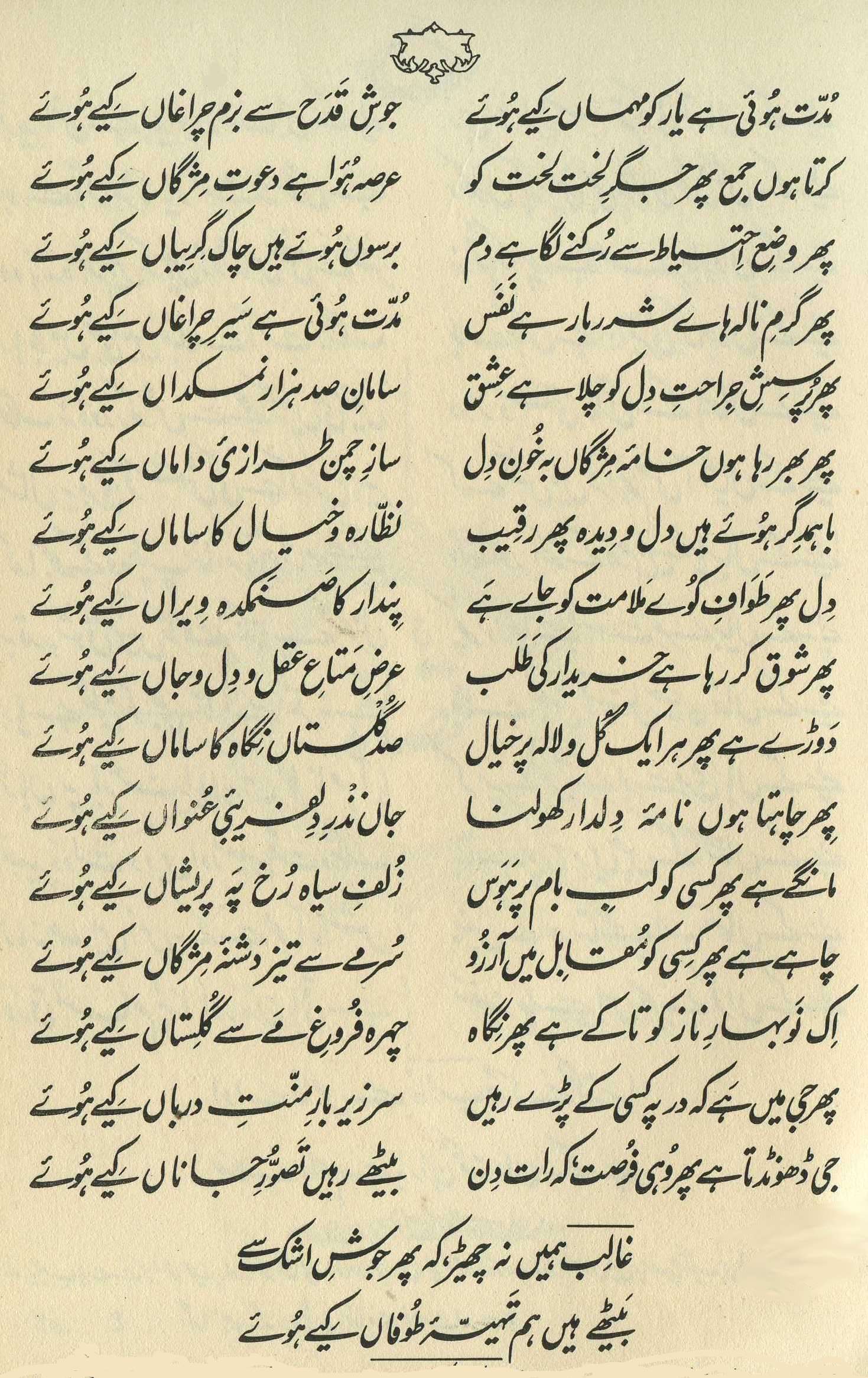
Rose and tulip are metaphor s for beautiful ones, and in 'a hundred gardens of equipment' he has assumed the garden to be a measure of the gaze-- for the reason that looks of desire and ardor fall on the garden. (264)
== Nazm page 264

He says, again the thought has begun to run toward beautiful ones. In the gaze the equipment of hundreds of gardens has been collected. (322)
Mirza has composed an extraordinary verse, and he has captured in words a picture of the state of the human heart in the extremity of ardor. (499)
On the structure of this ghazal as a kind of loosely 'continuous' one, see 233,1 .
Of course the 'rose and tulip' could mean beautiful human beings, or beloveds. But they can perfectly well also mean the flowers themselves. The quasi-personified 'Thought' has equipped itself with ample provisions for its imaginative delights: it has appropriated a hundred gardens' worth of ravishing flowers. By requisitioning flowers instead of beloveds, 'Thought' has added an extra layer of complexity to what looks to be an extremely simple verse. Here are some possible implication s:
=Arrogantly beautiful and cruel beloveds are not available even to the thought, so that the imaginative lover is obliged to settle for flowers.
=The flowers so resemble beloveds (and/or the beloveds so resemble flowers) that to think of one is to think of the other.
=The single beloved so outranks the flowers that she can only be imagined in terms of all the flowers in the world.
=The beauty of the garden in its verdure and spring-like flourishing is so inextricably the setting for passion, that the imagination must first prepare the scene before introducing the actors.
=The hundred gardens are for the 'gaze' to survey, as the eye sweeps over their masses of color; but by contrast, Thought considers the flowers individually, and makes of them what it chooses.
graphics/garden.jpg