Verse 5after 1816aa;Nkiye hu))e
G3
1
again Passion has set out for inquiry about [the health of] the wounds of the heart
2
having made the provision of a hundred thousand salt-dishes
'Asking, questioning, interrogating, inquiring, inquiry (generally after health)'.
'Furniture, baggage, articles, things, paraphernalia; requisites, necessaries, materials, appliances; instrument, tools, apparatus; provision made for any necessary occasion, necessary preparations'.
| References | |
|---|---|
| Arshi, Imtiyaz Ali | Ghazal# 190 |
| Raza, Kalidas Gupta | 301-02 |
| Nuskhah-e-Hamidiyah | 284-286 |
| Hamid Ali Khan | Open Image |
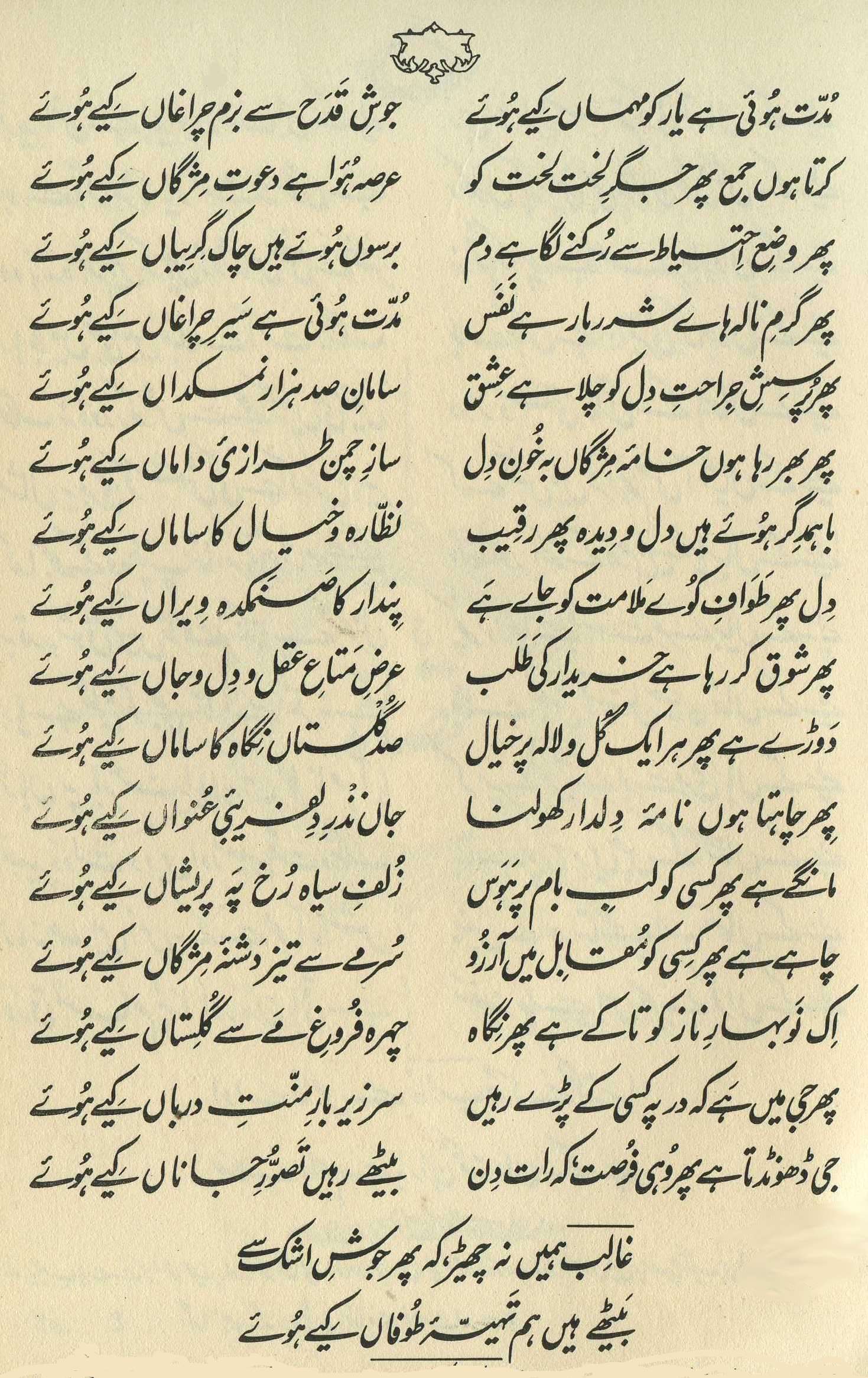
The idea is that passion has again set out to sprinkle salt on the wounds of the heart. (264)
== Nazm page 264

He says, 'Again the tumult/saltiness [] of passion is collecting the equipment for scattering salt on the wounds of the heart'. (321)
Now Passion, having brought all the hundreds of thousands of salt-dishes, is setting out to make fresh the old/suppressed wounds. (497)
On the structure of this ghazal as a kind of loosely 'continuous' one, see 233,1 .
It's so good of Passion, the solicitous friend, to set out to visit the much-wounded heart; of course it will check on, and inquire about the health of, its old companion. And like any proper visitor to a sickroom, it comes bearing some small but well-chosen and encouraging gifts-- which in this case take the witty, enjoyable form of 'a hundred thousand salt-dishes'.
Salt rubbed on an open wound is of course a torment-- and for that very reason, it's exactly what the heart-wounds will most enjoy. (For more on this paradox ical idea, see 17,7 .) We're back at the central 'pain is pleasure' paradox that forms the mystical heart of the ghazal world.
And of course since the visitor is Passion, it's amusing to think what form its sympathetic inquiries will take. Will it solicitously inquire how raw the wounds are feeling lately, whether they are sufficiently fiery and inflamed? 'Is there anything I can do to help?' it will inquire. 'And oh by the way, here's a small present I thought you might like, to cheer you up-- it's nothing, really, just a few little salt-dishes.'
Why 'a hundred thousand' salt-dishes? Are there are that many wounds in the heart? Or is each wound insatiable, longing to be buried in dish after dish of salt? Either way, the scenario is sufficiently absurd to avoid any real grotesquerie.
For a description of another such consoling visitor--one who brings the sick person perhaps even more suitable gifts-- see 2,1 .
For other verses that connect wounds and salt, see 77,1 .
graphics/saltdishes.jpg