Verse 41816amdekhte hai;N
G12
1
a spectacle-- that, oh you absorbed in mirror-holding
2 a
with what longing we look at you!
2 b
with what [kind of] longing do we look at you?
'Walking abroad for recreation; entertainment, exhibition, show, sight, spectacle; sport, amusement, pleasure, fun, jest, joke; anything strange or curious'.
| References | |
|---|---|
| Arshi, Imtiyaz Ali | Ghazal# 88 |
| Raza, Kalidas Gupta | 202-203 |
| Nuskhah-e-Hamidiyah | 148-149 |
| Asi, Abdul Bari | 163-164 |
| Gyan Chand | 261-262,538-539 |
| Hamid Ali Khan | Open Image |
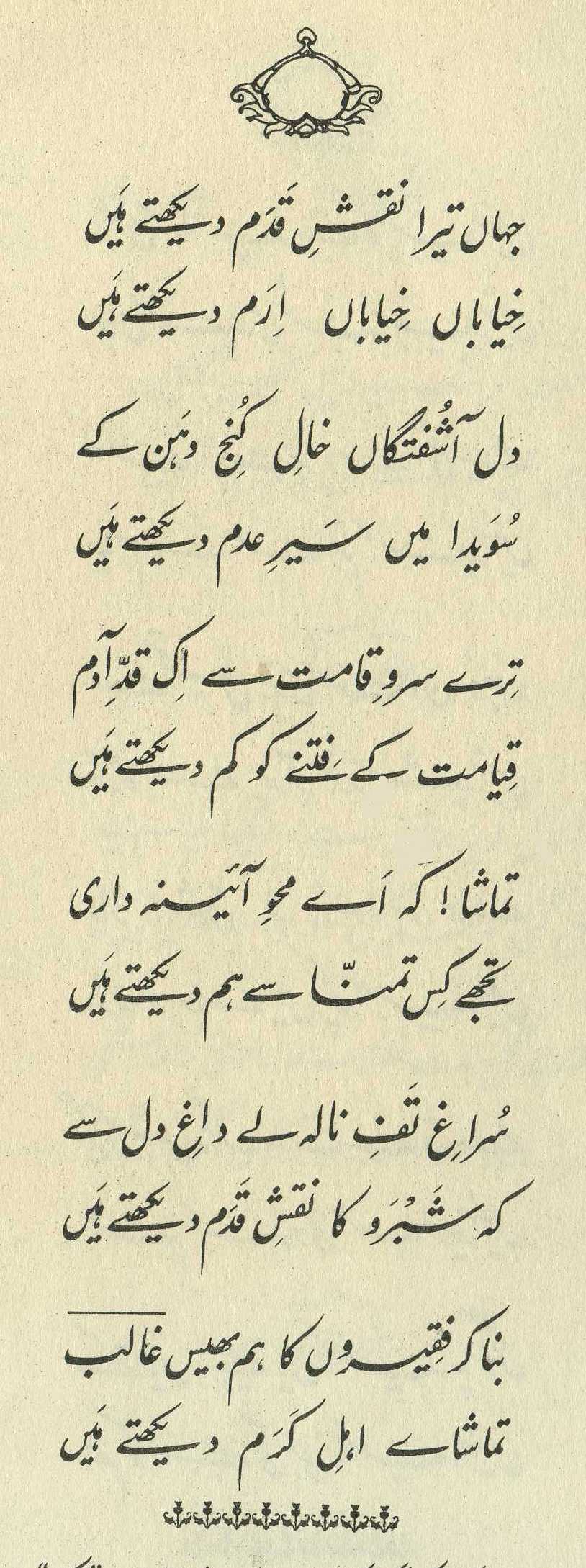
According to that [Persian] taste the author has omitted the verb. The meaning is, 'Why are you looking at your radiance in a mirror? Just take a look at this spectacle: with what longing we are looking at you.' But in Urdu, to say only [without the verb ] is not the idiom. (97)
== Nazm page 97

A 'mirror-bearer' [] is normally some kind of servant. But here he has called the beloved 'mirror-bearer'. Instead of 'bearing a mirror' [], to say 'looking in a mirror' [] seems more appropriate here. In the first line, where is, is the rightful place of . (188)
It's a strange thing that some meter s that are, and have remained, very popular in Urdu, did not please Ghalib. Thus the meter (= four times) [= #37 , which almost every important Urdu poet has certainly used at least a few times, is not present at all in Ghalib. In just the same way or too [= #28, #29 have received very little attention from Ghalib, although virtually all the forms of this meter have remained current in Urdu since the beginning. Besides the present ghazal, Ghalib will hardly have composed more than three or four others in .
[Some commentators have considered that it should be instead of]. I give preference to because it's more meaningful, and also because Maulana Arshi has written it so. In there's no depth, while in the following aspects emerge: (1) ; (2) What a spectacle it is that...!; (3) The spectacle is this: that...; (4) This too is a spectacle: that....
The commentators have taken 'mirror-holding' [] in the sense of 'looking into a mirror' [], which is not incorrect. But if it's taken with the meaning of 'holding up a mirror' [], then the interpretation it produces for the verse is a more subtle one.... Ghalib's beloved is a mirror of a kind in which [everything in earth and heaven] is mirrored.... To see her is as if to see the life of creation. To subdue her is as if to subdue the life of creation. The beloved is lost in herself, in her a world shines forth-- and the speaker isn't looking at this shining world, but is looking only at her, because he knows that everything is in the beloved. The beloved considers her own personality and the creation to be one, and doesn't distinguish among the three. Now 'with what longing we look at you' takes on the meaning that 'I'm not looking at you with the eye of a common lover, but rather my longing too, like you, is all creation.'
== (1989: 126-27) 2006: 149-50
In the textual disagreement between and , the latter reading has some manuscript support and much commentarial approval-- it is adopted by Hasrat (p. 84); Bekhud Dihlavi (p. 147); Shadan (p. 265); Baqir (p. 243); Chishti (p. 514); Mihr (p. 312). But I'm glad to go with Nazm, Bekhud Mohani (p. 192), Hamid, Faruqi, and-- it goes without saying-- Arshi himself, my textual authority. Faruqi has pointed to the superior ambiguity and multivalence of the reading; probably this is exactly what sets many commentators' teeth on edge.
This is a verse entirely about sight-- about a spectacle, a mirror-holder, and a gazer. Faruqi notes that the 'mirror-holding' beloved may in fact be not just holding a mirror absorbedly to her own face, but also holding up a mirror to us-- a mirror that reflects everything, reflects life itself. The lover's transcendent passion turns the beloved into a cosmic principle. (After all, if the beloved regards the lover with favor, it's as if 'a whole age' will favor him, as we know from 25,5 .) This reading of Faruqi's greatly enriches the verse.
When it comes to the equally second line, besides the obvious and lovely meaning of (2a), the grammar also clearly enables the interrogative reading of (2b). If the beloved is holding a mirror up to the lover, perhaps he sees in it his own inner life? Is he then interrogating his own state of mind (and heart)? Is the lover wryly observing what a 'spectacle' he's making of himself, and asking why and how he longs for someone so utterly self-absorbed, or so cosmically unavailable?
graphics/mirror.jpg