Verse 51816aa;Nho jaa))egaa
G1
1
in everyone's heart is your place; if you would become favorable
2
to me, so to speak, a single/particular/unique/excellent age/world will become gracious/propitious
'One, single, sole, alone, only, a, an; the same, identical; only one; a certain one; single of its kind, unique, singular, preëminent, excellent'.
'Time, period, duration; season; a long time; an age ... ;--the world; the heavens; fortune, destiny'.
'Loving, affectionate, friendly, kind, benevolent, beneficent, favouring, indulgent, gracious, propitious; compassionate, merciful; --s.m. A friend'.
| References | |
|---|---|
| Arshi, Imtiyaz Ali | Ghazal# 24 |
| Raza, Kalidas Gupta | 155-156 |
| Nuskhah-e-Hamidiyah | 70-71 |
| Gyan Chand | 106 |
| Hamid Ali Khan | Open Image |
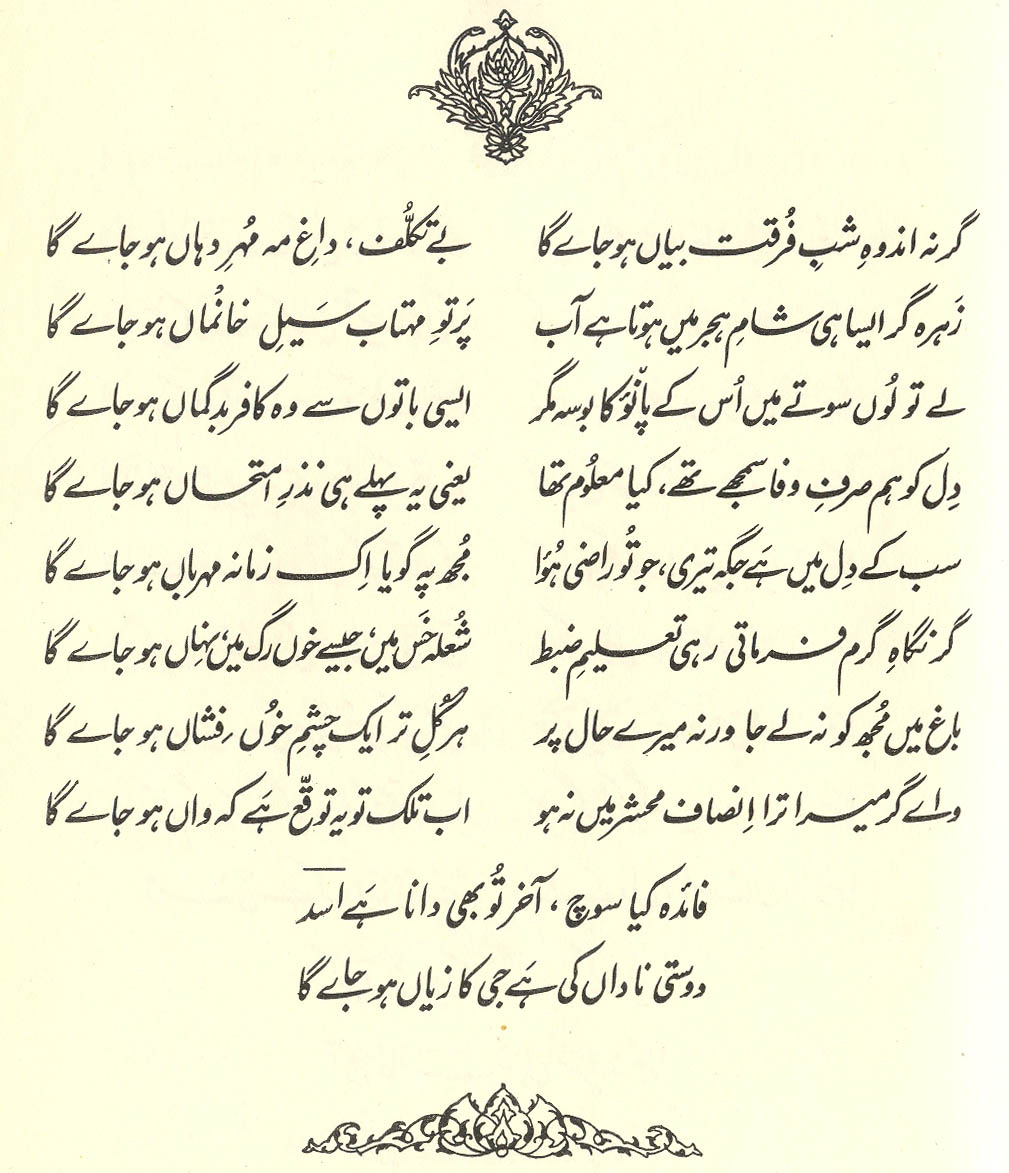
When you are in everyone's heart, then if you become favorable toward me, everyone's hearts will become favorable toward me. (26)
== Nazm page 26

He's composed an extraordinarily eloquent [] verse. (52)
Oh beloved, all hold you dear. If you become pleased with me, then the whole world will become gracious to me. 'You' can only be taken to mean the Lord. (63)
On the use of for 'if', see 20,9 .
The normal reading of the first line would be that since everybody cherishes you and values you, your image has a (metaphorical) place in everybody's heart, and if you are favorable to me, then everybody will notice and imitate your behavior. Then in the second line it becomes clear that what is in everybody's heart is no ordinary passive image or idea of you, but literally you yourself. For if you adopt a favorable attitude toward me, then instantaneously all the world/generation will do so.
Or rather, it's 'as if' all the world/generation will do so-- means 'so to speak' or 'as if'. Does this represent some kind of qualification? Maybe it represents another possibility: because you dwell (chiefly? especially?) in people's hearts, you command their deep, essential feelings. So if you are favorable to me, that's all I need: it's 'as if' everybody was favorable, because who gives a damn about 'everybody' anyway, when only you are the underlying principle that animates all their hearts?
Bekhud Mohani insists that this verse can only be addressed to God, but I don't see the need for that limitation. The lover's adoration for the beloved, and his sense of her omnipotence, can certainly rise to the level expressed in this verse. Just consider 25,3 .
On the use of the perfect verb form as a subjunctive, see 35,9 .
graphics/insideheart.jpg