Verse 21816aa;Nho jaa))egaa
G1
1 a
if during the evening of separation the gall-bladder [habitually] is only/emphatically such water/luster
1 b
if during the evening of separation one is [habitually] terrified only/emphatically in such a way
2
[then] the ray of moonlight will become a flow/torrent of the household
'Gall-bladder; bile; --boldness, spirit, pluck: -- , lit. 'The gall to turn to water,' to be much distressed or terrified, to be panic-stricken, to take fright'.
'Water; water or lustre (in gems); temper (of steel, &c.); edge or sharpness (of a sword, &c.); sparkle, lustre; splendour; elegance; dignity, honour, character, reputation'.
'A flowing; a flow of water, a torrent, a current'.
'House and home, household furniture, everything belonging to the house; household, family'.
| References | |
|---|---|
| Arshi, Imtiyaz Ali | Ghazal# 24 |
| Raza, Kalidas Gupta | 155-156 |
| Nuskhah-e-Hamidiyah | 70-71 |
| Gyan Chand | 106 |
| Hamid Ali Khan | Open Image |
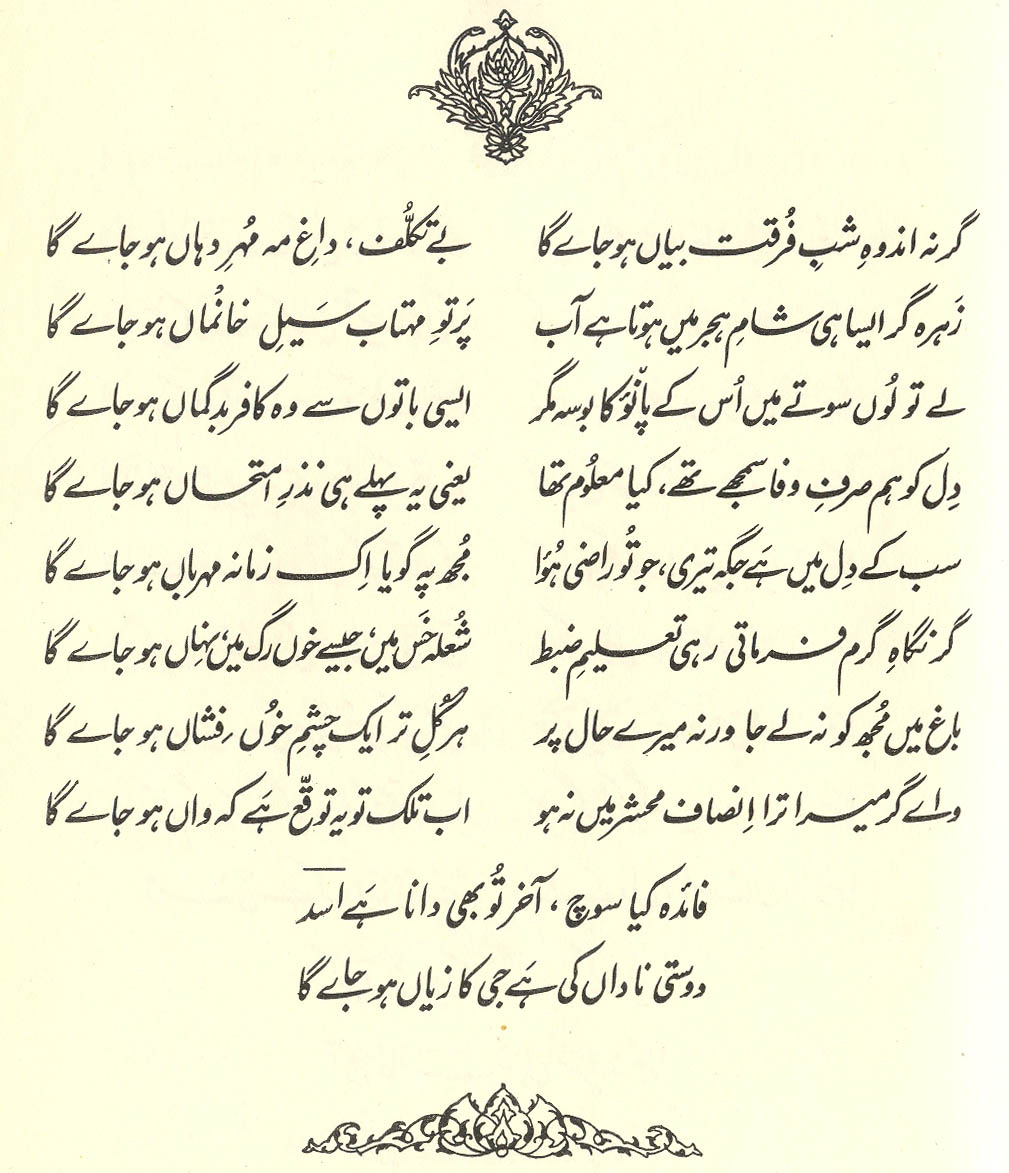
That is, the terror of the night of separation turns everyone's gall-bladder to water. So how would it be strange if the moonlight's gall-bladder too would turn to water, and it would become a flood for my house. (26)
== Nazm page 26

He says, 'If this rule has been established that the harshnesses of the evening of separation turn the gall-bladder into water, and cause it to weep tears of blood, then it's not strange that moonlight would become a flood of water and carry away the doors and walls of my house'. (52)
In this verse too [as in the previous one], he has not set foot on the common highway. He says, 'When my gall-bladder turns to water like this from the terror of the night of separation, then it looks to me as if moonlight will become a flood for the destruction of my house'. (62)
The intriguing little phrase shouldn't be overlooked. The gall-bladder doesn't habitually turn to just any old water, but to 'only/emphatically such water'. (And the phrase isn't adverbial, or else it would be .) But what does the 'such' mean? As so often, Ghalib leaves us to figure it all out for ourselves.
The only clue we get is-- the second line. It's clear that we're dealing with imagery that juxtaposes and intertwines light and water. Thus we notice the complexity of (see the definition above), which strongly evokes, among other things, 'luster, brilliance' (in English too we speak of a diamond 'of the first water'). What would it take to make a 'ray of moonlight' into a 'torrent in the household'?
Well, one obvious starting point is that all this happens in the lover's chamber during the 'evening of separation', which is, as everybody in the ghazal world knows, extremely, opaquely, hopelessly dark. And the idea of small rays of light looking extra-brilliant as they come through the crevice-work in the wall, or even of cotton-bits that look bright by contrast to the intense darkness that surrounds them, is one that Ghalib liked to play with. Of these three examples, 87,4 , 113,2 , and 113,4 , the latter even makes use of moonlight as part of its contrastive dark-light imagery.
So if during these dire evenings the gall-bladder (or the bile that it produces) is of 'only/emphatically such water/luster', there's a double sense of panic and horror on the emotional side (from the idiomatic sense of ), and on the physical side extreme darkness (where 'such luster' means such a total lack of luster, such grimly extreme blackness). Thus the evening of separation makes the gall-bladder (or the bile that it produces) so morbidly dark that by sheer contrast, a single ray of moonlight looks as powerful and overwhelming as a torrent or flood. With a nice subtlety, even something that ought to be a source of comfort or hope-- a ray of moonlight filtering into the lover's radical darkness-- itself becomes a fresh cause for panic.
Nazm compares the moon to a lover, so that its gall-bladder too turns to water during the horrors of the night of separation. Thus the moonlight streaming into the lover's darkened house will become a torrent of water/luster []. The first line doesn't specify whose gall-bladder it is, so this reading too seems possible. As usual, Ghalib is using an idiomatic expression ( ) in both its colloquial and its dictionary senses.
Bekhud Mohani takes all this as a hallucinatory effect produced as the lover's own gall-bladder turns to water during the night of separation. The lover will be so distraught, disoriented, and paranoid that he will see an innocent ray of moonlight as the waters of a mighty torrent threatening his household.
Either the lover experiences grim and pathologically total darkness; or the lover experiences terrifying hallucinations; or the moon behaves like a lover (with possibly dangerous results). In any case, there's no indication of any error or illusion or safe layer of metaphoricalness. The ray of moonlight 'will turn into, will become' [] a flood in the house. During the night of separation, almost any dire thing can happen. But at the same time, does the lover ever really attain the luxurious finality of dying? Remember 20,8 .
graphics/moonflood.jpg