Verse 71816aa;Nho jaa))egaa
G1
1
don't take me into the garden; otherwise, over my condition
2
every moist/wet rose will become a single/particular/excellent/unique blood-scattering eye
'New, fresh; green; young, tender, soft; juicy, moist, damp, wet, wet through, saturated (with moisture, or grease, &c.)'.
| References | |
|---|---|
| Arshi, Imtiyaz Ali | Ghazal# 24 |
| Raza, Kalidas Gupta | 155-156 |
| Nuskhah-e-Hamidiyah | 70-71 |
| Gyan Chand | 106 |
| Hamid Ali Khan | Open Image |
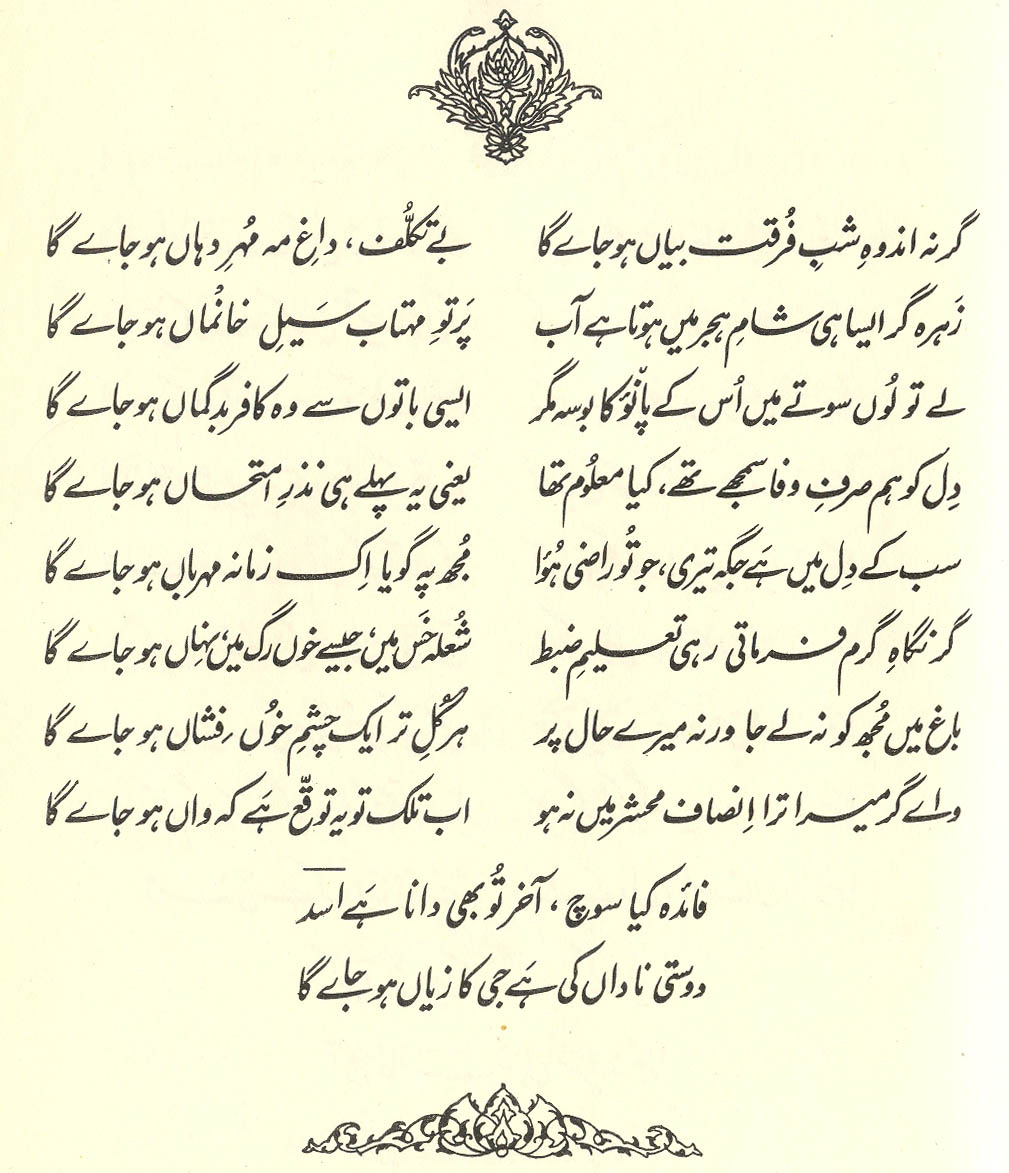
That is, my state is such that whoever sees it weeps. (27)
== Nazm page 27

He says, from the grief and sorrow of passion my condition has become so dire and pathetic that whoever sees me has tears begin flowing uncontrollably from his eyes. If you take me with you into the garden, then the fresh, moist roses will become blood-scattering eyes and shed tears of blood at my condition. The necessary result will be that instead of enjoying a pleasant stroll in the garden, you will experience displeasure. (53)
'Garden' can also refer to a pleasure gathering; that is, if I go there, then laughing men will begin to weep. (63)
The lover is apparently so weak that he can hardly walk unaided, so he has to have help in getting around. But despite (or because of?) his weakened condition, he is sympathetic to others: he requests not to be taken into the garden, because the dewy roses will shed tears of blood at his wretchedness.
To imagine a fresh, moist, dewy rose as 'a single blood-scattering eye' has an obvious metaphorical grounding. The rose is round like an eye, the dewdrops resemble tears, the teardrops are blood-colored because they are on the red rose. But still-- a garden full of single eyes on stalks, each dripping with blood? It sounds like some dire discovery within a , in the dastan tradition; or Hatim's tree with severed heads hanging off its branches.
Well, perhaps I'm exaggerating a bit. It isn't the most grotesque image Ghalib ever came up with. But still, if you're going to appreciate it, you have to be remarkably far from the real world, and so deep into ghazal convention that you don't actually form a mental image of round red eyeballs, on stems, dripping blood.
Ghalib has in the divan half a dozen such verses. In 62,6 , 173,3 , 234,2 , the lover's eyes are weeping bloody tears of passion; in 147,3 the eyes are Majnun's. But in 183,2 , the beloved's glances create a 'blood-scattering' effect on the lover. And among the unpublished verses, 424x,4 creates a 'blood-scattering' effect of an unclear nature, through the 'gaze' of a seemingly unlikely 'adorner, maidservant'.
There's really nothing at all compelling in the present verse. It's the one-dimensional kind that other poets compose all the time, but Ghalib rarely does.
graphics/wetrose.jpg