Verse 21847aa;Nke liye
G9
In this meter the next-to-last long syllable may be replaced by two shorts.
1
what the hell, if the friend's eyelashes are thirsty for blood?!
2
I would keep some for even/also my own blood-scattering eyelashes!
| References | |
|---|---|
| Arshi, Imtiyaz Ali | Ghazal# 211 |
| Raza, Kalidas Gupta | 388-89 |
| Hamid Ali Khan | Open Image |
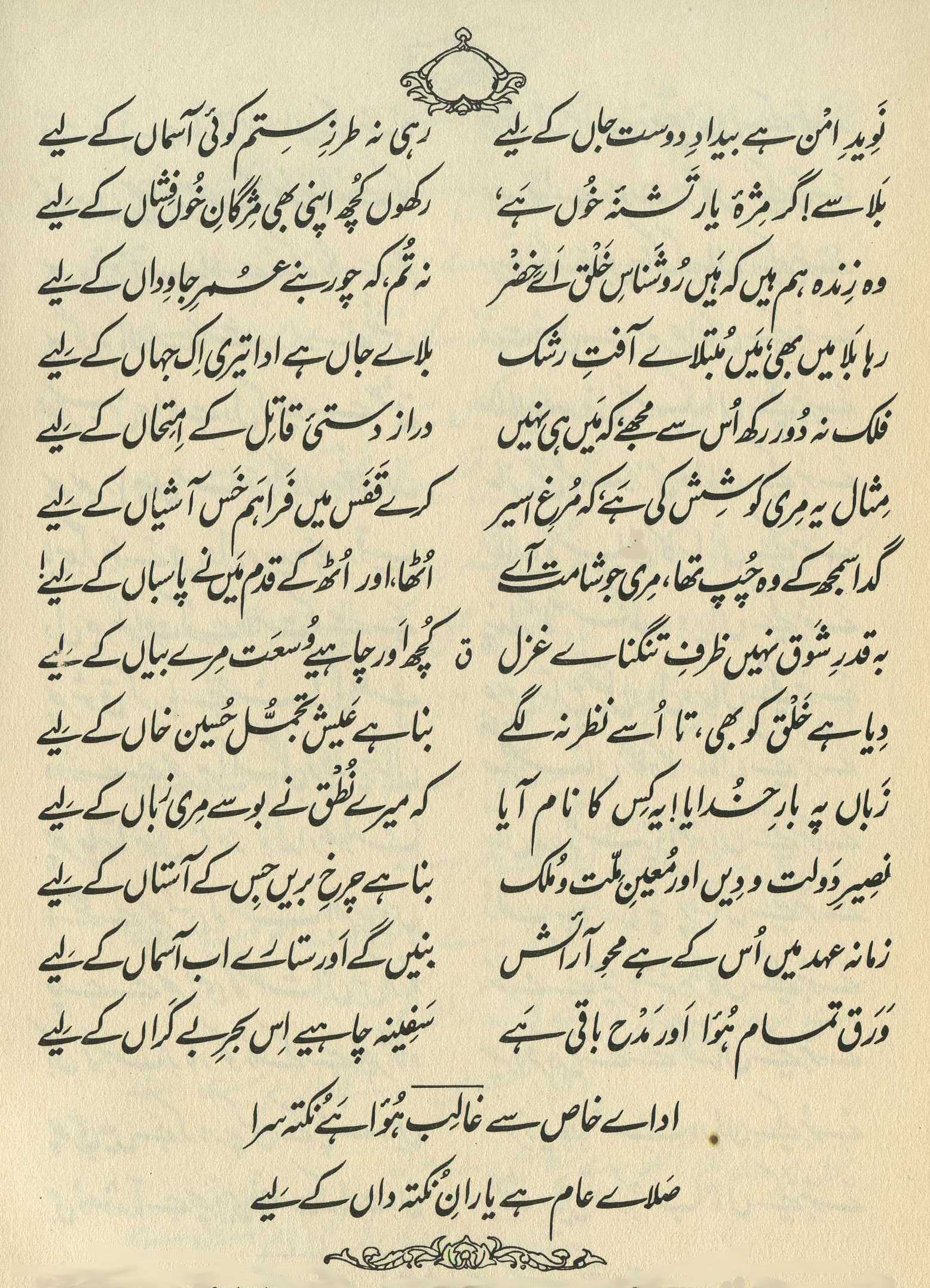
If her eyelashes are blood-drinking [], then my eyelashes too are blood-scattering []. If I would give all the blood to her alone, then what would I keep for my own eyelashes? (265)
== Nazm page 265

He says, 'What can I do? If the beloved's eyelashes are still thirsty for more blood, I've already fed them their share of the heart's blood. Now whatever amount of blood is left in the heart is the share of my own blood-scattering eyelashes.' (324)
If the beloved's eyelashes are thirsty for blood, then let them be thirsty. I ought also to keep some of my heart's blood for my own blood-raining eyelashes. (503)
On the nuances of the idiomatic expression , see 58,1 .
This light and amusing little verse is a classic example of what I call a mushairah verse. It has all the relevant qualities in a clearly deployed form. The first line is exclamatory and even a bit shocking-- since when does the lover reject any demand of the beloved's? Her eyelashes are imperious, and their demand for blood is well-established in the ghazal universe. In fact, it can be said that the lover's blood really belongs to them, and that he only holds it in trust for them, as is made clear in 16,1 and 113,3 . So how does he have the nerve to deny them their right, with even a tone of indignation?
In mushairah performance style, we're of course made to wait as long as is conveniently possible before we're allowed to hear the second line. And even then, as the first part of the line unfolds before us we're still unable to 'get' it. Not until the last possible moment, when we hear the 'punch-word' , do we suddenly catch the meaning and the cleverness at the same instant: !
And then, the final quality of a mushairah-verse: when it's over, it's over. Once we've had that little burst of pleasure, we're entirely sure there's nothing more to come, no subtleties or further possibilities, and we can go on to the next verse.
The humor comes from the harassed lover's back-to-the-wall attempt at fairness; he's like a parent being pestered by two clamorous five-year-olds, and he's determined to give each set of eyelashes its due. But we also realize with amusement that the seeming fairness masks the huge one-sidedness of the fact that both batches of blood are destined for the beloved's delectation, and it's really only a question of exactly when and how they'll be presented to her.
graphics/bloodytears.jpg