Verse 111847aa;Nke liye
G9
In this meter the next-to-last long syllable may be replaced by two shorts.
1
helper of realm/dominion and faith, and lawgiver of religious-community and land/country
2
for whose abode the lofty sphere/heaven has {come about / appeared}
| References | |
|---|---|
| Arshi, Imtiyaz Ali | Ghazal# 211 |
| Raza, Kalidas Gupta | 388-89 |
| Hamid Ali Khan | Open Image |
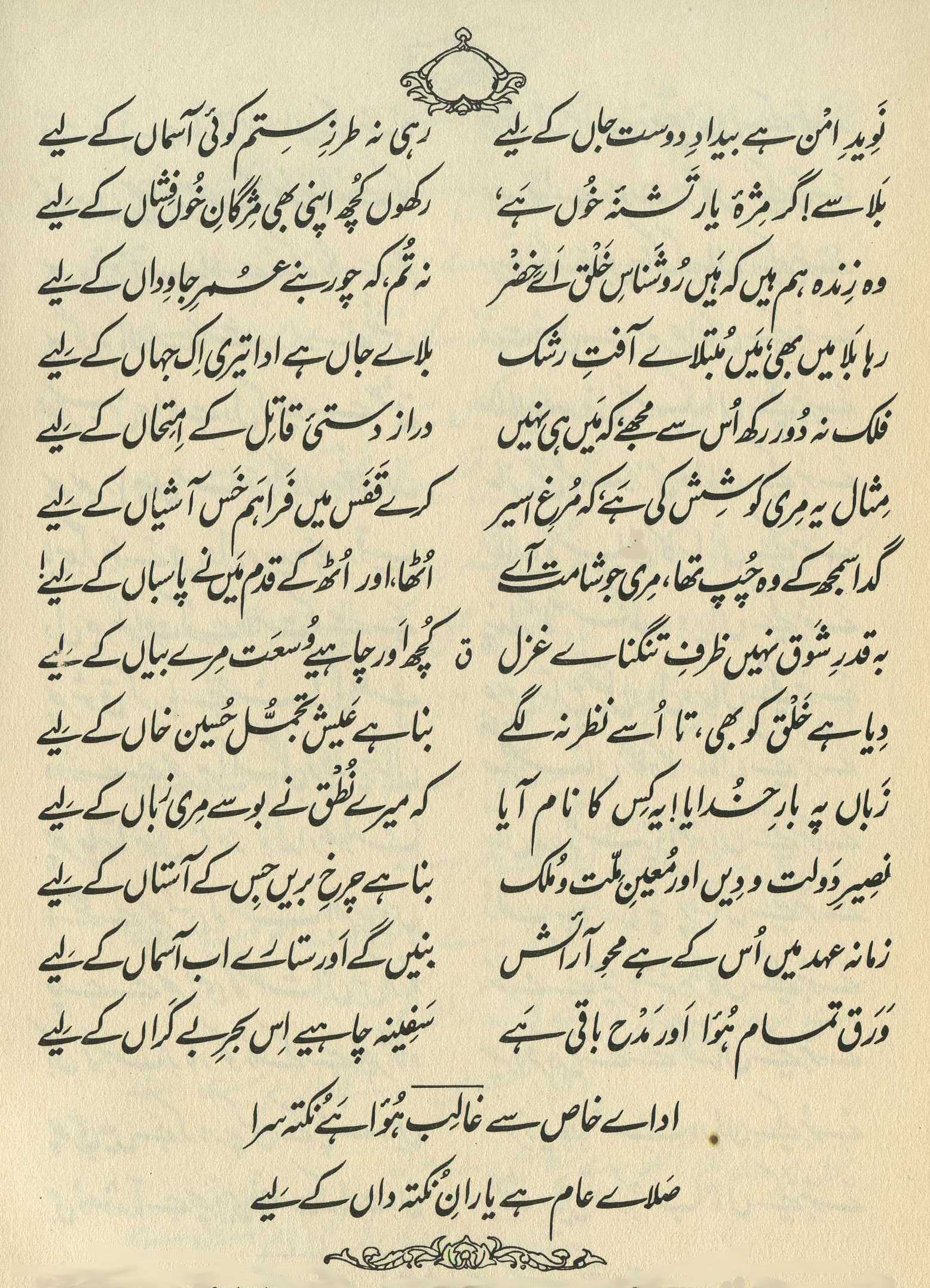
In the first line he has collected together pairs of synonymous words: and ; and and ; and and . (266)
== Nazm page 266

He says he is a helper of realm and faith, and also a lawgiver of religious-community and land. And he's a person such that the lofty sphere has been made [] for the sake of being his abode. (326)
Helper of faith and world, and supporter of community and land, for whom the lofty sky has been made [] in order to become an abode. (507)
The nature of this verse as the third in a kind of four-verse verse-set is discussed in 234,8 .
Here's another verse ideally suited to support my argument made in 234,8 . I'd give this one away too, if anyone wants it.
Since it makes no sense as an independent verse, it certainly seems to require the frame of some kind of verse-set around it.
Instinctively, both Bekhuds convert the verb from the awkward intransitive [] into the much more coherent passive []. The intransitive provides the same opening for the second line as in 234,9 . Why is Ghalib so eager to present 'enjoyment' in {234,9}, and the 'lofty sphere' in the present verse, as somehow simply 'coming into being' or 'appearing', with no hint of a maker lurking in the background? I would have guessed that it's because it's so silly and insulting to God to say that he did all this just for a minor North Indian aristocrat-- but then, in the first line of {234,9} the poet does say exactly this. So why, after that one time, does he work around it with the awkwardly organic intransitive forms? I don't know, and the verse is so puerile that I don't care. There's a similar structure in the next verse, 234,12 , too.
graphics/princes1920s.jpg