Verse 31847aa;Nke liye
G9
In this meter the next-to-last long syllable may be replaced by two shorts.
1
we are {truly / in such a way} alive/living-- {we who are / since we are} an acquaintance of people/'creation', oh Khizr
2
not you, {who became / since you became} a thief for the sake of eternal life
'One whose face is known, an acquaintance'.
'Creating; —creation; mankind; people'.
'A thief, a robber, a pilferer; ...— adj. Secret, hidden, masked, sly, treacherous, false'.
| References | |
|---|---|
| Arshi, Imtiyaz Ali | Ghazal# 211 |
| Raza, Kalidas Gupta | 388-89 |
| Hamid Ali Khan | Open Image |
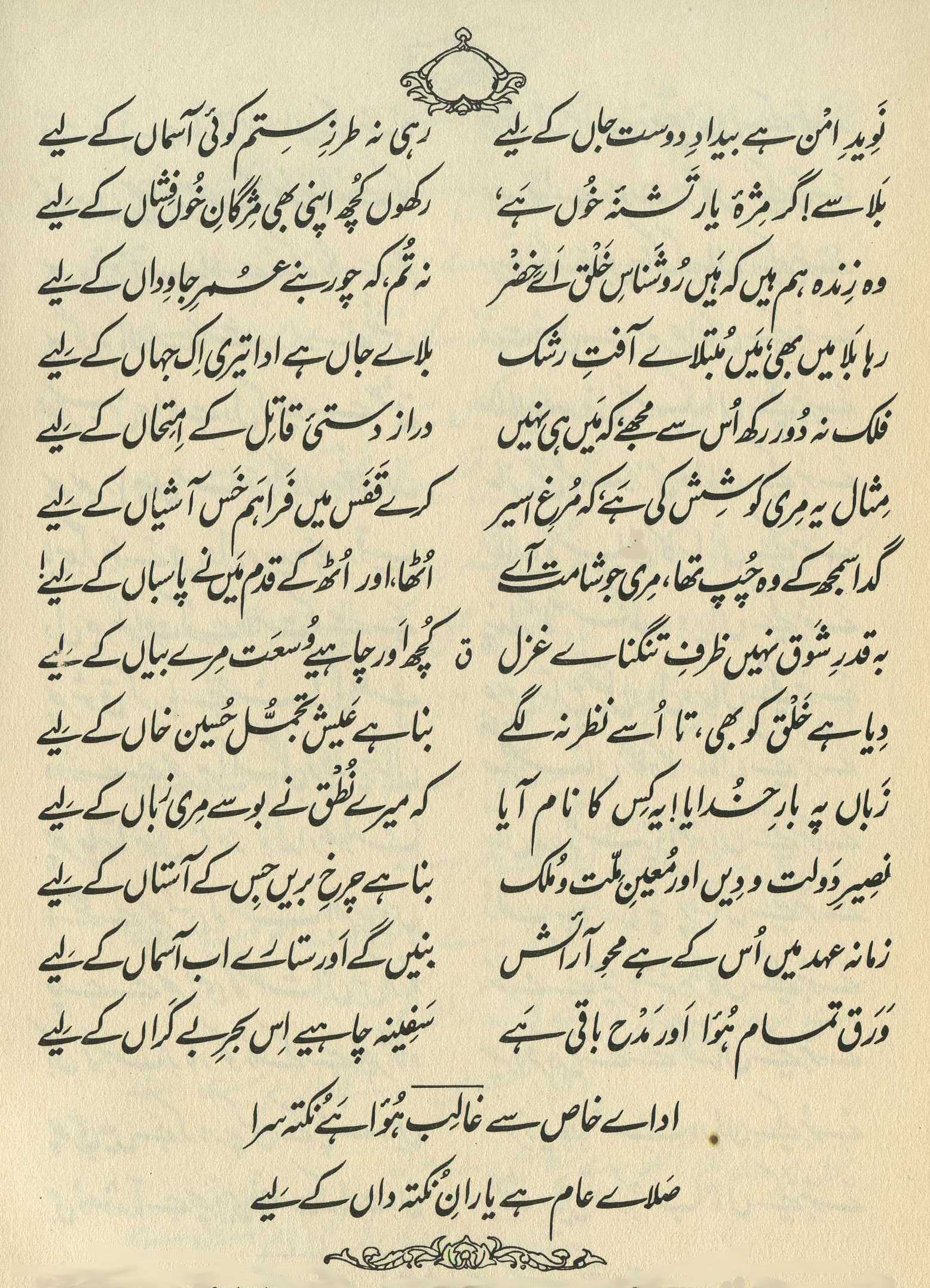
That is, what good is such an eternal life, when you wander around in concealment like a thief? (265)
== Nazm page 265

It's a new kind of mischievousness. Addressing Hazrat Khizr, may peace be upon him, he says, look, 'life' is the name of our living in the world and keeping on mixing with people. If you've obtained eternal life, what benefit did you gain? You remain hidden from people's eyes. What good is such an eternal life, thanks to which you would be obliged to remain hidden from people's eyes? (324)
That is, on the strength of our fame we have eternal life, and the way the whole world knows me today, in the same way it will know me till Doomsday. So with regard to eternal life, you and I are equal. You have indeed attained this much of a superiority: that the whole world knows me, and it doesn't know you. (503)
Ghalib seems to enjoy needling Khizr , just as he needles Farhad . The Islamic folk-traditional story of how Khizr undertook to guide Alexander to the Water of Life has many variants. The majority of them (though not all) involve some kind of treachery on Khizr's part. But they all agree on the outcome: that Khizr drank the Water of Life, while Alexander did not. A reference to this story also appears in 215,9 . It's on the basis of this story that Khizr can be considered to have become a 'thief' in order to procure the Water of Life. For more on Khizr, see 68,1 .
As the commentators point out, another consequence of Khizr's new status (after drinking the Water of Life) is that he becomes unknowable, or at least unrecognizable. Story tradition knows what he looks like-- he is a venerable old man dressed in green, and acts as a guide to lost travelers-- but the travelers whom he guides are not able to recognize him as himself. In this connection see 159,6 , which also turns on issues of recognition.
There's another lovely multivalence in the various meanings of . The speaker claims to be on personal, well-acquainted terms with God's 'creatures'-- or else, of course with 'creation' or even 'creating' (see the definition above). The 'creative' activity of the poet is both God-like and this-worldly (that is, accepting of finiteness). It is thus superior both to the triviality and derivativeness of Khizr's act of theft, and to the desperate and unworthy lust for eternal life that motivated it.
The colloquial at the beginning of the first verse is an emphatic construction-- the speaker claims to be the really, the truly, the importantly, living one, the one who lives 'in such a way'. The expression works wonderfully here in Urdu, though it's hard to translate consistently.
'Khizr, the Green One' by Hussein Nuri, 2003:
http://www.flickr.com/photos/olafkellerhoff/3598407750/ http://www.flickr.com/photos/olafkellerhoff/3598407750/ graphics/khizr.jpg