Verse 11847aa;Nke liye
G9
In this meter the next-to-last long syllable may be replaced by two shorts.
1
the friend's injustice/cruelty is the good-news of security/safety for my life
2
there has remained no style of tyranny for the sky
'Good news, glad tidings'.
'Security, safety; tranquillity, peace'.
| References | |
|---|---|
| Arshi, Imtiyaz Ali | Ghazal# 211 |
| Raza, Kalidas Gupta | 388-89 |
| Hamid Ali Khan | Open Image |
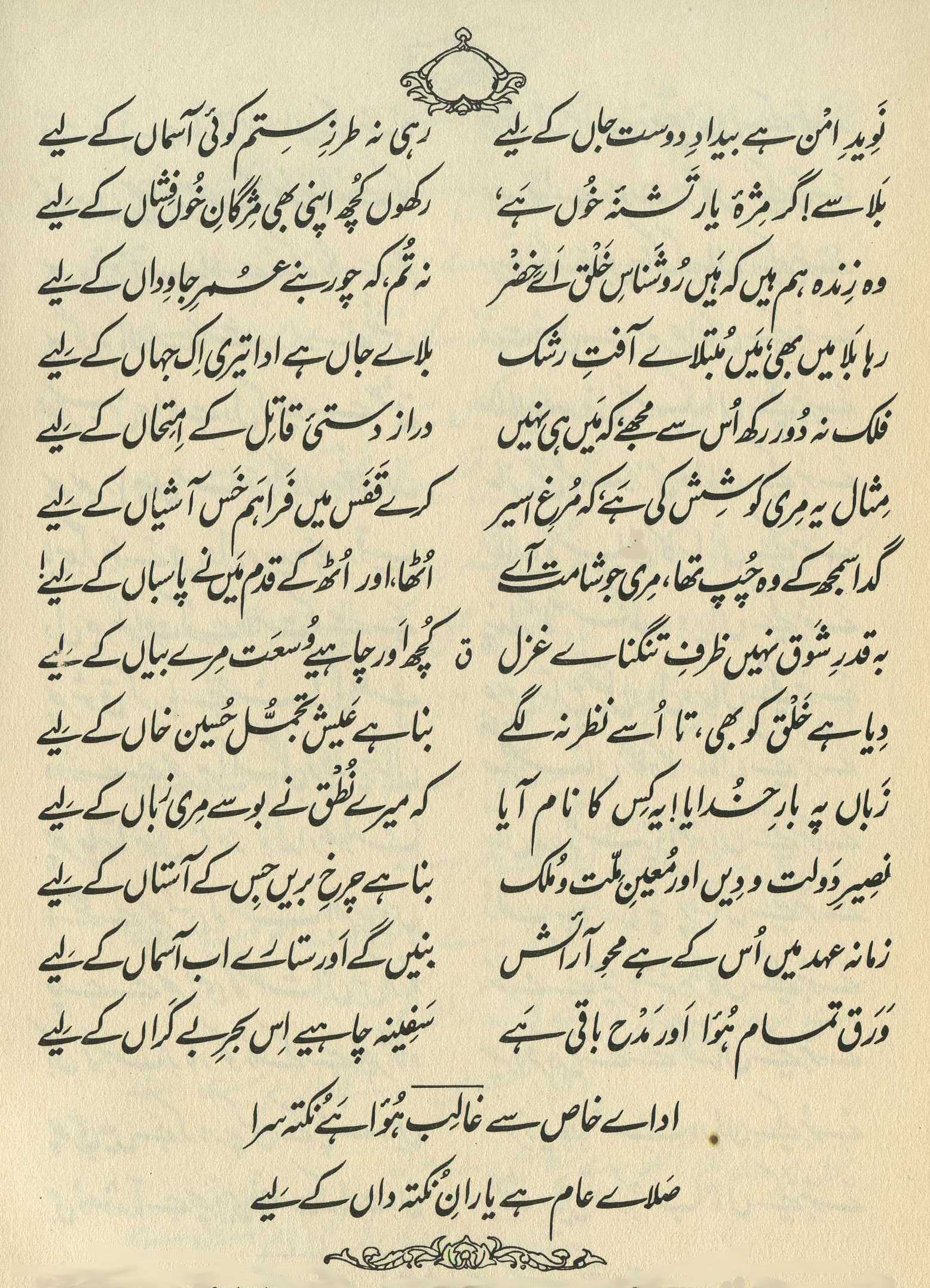
The beloved's injustice/cruelty made me fearless of the injustice/cruelty of the heavens. She left no tyranny untried-- now where will the sky find any new style of tyranny? Atish says:
[from the turning of the eyes of idols, we went down into the dust
the sky was left with its enthusiasm for injustice/cruelty]
The word was formerly feminine, and even now is so in Delhi; but in Lucknow the common idiom treats it as masculine. (265)
== Nazm page 265

He says, the tyranny of the beloved toward us proved very fortunate, because however many forms of tyranny and oppression there were, she used them all. As if however many oppressions there were, they all became exhausted-- now the sky cannot invent a new style of tyranny, so if it would oppress us, then how would it do so? The meaning is that having endured her tyranny, he has become protected for a whole lifetime from the oppression of the sky. (323)
The first thing worthy of notice is that with 'injustice/cruelty' he has placed the word 'friend'.... And this establishes that the oppression of the friend seems to be more desirable than not only the injustice of the age, but even the graciousness of the age. (501)
Bekhud Dihlavi points out that forms of cruelty seem to be exhaustible, so that once the 'friend' has used them all up, there are no fresh ones left for the sky. A similar zero-sum economy seems to apply, in 111,12 , to blessings.
As usual in the ghazal world, the direction of comparison is not from something else to the beloved ('she is like a spring day') but from the beloved to something else ('a spring day is like her')-- from the beloved to anything and everything else, here including fate, destiny, and the celestial sphere itself (from which disasters [] notoriously descend). In terms of injustice/cruelty, she gets there first, and has it all and does it all; by comparison, the sky is nowhere, it's left helpless and irrelevant. For another, and even more extreme, example of her predominance over the sky, see 27,8 .
The first line of this verse provides direct evidence of the built-in flexibility of word order in cases of what I call 'symmetry'. For the first line literally says 'the good-news of security/safety is the friend's injustice/cruelty, for my life'. If this is read in direct word-order ('A is B') terms, it becomes almost uninterpretable; to make semantic sense, it must be read in the reverse order, 'B is A'.
Note for grammar fans: The second line should really be in the present perfect tense, to accord with English usage; on this mismatch see 38,1 .
graphics/sky.jpg